Lok Sabha Passage of Finance Bill and Fiscal Deficit Targets
Source:The Hindu ↗
Why It Matters
The Union Budget and its passage through the Finance Bill are core components of India's macroeconomic management and parliamentary functioning. UPSC frequently tests the distinction between Money and Finance Bills, as well as concepts like fiscal deficit, revenue vs. capital expenditure, and debt financing mechanisms.
Summary
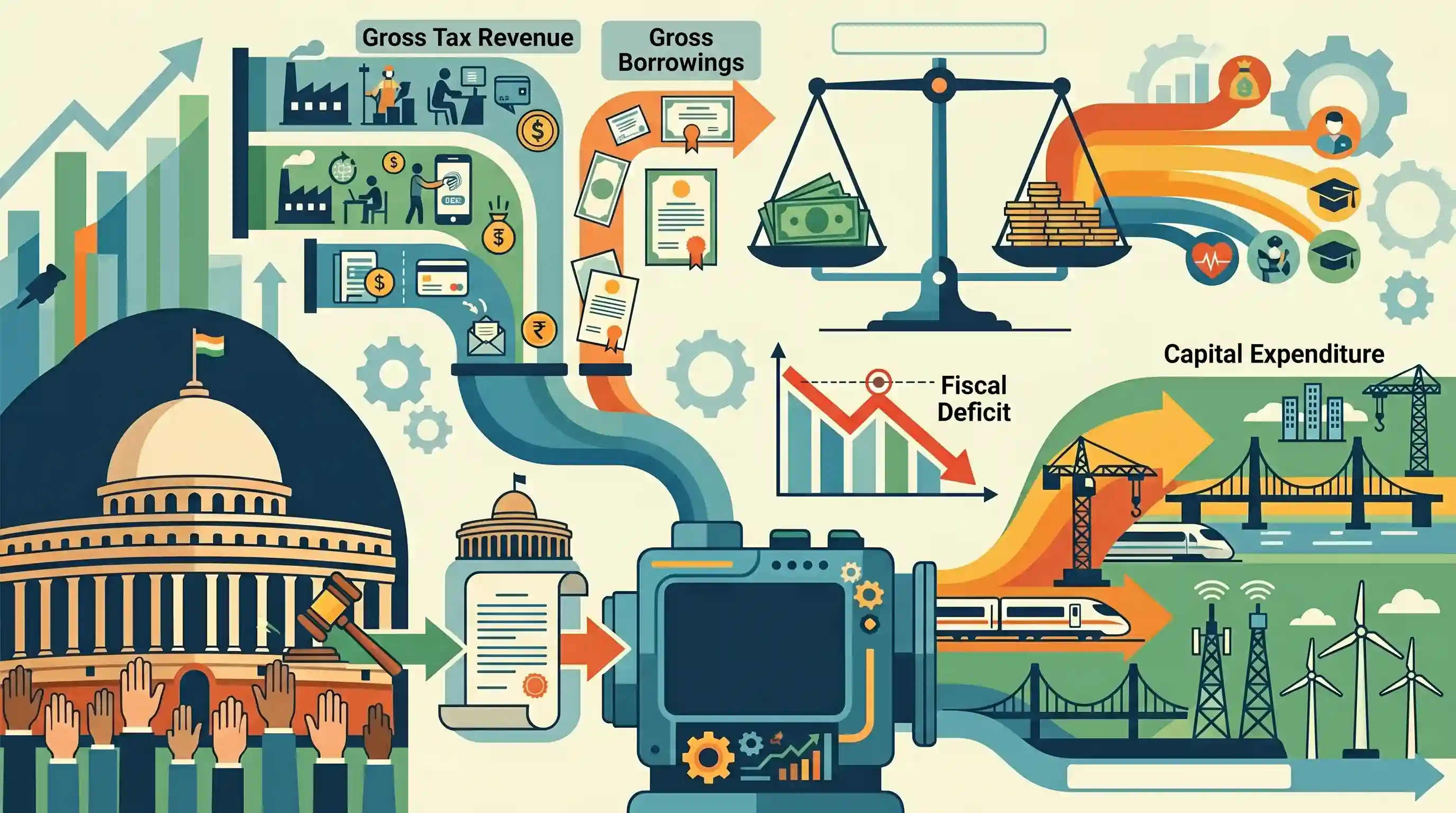
The Lok Sabha successfully passed the Finance Bill 2026, incorporating 32 government amendments. This legislative milestone paves the way for the implementation of the Union Budget 2026-27, pending the Rajya Sabha's approval. The budget outlines significant economic targets, including a total expenditure of ₹53.47 lakh crore and capital expenditure of ₹12.2 lakh crore. Furthermore, the government aims to achieve a fiscal deficit of 4.3% of GDP, with gross tax revenue projected at ₹44.04 lakh crore and gross borrowings at ₹17.2 lakh crore. This highlights the government's dual focus on sustaining capital investments while pursuing fiscal prudence.
Key Points
- The Lok Sabha passed the Finance Bill 2026 with 32 government amendments, advancing the budgetary approval process.
- The Union Budget 2026-27 projects a total expenditure of ₹53.47 lakh crore, a 7.7% increase over the previous fiscal year.
- Capital expenditure is prioritized with an allocation of ₹12.2 lakh crore to spur long-term economic growth.
- The fiscal deficit is targeted at 4.3% of GDP, indicating a path towards fiscal consolidation from the 4.4% in the current fiscal.
- Gross tax revenue collection is estimated at ₹44.04 lakh crore, alongside a gross borrowing target of ₹17.2 lakh crore.
Important Terms
Finance Bill

An annual legislative proposal to implement the government's taxation and financial changes. It is introduced with the Union Budget and is often classified as a Money Bill under Article 110 to ensure passage.
UPSC context
GS-2 Polity; tests legislative procedures, Articles 110/117, and the constitutional distinction between Money and Financial Bills.
Annual Financial Statement
The formal name for the Union Budget under Article 112. It presents the government's estimated receipts and expenditures for a financial year, distinguishing between revenue and capital accounts.
UPSC context
GS-3 Economy; tests constitutional requirements for budgeting, fiscal policy orientation, and the division of public accounts.
Fiscal Deficit
The difference between the government’s total expenditure and its total non-debt receipts. It indicates the total amount of borrowing required by the government to fund its operations and investments.
UPSC context
GS-3 Economy; tests macroeconomic stability, fiscal consolidation targets under the FRBM Act, and the implications of public debt.
Capital Expenditure (Capex)
Funds used by the government to acquire, maintain, or improve long-term physical assets like infrastructure or to repay loans. It is intended to boost the economy's long-term productive capacity.
UPSC context
GS-3 Economy; tests the quality of government spending, the multiplier effect on growth, and asset-liability management.
Money Bill
A Bill defined under Article 110 dealing exclusively with taxation, borrowing, or the Consolidated Fund. It requires Speaker certification and grants the Lok Sabha supreme authority over the Rajya Sabha.
UPSC context
GS-2 Polity; tests Article 110, the Lok Sabha Speaker's powers, and the limited 14-day recommendation role of the Rajya Sabha.
Prelims Trap
"The passage of the Finance Bill authorizes the government to withdraw funds from the Consolidated Fund of India."
This is a classic trap. The Finance Bill legalizes taxation/revenue (Article 265). It is the Appropriation Bill (Article 114) that authorizes the withdrawal of funds.
Static Concepts Connected
What distinguishes the Finance Bill from the Appropriation Bill?
- Finance Bill: Gives effect to the government's financial proposals and taxation (revenue side). Usually introduced as a Money Bill under Article 110.
- Appropriation Bill: Legally authorizes the withdrawal of funds from the Consolidated Fund of India to meet approved budget expenses (expenditure side) under Article 114.
How does Capital Expenditure differ from Revenue Expenditure?
- Capital Expenditure: Spending that creates physical/financial assets (e.g., infrastructure) or reduces liabilities (loan repayment). It drives long-term economic growth.
- Revenue Expenditure: Day-to-day operational spending that neither creates assets nor reduces liabilities (e.g., salaries, subsidies, interest payments).
Cross-Topic Patterns
Fiscal Glide Path & FRBM Act
The 4.3% deficit target reflects the post-pandemic fiscal glide path goal to stabilize below 4.5%. UPSC frequently links current deficit trends directly to FRBM Act mandates and escape clauses.
Borrowings & The Crowding Out Effect
₹17.2 lakh crore gross borrowings are needed to bridge the deficit. Heavy sovereign borrowing often triggers questions on the 'crowding out effect', where government absorbs market credit, hurting private investment.

Questions linking capital expenditure multipliers to the post-pandemic fiscal deficit glide path (below 4.5%) are highly probable in 2026.
Linked PYQs · 4
Linked PYQs · 4
- 2024PrelimsGS1
Which of the following statements are correct in respect of a Money Bill in the Parliament? 1. Article 109 mentions special procedure in respect of Money Bills. 2. A Money Bill shall not be introduced in the Council of States. 3. The Rajya Sabha can either approve the Bill or suggest changes but cannot reject it. 4. Amendments to a Money Bill suggested by the Rajya Sabha have to be accepted by the Lok Sabha. Select the answer using the code given below :
- 2023PrelimsGS1
With reference to Finance Bill and Money Bill in the Indian Parliament, consider the following statements: 1. When the Lok Sabha transmits Finance Bill to the Rajya Sabha, it can amend or reject the Bill. 2. When the Lok Sabha transmits Money Bill to the Rajya Sabha, it cannot amend or reject the Bill, it can only make recommendations. 3. In the case of disagreement between the Lok Sabha and the Rajya Sabha, there is no joint sitting for Money Bill, but a joint sitting becomes necessary for Finance Bill. How many of the above statements are correct?
- 2021PrelimsGS1
Which one of the following is likely to be the most inflationary in its effects?
- 2021MainsGS3
Distinguish between Capital Budget and Revenue Budget. Explain the components of both these Budgets.
