Supreme Court directive on High Court judicial vacancies appointment
Source:The Hindu ↗
Why It Matters
The delay in the appointment of judges is a recurring friction point between the Executive and Judiciary in India, directly impacting the fundamental right to speedy trial and the broader administration of justice. This is a critical case study for GS2 questions on the Collegium system, judicial pendency, and criminal justice reform.
Summary
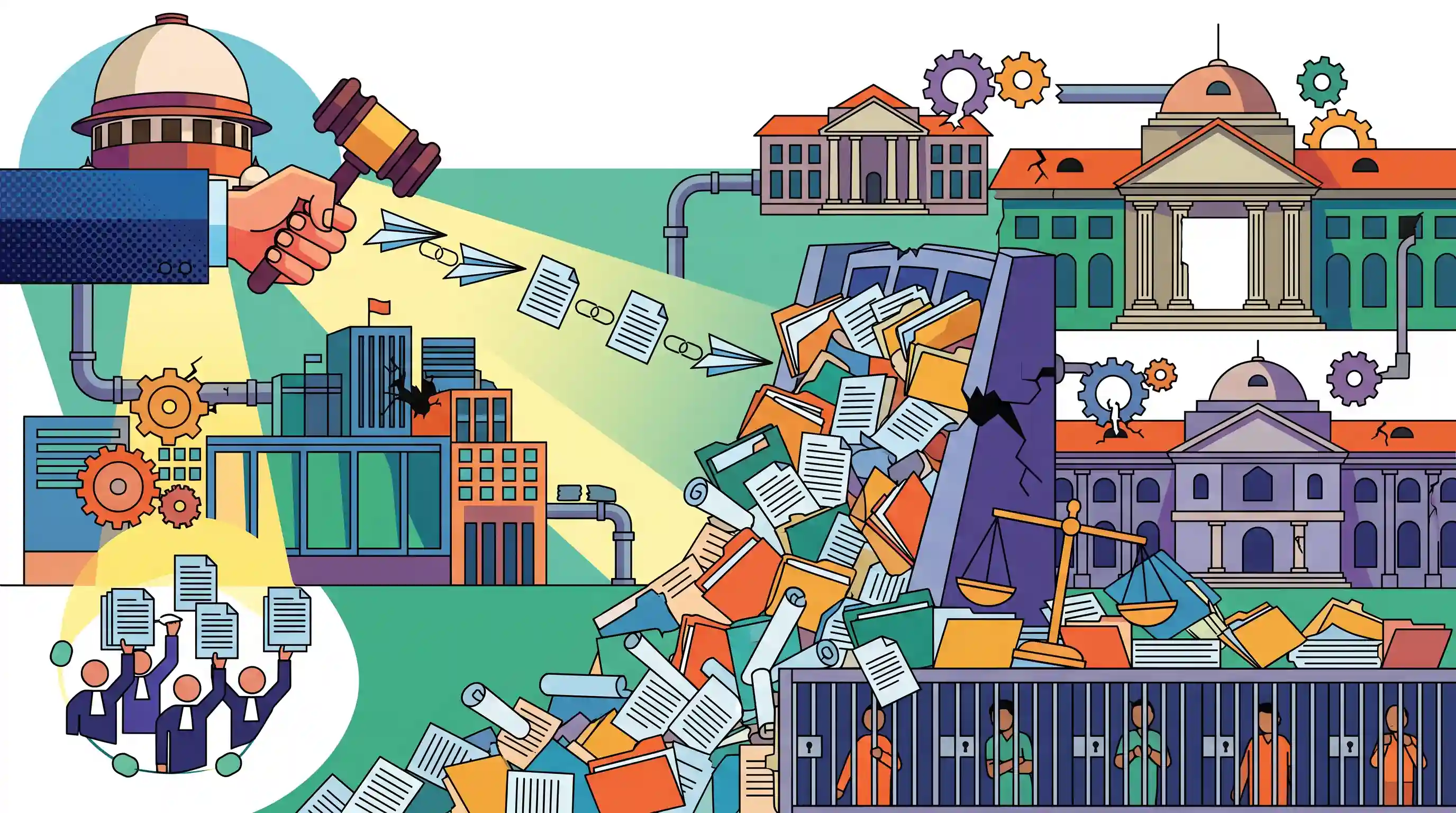
The Supreme Court has forcefully reminded the Union Government to expedite the clearance of Collegium recommendations for High Court judges, warning that judicial vacancies directly contribute to massive case backlogs. During a suo motu hearing on easing bail processes for undertrials, the bench highlighted that over seven lakh criminal appeals are pending in High Courts. Significant vacancies exist in major courts, such as the Allahabad High Court, which is functioning with less than half of its sanctioned judicial strength. The delay in appointments exacerbates the strain on the criminal justice system and hinders the swift delivery of justice.
Key Points
- The Supreme Court has directed the Union Government to rapidly process and clear Collegium recommendations for appointing High Court judges.
- As of the hearing, 29 Collegium recommendations made since November 9, 2022, remained pending with the Centre.
- High vacancies are paralyzing courts; the Allahabad High Court operates with only 79 judges against a sanctioned strength of 160.
- The SC connected these vacancies directly to the massive backlog of cases, noting over 7 lakh criminal appeals are currently pending across High Courts.
- The directive arose during a suo motu hearing focused on streamlining and easing the bail process for undertrial prisoners.
Important Terms
Supreme Court of India

The highest judicial authority in India, established under the Constitution as the final court of appeal, protector of fundamental rights, and guardian of the Constitution.
UPSC context
GS Paper II (Judiciary). Tests powers, jurisdiction, and the independence of the apex court.
Collegium System
A non-constitutional system for appointing and transferring judges of the higher judiciary, evolved through Supreme Court judgments (Three Judges Cases) rather than legislation.
UPSC context
GS Paper II (Judiciary). Tests knowledge of judicial appointments and executive-judiciary relations.
Undertrials
Individuals detained in judicial custody while awaiting trial. They are presumed innocent but often face prolonged detention due to judicial backlogs.
UPSC context
GS Paper II (Social Justice/Criminal Justice). Tests awareness of prison reforms and Article 21.
Separation of Powers
A constitutional principle dividing government functions into three branches—Legislature, Executive, and Judiciary—to prevent the concentration of power and ensure checks and balances.
UPSC context
GS Paper II (Polity). Essential for understanding the interaction between government organs.
Allahabad High Court
The High Court with the highest sanctioned judge strength in India. It is frequently cited as the epicenter of judicial vacancy crises and pendency.
UPSC context
GS Paper II (Judiciary). Case study for judicial infrastructure and regional vacancy impacts.
Suo Motu
A Latin term meaning 'on its own motion,' referring to a court taking legal action independently without a formal petition from any party.
UPSC context
GS Paper II (Judiciary). Tests understanding of judicial activism and public interest litigation.
Prelims Trap
The collegium for High Court judge appointments comprises the CJI and the four senior-most SC judges.
The SC Collegium for High Court appointments requires the CJI and only the TWO senior-most judges, whereas Supreme Court appointments require FOUR.
Static Concepts Connected
How are High Court Judges appointed under the Constitution?
- Constitutional Mandate: Article 217 dictates appointment by the President after consultation with the CJI, the State Governor, and the respective High Court Chief Justice.
- Collegium Role: The SC Collegium responsible for recommending HC appointments comprises the CJI and the two senior-most judges of the Supreme Court.
- MoP Friction: The Memorandum of Procedure (MoP) guides appointments but notably lacks a strict legal timeframe for the Union Government to clear names, causing friction.
What are the legal safeguards for undertrial prisoners?
- Article 21: The Supreme Court has firmly established that the 'right to a speedy trial' is an implicit fundamental right under the right to life and liberty.
- Statutory Bail: Provisions like Section 436A of CrPC (now in BNSS) mandate release on personal bond if an undertrial has served half the maximum sentence for the alleged offense.
Cross-Topic Patterns
Collegium delays & Basic Structure
The ongoing friction over the Memorandum of Procedure (MoP) and pending appointments ties directly to the NJAC judgment, separation of powers, and the principle of judicial independence.
Undertrials & Human Rights
A staggering 75% undertrial population links administrative bottlenecks like judicial vacancies directly to chronic prison overcrowding and Article 21 human rights violations.

Expect a 2026 Prelims question contrasting SC vs HC collegium compositions and testing the MoP's lack of statutory time limits.
Linked PYQs · 4
Linked PYQs · 4
- 2025MainsGS2
Discuss the evolution of collegium system in India. Critically examine the advantages and disadvantages of the system of appointment of the Judges of the Supreme Court of India and that of the USA.
- 2017MainsGS2
Critically examine the Supreme Court's judgement on 'National Judicial Appointments Commission Act, 2014' with reference to appointment of judges of higher judiciary in India.
- 2021PrelimsGS1
With reference to Indian judiciary, consider the following statements : 1. Any retired judge of the Supreme Court of India can be called back to sit and act as a Supreme Court judge by the Chief Justice of India with prior permission of the President of India. 2. A High Court in India has the power to review its own judgement as the Supreme Court does. Which of the statements given above is/are correct?
- 2014PrelimsGS1
The power to increase the number of judges in the Supreme Court of India is vested in
