COP30 Climate Summit Outcomes and Adaptation Focus
Source:The Hindu ↗
Why It Matters
COP30 represents a pivotal moment in international climate diplomacy, 10 years after the Paris Agreement. For UPSC aspirants, the evolving focus from strict mitigation to adaptation and 'just transition', alongside the ongoing North-South divide over climate finance, is crucial for both GS3 (Environment) and GS2 (International Relations).
Summary
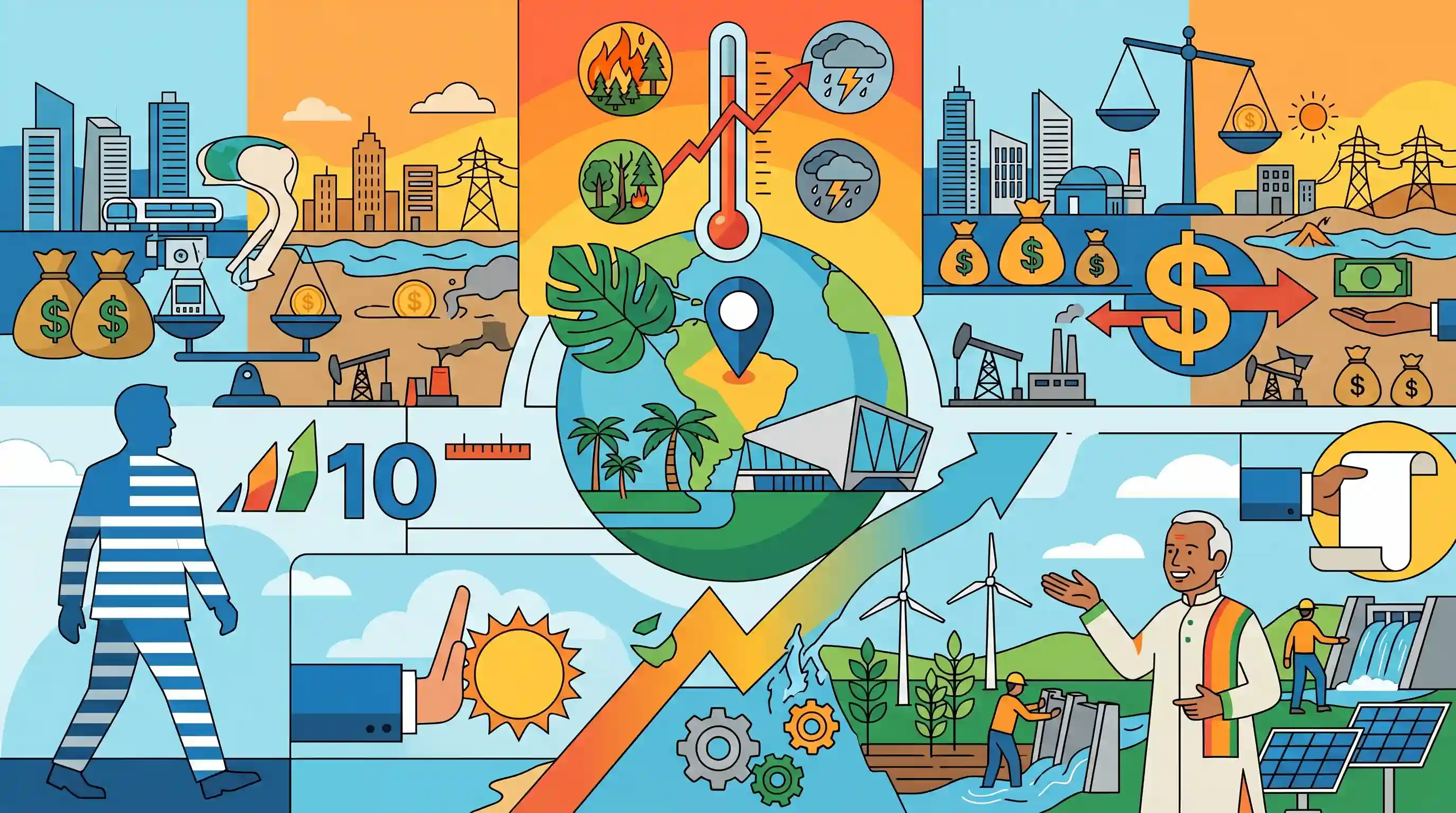
The article reviews the outcomes of COP30 in Belem, Brazil, which highlighted a shift in the global climate narrative towards 'adaptation' and 'just transition' rather than strict mitigation goals. Set against the backdrop of the 10th anniversary of the Paris Agreement and rising global temperatures, the summit saw persistent divisions between developed and developing nations over finance and fossil fuel phase-outs. The absence of the United States altered the power dynamics, allowing the focus to shift towards practical implementation and resilience building, a stance welcomed by India, which withheld announcing updated Nationally Determined Contributions (NDCs).
Key Points
- COP30 in Belem, Brazil, marked the 10th anniversary of the Paris Agreement amidst concerns that global temperatures in 2024 breached the 1.5°C limit.
- The summit witnessed familiar divides: developed countries pressed for hard targets to phase out fossil fuels, whereas developing nations and petro-states demanded more financial support and historical accountability.
- The absence of the United States from the summit weakened the negotiating power of the developed country bloc.
- The final outcome shifted focus toward "adaptation" and "just transition," recognizing the need for practical measures to build climate resilience.
- India supported the summit's acknowledgment of developing countries' concerns but chose not to announce updated Nationally Determined Contributions (NDCs).
Important Terms
UNFCCC

The 1992 parent treaty of the Paris Agreement, aiming to stabilize atmospheric greenhouse gas concentrations. It serves as the primary international framework for annual climate negotiations (COPs).
UPSC context
GS Paper 3 (Environment); GS Paper 2 (International Relations). Fundamental for understanding global climate governance and India's role in negotiations.
Paris Agreement
A 2015 legally binding international treaty to limit global warming to well below 2°C, preferably 1.5°C. COP30 marked its 10th anniversary and shifted focus toward implementation.
UPSC context
GS Paper 3 (Environment). The central pillar of international climate commitments and the basis for all current national environmental policies.
Nationally Determined Contributions (NDCs)
Non-binding national climate plans submitted every five years under the Paris Agreement. India's updated 2035 NDC targets a 47% reduction in emissions intensity and 60% non-fossil power capacity.
UPSC context
GS Paper 3 (Environment). Essential for tracking India's 'Panchamrit' goals and progress toward the 2070 net-zero target.
Just Transition
A framework ensuring the shift to a green economy is fair and inclusive, supporting workers and communities dependent on fossil fuels. COP30 established a specific implementation mechanism for this.
UPSC context
GS Paper 3 (Environment & Economy); GS Paper 1 (Social Justice). Key to discussions on sustainable development and inclusive growth.
Climate Finance
Financial resources provided by developed nations to help developing countries manage mitigation and adaptation. Discussions at COP30 centered on the New Collective Quantified Goal (NCQG) of $1.3 trillion.
UPSC context
GS Paper 3 (Economy/Environment). Central to the North-South divide and the principle of Common But Differentiated Responsibilities (CBDR).
Adaptation
Actions taken to adjust to the actual or expected impacts of climate change. COP30 called for tripling adaptation finance by 2035 and refined the Global Goal on Adaptation (GGA).
UPSC context
GS Paper 3 (Environment/Disaster Management). Tests understanding of resilience-building versus emission-reduction strategies in the face of escalating climate disasters.
Prelims Trap
"India successfully submitted its updated Nationally Determined Contributions (NDCs) at COP30 in Brazil to align with new adaptation targets."
India deliberately withheld its updated NDCs at COP30 to pressure developed nations on climate finance. Updating was a key tension point, not a blanket consensus.
Static Concepts Connected
What are Nationally Determined Contributions (NDCs) under the Paris Agreement?
- Origin: Established under Article 4 of the 2015 Paris Agreement as national climate action plans.
- Update Cycle: Countries must communicate new or updated NDCs every five years, outlining mitigation and adaptation goals.
- Ratchet Mechanism: Successive NDCs must represent a progression beyond the country's current pledge, reflecting highest possible ambition.
What is the principle of Common But Differentiated Responsibilities (CBDR)?
- Rio Earth Summit: Formalized at the 1992 UNFCCC, acknowledging that states have unequal historical contributions to global environmental degradation.
- Core Application: It places a greater burden on developed nations to provide climate finance and technology transfer to developing nations.
Cross-Topic Patterns
Geopolitics + Climate Leadership Vacuum
The U.S. absence at COP30 altered negotiating dynamics, demonstrating how domestic political shifts in developed nations empower the Global South to dictate terms on adaptation and CBDR.
Just Transition + Labor Economics
Transitioning away from fossil fuels links GS3 environment to GS3 economy, particularly structural unemployment in coal-heavy regions and the need for inclusive rehabilitation of vulnerable workforces.

Expect a 2026 Prelims question contrasting the 'ratchet mechanism' of NDCs with the emerging, voluntary 'Just Transition' frameworks.
Linked PYQs · 3
Linked PYQs · 3
- 2025MainsGS3
Write a review on India's climate commitments under the Paris Agreement (2015) and mention how these have been further strengthened in COP26 (2021). In this direction, how has the first Nationally Determined Contribution intended by India been updated in 2022?
- 2021MainsGS3
Describe the major outcomes of the 26th session of the Conference of the Parties (COP) to the United Nations Framework Convention on Climate Change (UNFCCC). What are the commitments made by India in this conference?
- 2022MainsGS3
Discuss global warming and mention its effects on the global climate. Explain the control measures to bring down the level of greenhouse gases which cause global warming, in the light of the Kyoto Protocol, 1997.
