Fifth GARC Report Focuses on Digital Governance and Public Service
Source:cmogujarat ↗
Why It Matters
It is directly relevant to GS Paper 2 / Governance sections regarding administrative reforms and e-governance initiatives at the state level, particularly policies implemented in Gujarat.
Summary
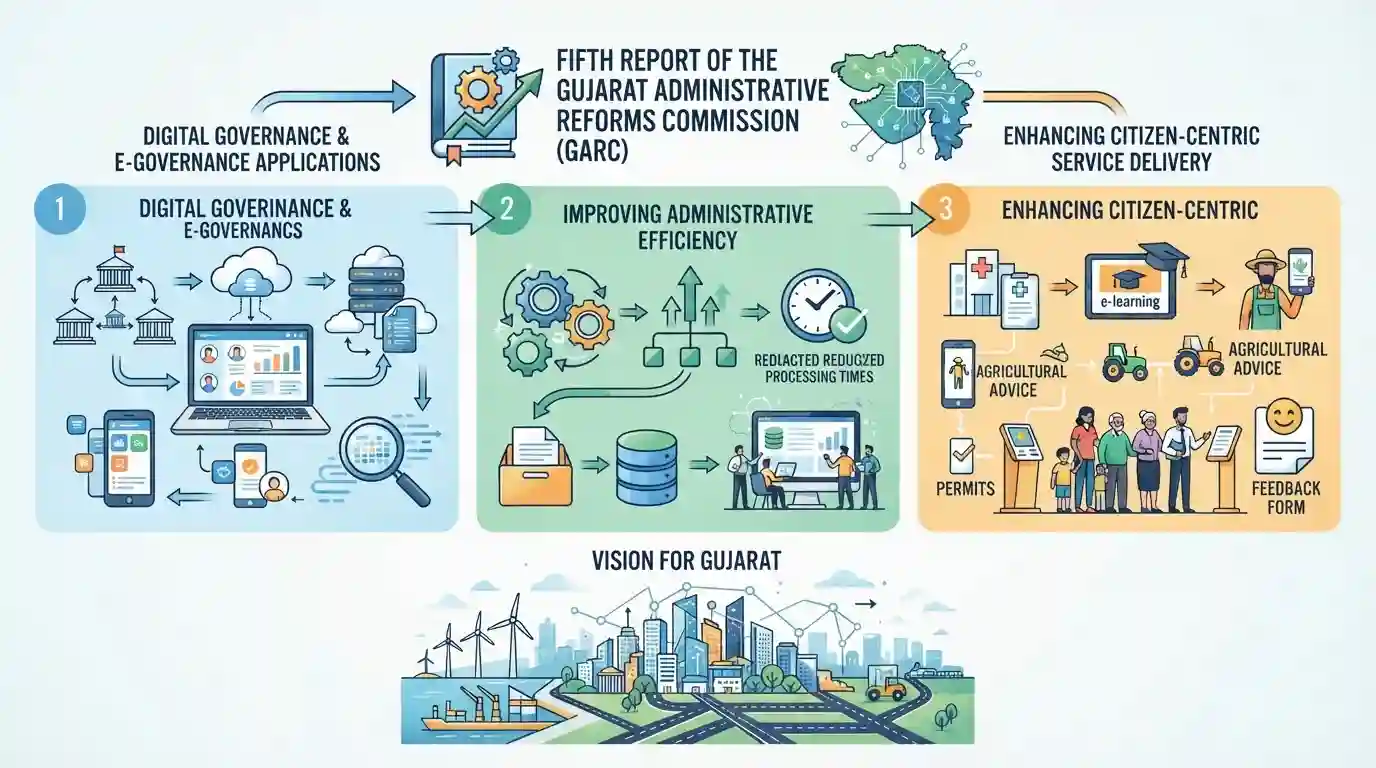
The article discusses the Fifth Report of the Gujarat Administrative Reforms Commission (GARC), which lays down comprehensive recommendations for advancing digital governance, improving administrative efficiency, and enhancing citizen-centric public service delivery across government departments in Gujarat.
Key Points
- The Fifth Report of the Gujarat Administrative Reforms Commission (GARC) focuses extensively on digital governance and modernizing public service delivery.
- The report highlights strategies for leveraging technology, e-governance, and digital infrastructure to make administration more transparent, responsive, and citizen-centric in Gujarat.
- It emphasizes seamless integration of government departments through digital platforms to improve operational efficiency and reduce administrative red tape.
Important Terms
Gujarat Administrative Reforms Commission (GARC)

A state-level body tasked with reviewing administrative frameworks and recommending strategic reforms to enhance governance efficiency, transparency, and public service delivery in Gujarat.
UPSC context
Relevant to GPSC Papers (Governance and Administration), testing administrative reforms, structural changes, and e-governance policy formulation in Gujarat.
Government of Gujarat
The state executive authority responsible for formulating public policies, implementing developmental programs, and driving digital governance innovations like 'One State – One Portal' across Gujarat.
UPSC context
Important for GPSC General Studies papers, focusing on state-level policy interventions, public administration, welfare delivery mechanisms, and digital initiatives.
Static Concepts Connected
What are the key pillars and objectives of the National e-Governance Plan (NeGP) in India?
- Core Objective: To make all government services accessible to the common man in his locality, ensuring efficiency, transparency, and reliability.
- Mission Mode: Comprises Mission Mode Projects (MMPs) spanning state, central, and integrated services such as e-District, MCA21, and Passport Seva.
- Infrastructure: Focuses heavily on public-private partnerships (PPPs) and shared infrastructure like State Data Centres (SDCs) and State Wide Area Networks (SWAN).
Cross-Topic Patterns
GARC Recommendations & National E-Governance Frameworks
The shift toward paperless administrative reforms mirrors national-level frameworks like the National e-Governance Plan (NeGP) and Digital India initiatives.
Citizen-Centric Governance & Service Delivery Acts
Integration of departmental data platforms tests administrative decentralization and the implementation of the Right to Public Services Act at the state level.

Expect statement-based questions on the role of State Administrative Reforms Commissions and e-governance bottlenecks in Gujarat administration.
Linked PYQs · 2
Linked PYQs · 2
- 2026GPSC_PRELIMSGS1
Which of the following initiatives are primarily aimed at strengthening digital governance and digital public infrastructure in India? 1. Digital India 2. Aadhaar 3. Unified Payments Interface (UPI) Choose the correct option from the following.
- 2025GPSC_PRELIMSGS1
Which of the following policies or programs are aimed at improving governance at the state and central level? 1. Digital India Mission 2. Smart Cities Mission 3. Direct Benefit Transfer (DBT) Scheme 4. Pradhan Mantri Awas Yojana (PMAY) Select the correct answer using the codes given below:
