Gold Imports and Merchandise Deficit Challenges in External Sector
Source:The Hindu ↗
Why It Matters
A widening trade deficit due to non-productive imports like gold exerts pressure on India's current account deficit and currency valuation. It underscores the structural challenge of the merchandise trade gap and the increasing reliance on services exports to maintain balance of payments stability.
Summary
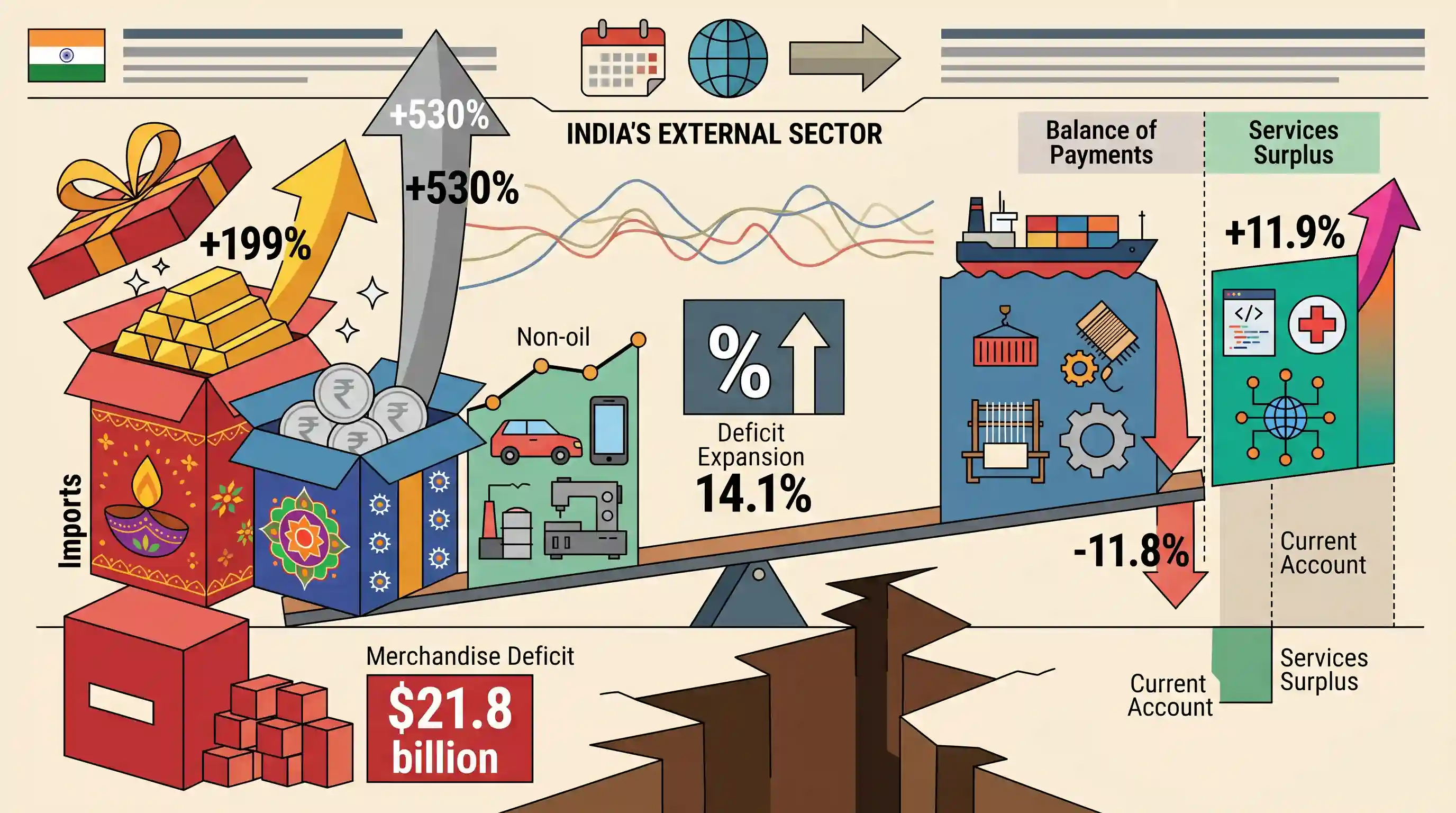
In October 2025, India's trade deficit expanded by 14.1% year-on-year to hit $21.8 billion, primarily driven by a massive festive-season spike in gold and silver imports alongside a contraction in merchandise exports. Gold imports surged by nearly 200% to $14.7 billion, and silver jumped over 530%. While overall goods exports slumped by 11.8%, services exports recorded a healthy 11.9% growth, somewhat mitigating the overall trade imbalance. The rise in non-oil, non-gold imports also highlighted robust domestic demand despite external export challenges.
Key Points
- India's trade deficit surged by 14.1% to $21.8 billion in October 2025.
- The widening deficit was driven by a massive festive season spike in imports of gold (up 200% to $14.7 billion) and silver (up 530% to $2.7 billion).
- Merchandise exports fell by 11.8%, reflecting sluggish global demand for goods, while services exports remained a bright spot, growing by 11.9%.
- Non-oil, non-gold imports also grew by 12.4% year-on-year, indicating robust domestic consumption.
Important Terms
Trade Deficit

The negative difference between a country's total value of imports and the total value of its exports of goods and services.
UPSC context
GS Paper III: Indian Economy. Key indicator for assessing macroeconomic stability, export competitiveness, and exchange rate pressures.
Balance of Payments (BoP)
A comprehensive record of all economic transactions between the residents of a country and the rest of the world during a specific period.
UPSC context
GS Paper III: External Sector. Critical for understanding the stability of the Rupee and foreign exchange reserve management.
Current Account Deficit (CAD)
A measurement of a country’s trade where the value of the goods and services it imports exceeds the value of the goods and services it exports.
UPSC context
GS Paper III: Economy. Tests understanding of structural vulnerabilities and their impact on India's sovereign credit ratings.
External Sector
The segment of the economy that deals with international trade, foreign investments, and financial transactions with the rest of the world.
UPSC context
GS Paper III: Main syllabus topic covering trade policies, FDI, and global economic integration.
Merchandise Trade
Trade involving the export and import of tangible, physical products such as commodities, manufactured goods, and raw materials.
UPSC context
GS Paper III: Economy. Focuses on manufacturing sector health and the impact of global supply chain disruptions.
Ministry of Commerce and Industry
The nodal Indian ministry responsible for formulating trade policies, promoting exports, and releasing official data on merchandise trade and industry.
UPSC context
GS Paper II & III: Governance and Economy. Institutional framework for foreign trade policy and industrial promotion.
Services Trade
Trade in intangible products such as IT, consulting, and tourism; typically a major surplus-generating sector for the Indian economy.
UPSC context
GS Paper III: Economy sectors. Highlights India's global comparative advantage and its role in narrowing the trade gap.
Prelims Trap
India's reported monthly 'trade deficit' accounts for the net balance of both merchandise and services trade.
The standard 'Trade Deficit' strictly refers to merchandise (goods) trade. Services fall under 'invisibles' in the broader Current Account. India runs a deficit in the former, but a surplus in the latter.
Static Concepts Connected
What are the primary components of India's Current Account?
- Merchandise Trade: The export and import of physical goods, which constitutes the Balance of Trade.
- Services Trade: Trade in non-physical entities like IT, software, BPO, and travel (part of Invisibles).
- Income Receipts: Investment income (profits, interest, dividends) and compensation of employees (part of Invisibles).
- Current Transfers: Unilateral transfers including private remittances from the diaspora, gifts, and grants (part of Invisibles).
Why are Non-Oil, Non-Gold (NONG) imports tracked separately?
- Core Consumption: They reflect the underlying domestic economic activity and consumer demand, stripping out highly volatile global commodities.
- Investment Indicator: High NONG imports often indicate strong capital expenditure, as they include machinery and raw materials needed by domestic firms.
- Volatility Filter: Oil and gold have price-inelastic demands that can distort the true macroeconomic picture of the domestic manufacturing sector.
Cross-Topic Patterns
Gold Demand vs. Financialization of Assets
Persistently high physical gold imports test the efficacy of schemes like Sovereign Gold Bonds (SGBs) and Gold Monetization aimed at financializing gold demand to ease CAD pressures.
Trade Deficits and Currency Management
A widening trade deficit puts depreciating pressure on the Rupee, often forcing RBI interventions that draw down forex reserves and inadvertently tighten domestic market liquidity.

Expect a 2026 prelims statement testing the exact difference between merchandise trade deficit, invisibles balance, and overall CAD.
Linked PYQs · 3
Linked PYQs · 3
- 2014PrelimsGS1
With reference to Balance of Payments, which of the following constitutes/constitute the Current Account? 1. Balance of trade 2. Foreign assets 3. Balance of invisibles 4. Special Drawing Rights Select the correct answer using the code given below.
- 2017MainsGS3
Account for the failure of manufacturing sector in achieving the goal of labour-intensive exports. Suggest measures for more labour-intensive rather than capital-intensive exports.
- 2018MainsGS3
How would the recent phenomena of protectionism and currency manipulations in world trade affect macroeconomic stability of India?
