Iran Transit Rule Changes Disrupt Fertilizer Cargoes Bound for India
Source:The Hindu ↗
Why It Matters
Demonstrates how geopolitical tensions at global maritime choke points (like the Strait of Hormuz) can directly impact India's domestic agriculture and food security by disrupting the supply of essential inputs like fertilizers.
Summary
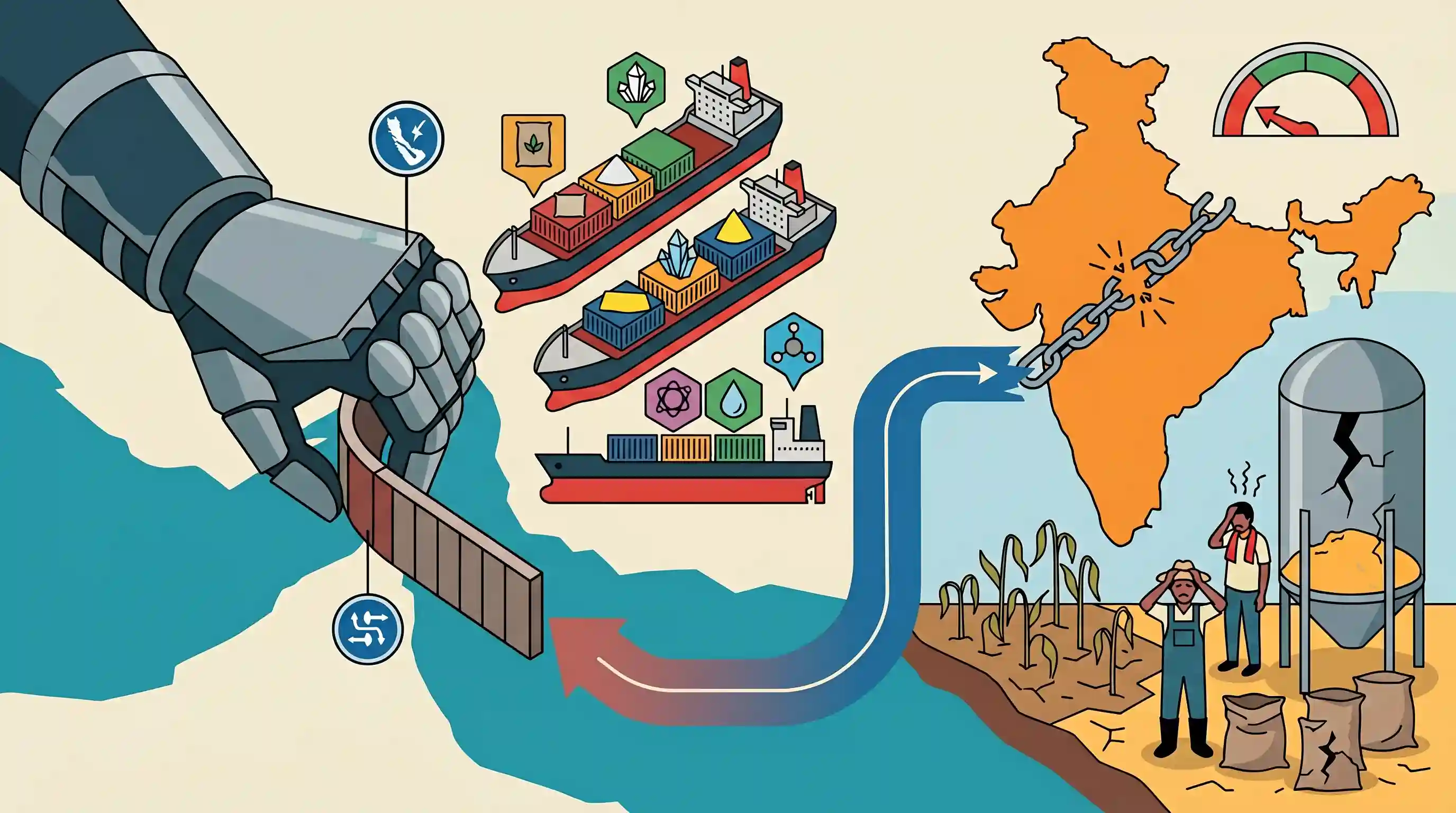
Iran's unexpected tightening of transit regulations at the Strait of Hormuz has stranded multiple large bulk carriers carrying essential fertilizers to India. The new directive by the Persian Gulf Strait Authority (PGSA), controlled by the IRGC, mandates prior clearance, severely disrupting maritime traffic in the crucial choke point. The blockade threatens India's agricultural sector, as the trapped shipments include millions of dollars worth of Urea, DAP, Sulphur, and Ammonia required for the upcoming kharif season. The situation underscores India's vulnerability to Middle Eastern geopolitical tensions and their direct impact on domestic food and supply chain security.
Key Points
- Iran's Islamic Revolutionary Guard Corps (IRGC) has enforced new transit rules at the Strait of Hormuz, requiring vessels to obtain an 'entry number' 48 hours prior to transit.
- This geopolitical move has trapped several bulk carriers in the Persian Gulf laden with critical fertilizers destined for India.
- The trapped cargo includes vital agricultural inputs such as Urea, Di-ammonium Phosphate (DAP), NPK, Sulphur, and Ammonia.
- The disruption threatens India's fertilizer supply chain just ahead of the crucial kharif cropping season, prompting urgent evacuation efforts by Indian authorities.
Important Terms
Persian Gulf Strait Authority (PGSA)

An Iranian agency established in 2026 to regulate and toll maritime transit through the Strait of Hormuz. Controlled by the IRGC, it mandates prior vessel clearance, creating significant legal and sanction-related risks.
UPSC context
GS Paper-II (International Relations); tests awareness of new maritime regulatory bodies and their impact on India’s resource security.
Strait of Hormuz
A strategic waterway between Iran and Oman connecting the Persian Gulf to the Gulf of Oman. It is the world’s most vital oil chokepoint, handling approximately 20% of global petroleum liquids.
UPSC context
GS Paper-I (Geography); evaluates knowledge of strategic maritime chokepoints and India's critical energy/fertilizer trade routes.
Islamic Revolutionary Guard Corps (IRGC)
A powerful branch of Iran’s military established in 1979 to safeguard the Islamic Republic. It operates independently of the regular army and oversees maritime security and regulatory enforcement in the Persian Gulf.
UPSC context
GS Paper-II (IR/Security); tests understanding of regional military actors and their influence on West Asian geopolitical stability.
Joint Maritime Information Center (JMIC)
A naval coordination entity that monitors maritime security and provides threat assessments for commercial shipping. It issues advisories to help vessels navigate high-risk zones like the Persian Gulf and Red Sea.
UPSC context
GS Paper-III (Security); tests knowledge of international maritime safety mechanisms and collective security measures in conflict zones.
Choke Point
A narrow geographical passage, such as a strait, that can be easily blocked. These are strategic vulnerabilities in global logistics where disruptions can trigger massive trade and energy price shocks.
UPSC context
GS Paper-I (Geography); core concept for analyzing global trade route vulnerabilities and economic geography.
Department of Agriculture & Farmers Welfare (DA&FW)
An Indian government department responsible for assessing national fertilizer requirements. it coordinates with states to ensure timely input availability based on cropping patterns, soil health, and seasonal demand.
UPSC context
GS Paper-III (Agriculture); tests understanding of institutional frameworks for managing agricultural inputs and national food security.
Kharif Season
The summer cropping season in India (June-October) coinciding with the southwest monsoon. It involves water-intensive crops like rice and maize that depend on the timely arrival of imported fertilizers.
UPSC context
GS Paper-III (Agriculture); tests knowledge of Indian cropping cycles and the impact of supply chain disruptions on farming.
Prelims Trap
"The Strait of Hormuz is a chokepoint bordered by Iran to the north and Saudi Arabia to the south."
The Strait of Hormuz is bordered by Iran to the north, but by Oman (via the Musandam Peninsula) and the UAE to the south, not Saudi Arabia.
Static Concepts Connected
How does India's fertilizer subsidy framework differentiate between Urea and P&K fertilizers?
- Urea Control: Urea remains under strict statutory price control. The government fixes a uniform Maximum Retail Price (MRP), and pays the difference as subsidy to manufacturers.
- NBS Scheme for P&K: Phosphatic and Potassic (P&K) fertilizers are governed by the Nutrient Based Subsidy (NBS) scheme. The government provides a fixed subsidy per nutrient, while companies determine the MRP.
- Feedstock Dependency: Domestic urea production heavily relies on Natural Gas (LNG), large volumes of which are imported via West Asian shipping routes.
What is the geographic and strategic significance of the Strait of Hormuz?
- Connectivity: It is a narrow maritime chokepoint connecting the Persian Gulf to the Gulf of Oman and the broader Arabian Sea.
- Bordering Nations: It is geographically bounded by Iran to the north and Oman (Musandam Peninsula) and the UAE to the south.
- Trade Lifeline: It is one of the world's most critical transit routes for global energy (oil and LNG) and petrochemicals exported from the Persian Gulf.
Cross-Topic Patterns
Geopolitics & Agrarian Inflation
Disruptions in maritime chokepoints like Hormuz don't just shock energy markets; they directly threaten India's kharif sowing via fertilizer shortages, linking West Asian IR to domestic food inflation.
Chabahar Port as a Strategic Bypass
Chabahar's location on the Gulf of Oman means it lies outside the Strait of Hormuz, offering India a strategic maritime bypass around Persian Gulf transit blockades.

Expect a 2026 prelims question merging West Asian chokepoint geography (Hormuz) with India's fertilizer (MOP/Urea) import dependencies.
Linked PYQs · 4
Linked PYQs · 4
- 2020PrelimsGS1
With reference to chemical fertilizers in India, consider the following statements : 1. At present, the retail price of chemical fertilizers is market-driven and not administered by the Government. 2. Ammonia, which is an input of urea, is produced from natural gas. 3. Sulphur, which is a raw material for phosphoric acid fertilizer, is a by-product of oil refineries. Which of the statements given above is/are correct?
- 2025MainsGS2
"Energy security constitutes the dominant kingpin of India's foreign policy, and is linked with India's overarching influence in Middle Eastern countries.” How would you integrate energy security with India's foreign policy trajectories in the coming years?
- 2017MainsGS2
The question of India's Energy Security constitutes the most important part of India's economic progress. Analyze India's energy policy cooperation with West Asian countries.
- 2024PrelimsGS1
Consider the following statements : Statement-I : Sumed pipeline is a strategic route for Persian Gulf oil and natural gas shipments to Europe. Statement-II : Sumed pipeline connects the Red Sea with the Mediterranean Sea. Which one of the following is correct in respect of the above statements?
