Fertiliser Subsidy Surge Driven by Consumption and Import Pressures
Source:Indian Express ↗
Why It Matters
Fertiliser subsidies form a significant portion of India's revenue expenditure. Understanding the macroeconomic (weak rupee) and geopolitical drivers of this subsidy, alongside domestic consumption patterns, is critical for answering questions on fiscal policy, agricultural reforms, and food security in GS Paper 3.
Summary
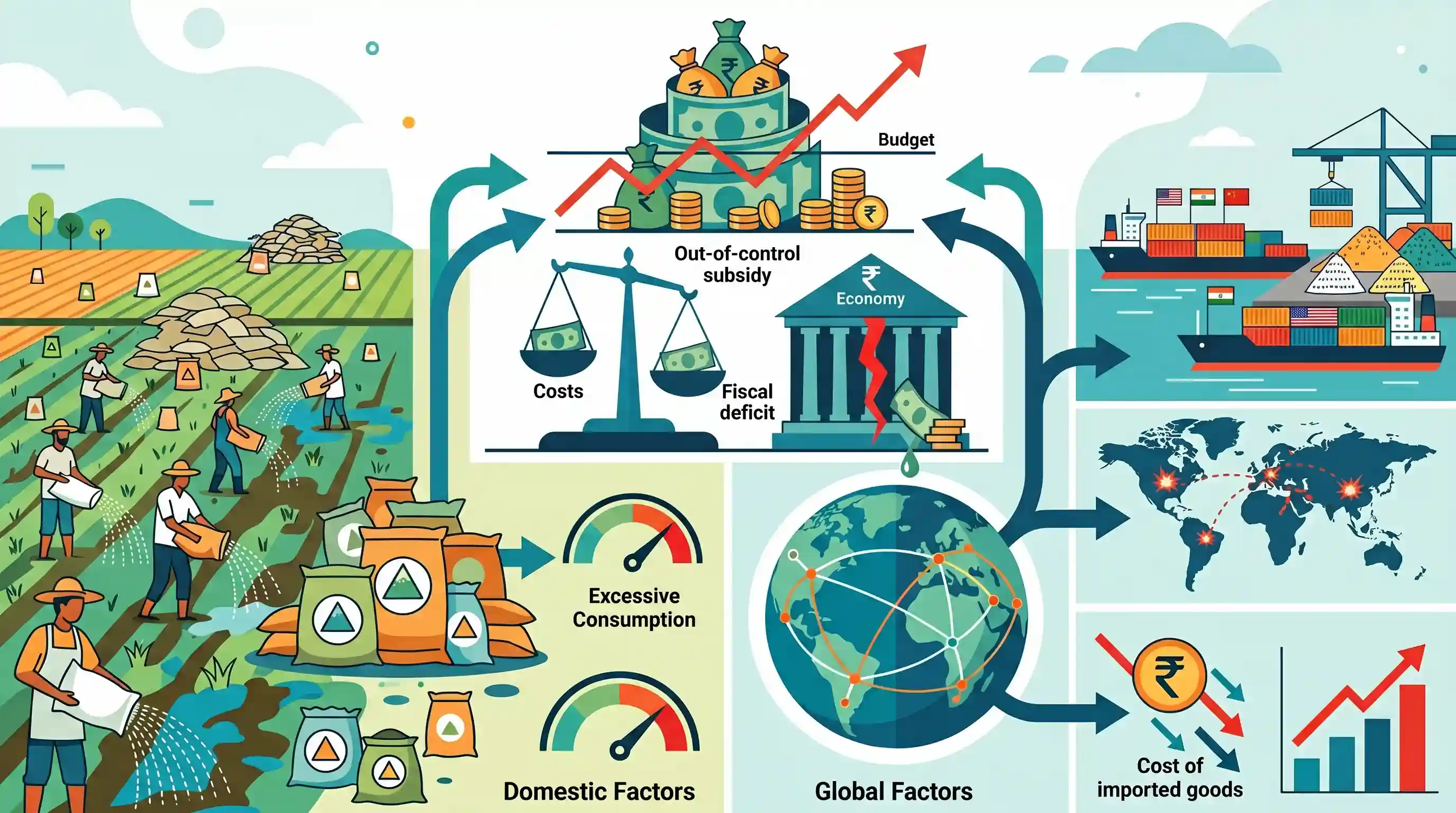
India's fertiliser subsidy is spiralling beyond the budgeted ₹1.7 lakh crore target, driven by a combination of domestic and global factors. Unrestrained and imbalanced consumption of fertilisers, especially urea, remains a persistent issue despite policy interventions. Furthermore, India's heavy reliance on imports for fertiliser raw materials and finished products makes it vulnerable to macroeconomic shocks. The depreciation of the rupee inflates import costs, while ongoing geopolitical tensions disrupt global supply chains and drive up international prices. This convergence of high consumption, currency weakness, and global volatility highlights the urgent need to rationalize the subsidy regime and boost domestic self-reliance to maintain fiscal prudence and agricultural viability.
Key Points
- Rising Fiscal Burden: The fertiliser subsidy bill has surged past the ₹1.7 lakh crore target, exacerbating fiscal pressures on the government.
- Unrestrained Consumption: Imbalanced and excessive use of fertilisers, particularly highly subsidised urea, continues unabated, harming soil health and inflating subsidy costs.
- Import Dependence and Weak Rupee: The depreciation of the Indian rupee significantly increases the import bill for critical raw materials (natural gas, sulphur, rock phosphate) and finished fertilisers (DAP, MOP).
- Geopolitical Vulnerability: Global tensions disrupt supply chains and create volatility in international energy and fertiliser markets, directly impacting domestic subsidy requirements.
- Policy Imperative: The situation underscores the need for structural reforms such as rationalising subsidies, promoting balanced fertilisation, and reducing import reliance to ensure long-term agricultural sustainability.
Prelims Trap
"All chemical fertilisers in India, including Urea, are governed under the Nutrient Based Subsidy (NBS) scheme."
Urea is NOT under the NBS scheme. The government controls the MRP of Urea, whereas for P&K fertilisers under NBS, a fixed subsidy is given and companies decide the MRP.
Static Concepts Connected
How does the Nutrient Based Subsidy (NBS) differ from Urea pricing?
- Urea Control: The government legally fixes the Maximum Retail Price (MRP) of urea and reimburses manufacturers the difference between production cost and MRP.
- NBS Mechanism: Introduced in 2010 for Phosphatic & Potassic (P&K) fertilisers; the subsidy is fixed per kg of nutrient (Nitrogen, Phosphorus, Potassium, Sulphur).
- MRP Freedom: Under NBS, manufacturers are allowed to fix the MRP of P&K fertilisers at reasonable levels, unlike the strictly government-administered Urea MRP.
What is the extent of India's import dependency for fertiliser raw materials?
- Potash (K): India is nearly 100% dependent on imports for Muriate of Potash (MOP) due to a complete lack of commercially viable domestic reserves.
- Phosphate (P): India has high reliance (approximately 95%) on imported rock phosphate and finished DAP to meet its agricultural needs.
- Nitrogen (N) Feedstock: While domestic urea production is high, it heavily relies on imported Liquefied Natural Gas (LNG) as the primary energy feedstock.
Cross-Topic Patterns
Weak Rupee's Double Fiscal Whammy
A depreciating rupee inflates the landed cost of imported LNG and Potash, simultaneously widening the Current Account Deficit and swelling the domestic agricultural subsidy bill.
Subsidy-driven Soil Desertification
Heavily subsidized Urea skews the NPK ratio (7.7:3.1:1 instead of 4:2:1), causing nitrogen leaching, groundwater contamination, and declining crop yield elasticity, linking economics to ecology.
PM-PRANAM as a Fiscal Tool
The PM-PRANAM scheme incentivizes states to reduce chemical fertiliser use, acting as a dual-purpose tool to restore soil health and curb the massive ₹1.7 lakh crore fiscal burden.

Expect a multi-statement Prelims 2026 question linking Urea's exclusion from NBS with India's 100% import dependency for Potash (MOP).
Linked PYQs · 3
Linked PYQs · 3
- 2020PrelimsGS1
With reference to chemical fertilizers in India, consider the following statements : 1. At present, the retail price of chemical fertilizers is market-driven and not administered by the Government. 2. Ammonia, which is an input of urea, is produced from natural gas. 3. Sulphur, which is a raw material for phosphoric acid fertilizer, is a by-product of oil refineries. Which of the statements given above is/are correct?
- 2023MainsGS3
What are the direct and indirect subsidies provided to farm sector in India? Discuss the issues raised by the World Trade Organization (WTO) in relation to agricultural subsidies.
- 2017MainsGS3
How do subsidies affect the cropping pattern, crop diversity and economy of farmers? What is the significance of crop insurance, minimum support price and food processing for small and marginal farmers?
