Fertiliser Supply Vulnerabilities Amid West Asian Conflicts
Source:Indian Express ↗
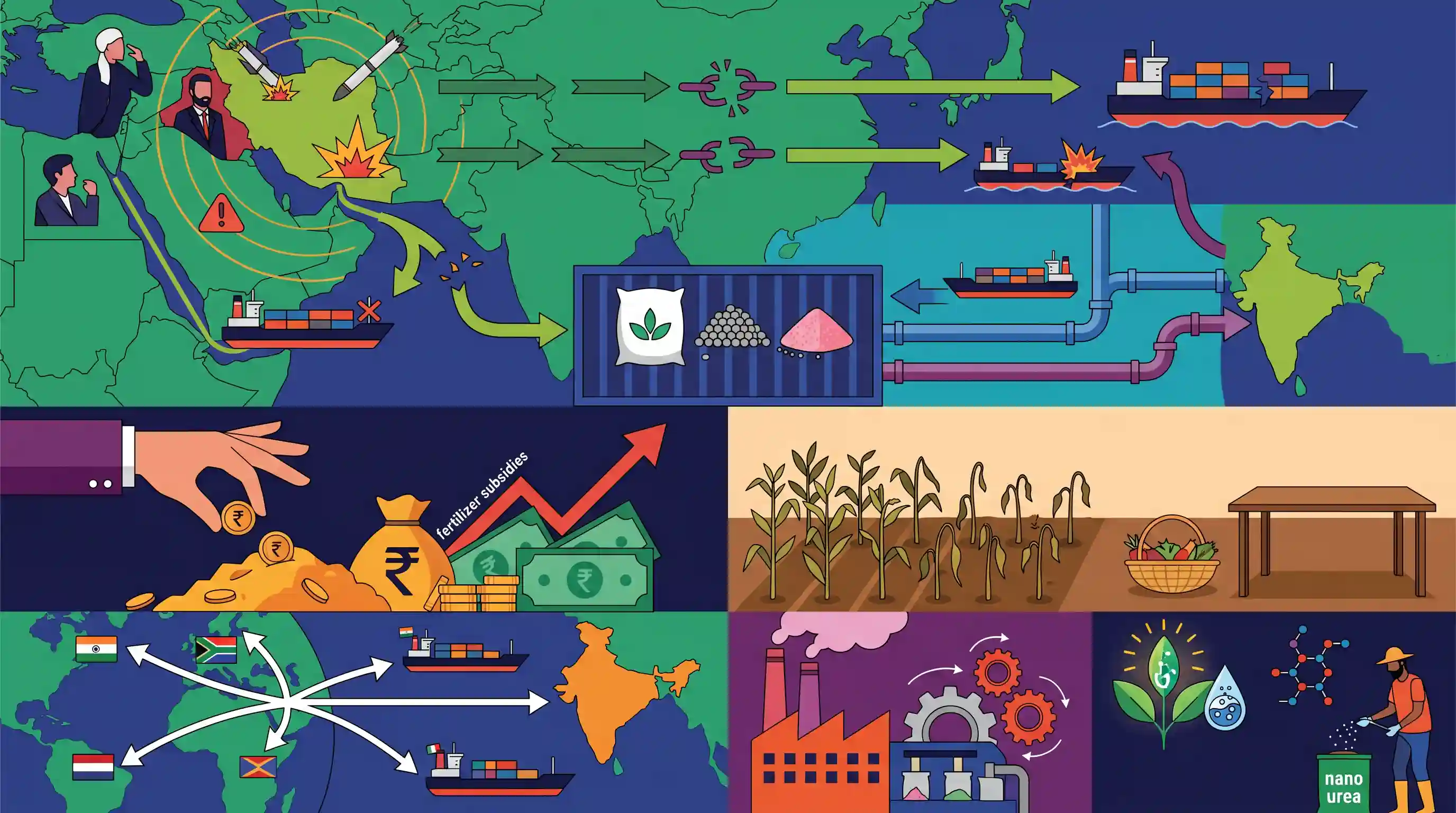
Why It Matters
Fertiliser availability is critical for India's agricultural output and food security. Geopolitical conflicts that disrupt this supply chain directly impact India's fiscal health by ballooning the subsidy bill, highlighting the vital intersection between global geopolitics (GS2) and domestic agriculture/economy (GS3).
Summary
The escalating geopolitical conflict in the Middle East, particularly involving Iran, has highlighted vulnerabilities in India's fertiliser supply chain. India relies heavily on imports for critical agricultural inputs like Urea, DAP, and MOP. With the conflict threatening vital maritime trade routes such as the Strait of Hormuz and the Red Sea, there is a looming risk of supply disruptions and price volatility in the global fertiliser market. Such a scenario would severely strain the government's finances by inflating the fertiliser subsidy bill and could jeopardize domestic food security and agricultural yields. The situation underscores the urgent need for India to build supply chain resilience by diversifying import sources, boosting domestic manufacturing capacities, and accelerating the adoption of alternative, efficient fertilizers through initiatives like PM PRANAM and Nano Urea.
Key Points
- Escalating geopolitical tensions involving Iran in the Middle East threaten to disrupt global supply chains, raising concerns over India's fertiliser imports.
- India is heavily dependent on imports to meet its domestic demand for essential fertilisers like Urea, Diammonium Phosphate (DAP), and Muriate of Potash (MOP).
- The conflict poses a risk to critical maritime chokepoints like the Strait of Hormuz and the Red Sea, which are vital for the transit of energy and fertilisers.
- Supply disruptions and spikes in global fertiliser prices would inflate India's fertiliser subsidy bill, straining the fiscal deficit and impacting agricultural productivity and food security.
- To mitigate such vulnerabilities, India is focusing on diversifying import sources, ramping up domestic production, and promoting alternative solutions like Nano Urea and the PM PRANAM scheme to reduce chemical fertiliser dependence.
Important Terms
PM PRANAM

PM Programme for Restoration, Awareness, Nourishment and Amelioration of Mother Earth. It incentivizes states to reduce chemical fertilizer use by providing 50% of the saved subsidy as a grant.
UPSC context
GS-III Agriculture/Environment; tests sustainable farming policies and fiscal strategies to manage the chemical subsidy burden.
Nutrient Based Subsidy (NBS) Scheme
A 2010 policy providing fixed annual subsidies based on the nutrient content (Nitrogen, Phosphate, Potash, Sulphur) of non-urea fertilizers to promote balanced soil fertilization.
UPSC context
GS-III Economics/Agriculture; tests understanding of subsidy mechanisms, soil health management, and fiscal deficit control.
Strait of Hormuz
A critical maritime chokepoint between the Persian Gulf and Gulf of Oman, handling approximately one-fifth of global oil and a large portion of India’s fertilizer feedstock.
UPSC context
GS-I Geography/GS-II International Relations; tests awareness of trade routes and geopolitical vulnerabilities impacting India’s resource security.
Nano Urea
An indigenously developed nanotechnology-based liquid fertilizer with 80-90% nutrient efficiency. It aims to replace bulky granular urea bags and reduce import dependence.
UPSC context
GS-III S&T/Agriculture; tests knowledge of technological innovations for agricultural self-reliance (Atmanirbharta).
DAP (Di-ammonium Phosphate)
A high-phosphorus fertilizer critical for root development. India is the world's largest importer, making domestic food security highly vulnerable to West Asian supply disruptions.
UPSC context
GS-III Agriculture; tests awareness of critical crop inputs and the impact of geopolitical conflicts on agricultural supply chains.
Prelims Trap
"Urea is covered under the Nutrient Based Subsidy (NBS) scheme, allowing market-linked retail prices."
Urea is excluded from the NBS scheme. Its Maximum Retail Price (MRP) is statutorily fixed by the government, whereas NBS applies only to non-urea Phosphatic and Potassic (P&K) fertilisers.
Static Concepts Connected
How does the subsidy framework differ for Urea vs. P&K fertilisers?
- Urea Subsidy: Government statutorily fixes the MRP at heavily discounted rates. Manufacturers are reimbursed the difference between production/import cost and the MRP.
- NBS Scheme: Applies to Phosphatic & Potassic (P&K) fertilisers. Government provides a fixed subsidy based on nutrient content (N, P, K, S); companies independently set the MRP.
Which are the critical maritime chokepoints for India's West Asian imports?
- Strait of Hormuz: Connects the Persian Gulf to the Gulf of Oman; acts as the primary transit point for West Asian oil and fertiliser exports to India.
- Bab el-Mandeb: Connects the Red Sea to the Gulf of Aden; crucial for shipments passing through the Suez Canal to the Indian Ocean.
Cross-Topic Patterns
Geopolitics meets Fiscal Deficit
Middle East supply shocks directly inflate India's fertiliser subsidy bill, illustrating how distant geopolitical conflicts threaten domestic macroeconomic stability and fiscal deficit targets.
Eco-schemes as Forex Shields
Nano Urea and PM PRANAM are marketed as ecological initiatives, but fundamentally serve a strategic purpose: reducing India's near 100% import dependence on MOP and saving foreign exchange.

Expect a multi-statement 2026 Prelims question linking Middle East chokepoints with India's MOP/DAP import dependence and the NBS scheme.
Linked PYQs · 5
Linked PYQs · 5
- 2024MainsGS3
Elucidate the importance of buffer stocks for stabilizing agricultural prices in India. What are the challenges associated with the storage of buffer stock? Discuss.
- 2017MainsGS3
How do subsidies affect the cropping pattern, crop diversity and economy of farmers? What is the significance of crop insurance, minimum support price and food processing for small and marginal farmers?
- 2023MainsGS3
What are the direct and indirect subsidies provided to farm sector in India? Discuss the issues raised by the World Trade Organization (WTO) in relation to agricultural subsidies.
- 2025MainsGS2
"Energy security constitutes the dominant kingpin of India's foreign policy, and is linked with India's overarching influence in Middle Eastern countries.” How would you integrate energy security with India's foreign policy trajectories in the coming years?
- 2024PrelimsGS1
Consider the following statements : Statement-I : Sumed pipeline is a strategic route for Persian Gulf oil and natural gas shipments to Europe. Statement-II : Sumed pipeline connects the Red Sea with the Mediterranean Sea. Which one of the following is correct in respect of the above statements?
