Feedstock Sourcing Bottlenecks in Scaling Compressed Biogas Ecosystem
Source:The Hindu ↗
কেন এটি গুরুত্বপূর্ণ
Highlights the critical intersection of renewable energy targets (biofuels) and agricultural logistics. It offers a practical waste-to-wealth solution for crop residue management (an alternative to stubble burning) and aligns with themes tested in Mains GS3 regarding energy security, supply chains, and environmental conservation.
সারসংক্ষেপ
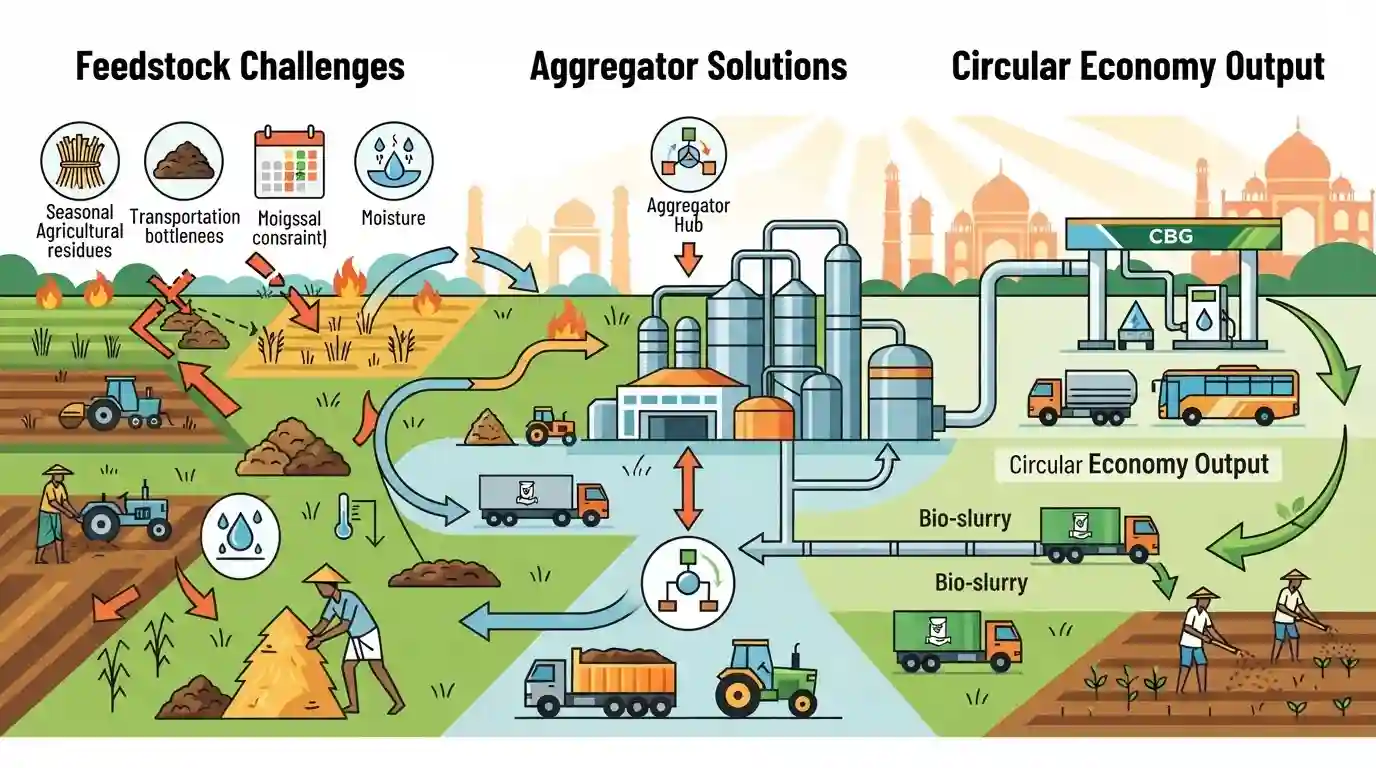
Scaling India's Compressed Biogas (CBG) ecosystem demands urgent resolution of supply chain bottlenecks related to feedstock sourcing. Despite the government's push through the ₹23,731-crore revamped GOBARdhan scheme, the sector struggles with the seasonal availability, high moisture content, and logistical constraints of utilizing agricultural residues and animal waste. Developing aggregator models, versatile multi-feedstock processing plants, and circular economy links (like returning bio-slurry to farmers) are essential next steps to unlock the waste-to-wealth potential and mitigate environmental issues like stubble burning.
মূল বিষয়
- Scaling the Compressed Biogas (CBG) ecosystem relies on building an efficient supply chain for feedstocks such as press mud, agricultural waste (paddy and wheat straw), and animal manure.
- The Union Cabinet approved a revamped GOBARdhan scheme with a ₹23,731 crore outlay until 2036 to boost CBG production tenfold.
- Logistical hurdles include the highly perishable nature of high-moisture feedstocks (which restricts sourcing to a 25-km radius), massive storage requirements, and vulnerability to fire hazards and monsoon spoilage.
- Feedstock availability is heavily seasonal; for instance, press mud is available only during the 4-5 month sugarcane crushing season, and paddy straw has a narrow 15-day collection window post-harvest.
- Solutions involve aggregator models, designing CBG plants to process multiple feedstocks to counter seasonal dips, and distributing bio-slurry back to farmers to incentivize agricultural waste supply.
গুরুত্বপূর্ণ শব্দ
GOBARdhan scheme

A central government initiative under the Swachh Bharat Mission (Gramin) to support villages in managing organic waste and converting cattle dung and crop residues into biogas and bio-slurry.
UPSC context
GS Paper II (Government Schemes) & Paper III (Environment); tests clean energy policies and rural waste-to-wealth programs.
Compressed Biogas (CBG)
A purified and compressed form of biogas produced through anaerobic digestion of organic wastes, containing over 90% methane, which serves as a green alternative to CNG.
UPSC context
GS Paper III (Energy and Environment); tests alternative transport fuels, decarbonization efforts, and energy security.
SATAT initiative
Sustainable Alternative Towards Affordable Transportation; a flagship initiative of the MoPNG to establish CBG production plants and promote CBG as a green vehicle fuel.
UPSC context
GS Paper III (Infrastructure and Economy); tests transport energy diversification and domestic import substitution.
Bio-slurry
The nutrient-rich, organic liquid residue left after anaerobic digestion of biomass in a biogas plant, used as a high-quality organic fertilizer and soil conditioner.
UPSC context
GS Paper III (Agriculture); tests understanding of organic farming, soil health restoration, and circular economy link.
Crop Residue Management
The systematic practice of managing agricultural leftovers after harvest to prevent stubble burning, improve soil organic matter, and provide feedstock for bioenergy generation.
UPSC context
GS Paper III (Environment & Agriculture); tests strategies to control seasonal air pollution and enhance soil fertility.
প্রিলিমস ফাঁদ
GOBARdhan scheme is exclusively aimed at managing cattle dung and animal waste.
Despite the acronym 'GOBAR', the scheme encompasses all organic/biodegradable waste, including crop residues (paddy/wheat straw) and industrial byproducts like press mud.
সংযুক্ত স্থির ধারণা
What is Compressed Biogas (CBG) and how is it produced?
- Anaerobic Digestion: Produced by microorganism breakdown of biomass in oxygen-free environments.
- High Methane: Purified to contain over 90% methane, giving it a calorific value equivalent to CNG.
- Bio-slurry Byproduct: The residual organic matter serves as a nutrient-rich bio-fertilizer, promoting circular agriculture.
What are the primary agricultural feedstocks used for CBG generation?
- Press Mud: A highly efficient, lignin-free byproduct of sugarcane juice filtration, available only during crushing seasons.
- Crop Residue: Paddy and wheat straw, which have a narrow post-harvest collection window but offer immense scale.
- Animal Waste: Cattle dung and poultry droppings, the traditional base for rural biogas setups.
আন্তঃবিষয় প্যাটার্ন
CBG as a stubble burning solution
Utilizing paddy straw for CBG directly connects renewable energy targets with winter air pollution mitigation in the National Capital Region (NCR).
Sugarcane's dual bioenergy role
Press mud for CBG parallels molasses for ethanol, making the sugarcane supply chain critical to India’s broader biofuel and energy security strategy.

Expect a multi-statement question combining CBG blending mandates, GOBARdhan's scope, and anaerobic digestion principles.
সংযুক্ত PYQ · 3
সংযুক্ত PYQ · 3
- 2024PrelimsGS1
Consider the following: 1. Battery storage 2. Biomass generators 3. Fuel cells 4. Rooftop solar photovoltaic units How many of the above are considered "Distributed Energy Resources"?
- 2023MainsGS3
Discuss several ways in which microorganisms can help in meeting the current fuel shortage.
- 2025MainsGS3
Elaborate the scope and significance of supply chain management of agricultural commodities in India.
