Feedstock Sourcing Challenges in Scaling CBG Ecosystem
Source:The Hindu ↗
આ શા માટે મહત્વનું છે
Feedstock supply chain management is the primary bottleneck for India's CBG and biofuel ambitions. Understanding these logistical and economic constraints is highly relevant for GS3 questions on energy security, the circular economy (GOBARdhan), and resolving stubble burning through market-linked waste-to-wealth models.
સારાંશ
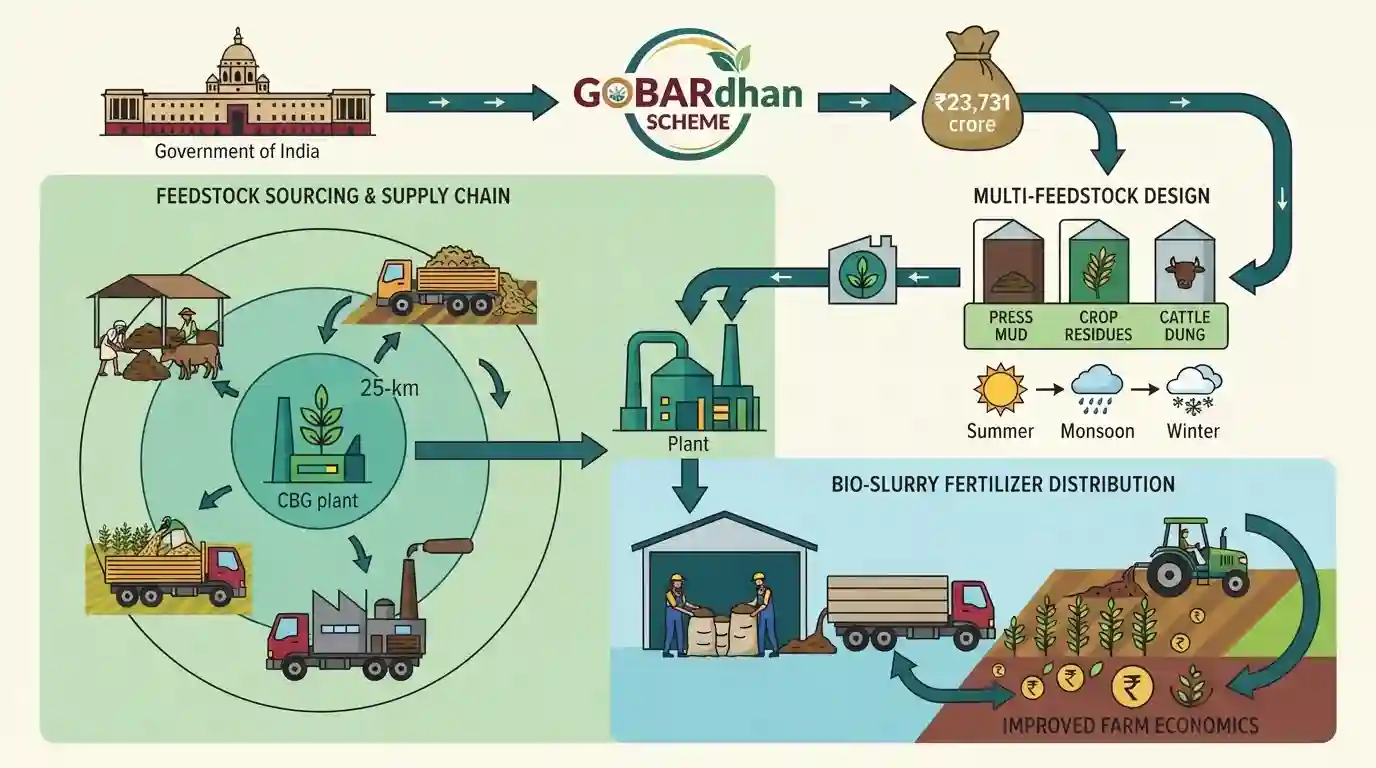
The scaling of India's Compressed Biogas (CBG) ecosystem, recently boosted by the revamped GOBARdhan scheme's ₹23,731 crore outlay, heavily relies on efficient feedstock sourcing and management. Addressing supply chain challenges associated with seasonal availability, moisture content, and transportation requires localized sourcing within a 25-km radius and leveraging aggregator models. Utilizing multi-feedstock designs—processing press mud, crop residues, and cattle dung—will ensure year-round viability for CBG plants. Furthermore, returning the resulting bio-slurry to farmers as organic fertilizer integrates agricultural waste management with sustainable energy production and improved farm economics.
મુખ્ય મુદ્દા
- The revamped GOBARdhan scheme with a ₹23,731 crore outlay aims to increase Compressed Biogas (CBG) production nearly tenfold by 2036.
- Scaling the CBG ecosystem depends critically on robust feedstock sourcing, storage, and management, overcoming challenges like high moisture content, perishability, and seasonal supply.
- Common feedstocks include press mud, agricultural residues (paddy/wheat straw), and cattle dung. Gas yields vary, with agricultural residues yielding around 10% compared to 6% for cow dung.
- Experts recommend sourcing feedstock within a 25-km radius and utilizing aggregator models to minimize transport costs and connect farmers with CBG plants.
- Multi-feedstock plant designs improve resilience against seasonal fluctuations, and the process produces bio-slurry that serves as a valuable organic fertilizer for farmers.
મહત્વપૂર્ણ શબ્દો
GOBARdhan Scheme

A national circular bioenergy scheme that transforms agricultural residues, cattle dung, and other organic wastes into clean biogas fuel and organic manure.
UPSC context
GS Paper 3: Government Policies and Renewable Energy. Tests initiatives promoting circular bioeconomy and waste-to-wealth.
Compressed Biogas (CBG)
A renewable, purified gaseous fuel produced by anaerobic digestion of organic waste, structurally similar to natural gas and serving as a green CNG alternative.
UPSC context
GS Paper 3: Environment, Energy, and Science. Tests alternatives to imported fossil fuels and climate-mitigation technologies.
SATAT Initiative
A strategic government initiative launched to promote Compressed Biogas (CBG) production and encourage its commercial use as a green transport fuel.
UPSC context
GS Paper 3: Infrastructure and Economic Development. Tests strategic programs aiming to reduce oil imports and decarbonize transportation.
Indian Biogas Association (IBA)
A nationwide professional organization of biogas industry stakeholders dedicated to advocating for, training in, and promoting sustainable bioenergy technology across India.
UPSC context
GS Paper 3: Environmental Conservation. Tests the role of civil/professional organizations in shaping energy transition and agricultural policy.
Bio-slurry
The nutrient-rich, organic by-product of anaerobic digestion in biogas plants, used as high-quality agricultural fertilizer to restore soil fertility.
UPSC context
GS Paper 3: Agriculture and Circular Economy. Tests understanding of organic farming, sustainable fertilizers, and recycling agricultural waste.
પ્રિલિમ્સ ટ્રેપ
The revamped GOBARdhan circular bioenergy scheme is administered by the Ministry of Jal Shakti or MNRE.
While GOBARdhan originally launched under Jal Shakti's Swachh Bharat Mission-Gramin, the newly revamped ₹23,731-crore circular bioenergy scheme is under the Ministry of Petroleum and Natural Gas (MoPNG).
સંલગ્ન સ્થિર ખ્યાલો
How does Compressed Biogas (CBG) differ from conventional Biogas?
- Methane enrichment: Purified to contain over 90% methane, compared to 55-60% in raw biogas, making it compositionally identical to CNG.
- Physical state: CBG is compressed at high pressure (around 200-250 bar) to facilitate cylinder storage and automotive/industrial use, unlike low-pressure raw biogas.
- Byproduct utility: Produces Fermented Organic Manure (FOM) as a nutrient-rich byproduct, which retains more nitrogen than traditional open composting.
What is the SATAT initiative and its core objective?
- Nodal ministry: Launched in 2018 by the Ministry of Petroleum and Natural Gas (MoPNG) to promote Compressed Biogas.
- Offtake guarantee: Enables entrepreneurs to establish CBG plants and sell produced gas to Oil Marketing Companies (OMCs) under commercial agreements.
- Socio-economic benefits: Aims to reduce natural gas import bills, manage agricultural waste like stubble, and generate rural entrepreneurship opportunities.
આંતર-વિષય પેટર્ન
CBG as an air quality solution
Sourcing paddy straw feedstock for CBG plants directly reduces stubble burning in Northern India, linking clean energy policy with National Clean Air Programme (NCAP) targets.
Bio-slurry and fertilizer subsidy rationalization
Substituting chemical fertilizers with CBG-derived Fermented Organic Manure reduces the fiscal burden of India's urea subsidies while promoting soil organic carbon.

Expect a multi-statement question testing revamped GOBARdhan nodal ministry (MoPNG), CBG methane purity standards, and bio-slurry vs urea.
સંલગ્ન PYQ · 4
સંલગ્ન PYQ · 4
- 2024PrelimsGS1
Consider the following materials: 1. Agricultural residues 2. Corn grain 3. Wastewater treatment sludge 4. Wood mill waste Which of the above can be used as feedstock for producing Sustainable Aviation Fuel?
- 2024PrelimsGS1
Consider the following: 1. Battery storage 2. Biomass generators 3. Fuel cells 4. Rooftop solar photovoltaic units How many of the above are considered "Distributed Energy Resources"?
- 2023MainsGS3
Discuss several ways in which microorganisms can help in meeting the current fuel shortage.
- 2022MainsGS3
Each year a large amount of plant material, cellulose, is deposited on the surface of Planet Earth. What are the natural processes this cellulose undergoes before yielding carbon dioxide, water and other end products ?
