H-1B Visa Fee Hike and Impact on Global Talent Mobility from India
Source:Indian Express ↗
Why It Matters
The potential $100,000 fee on H-1B visas highlights a significant non-tariff barrier to India's service exports and directly affects the Indian diaspora. It forces UPSC aspirants to critically analyze the changing nature of globalization, the structural challenges facing the Indian IT sector, and the evolving geopolitical dynamic between India and the US.
Summary
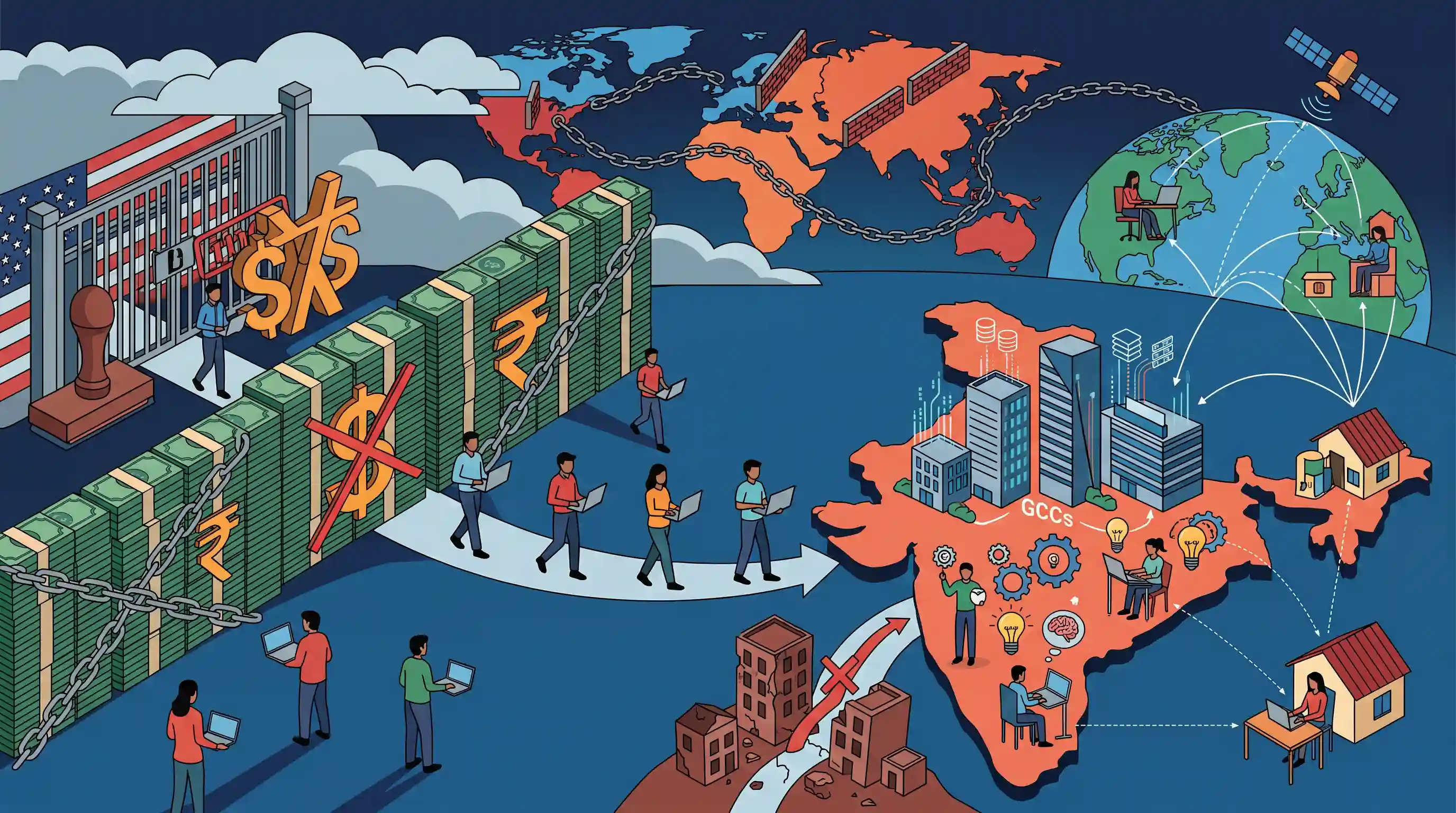
The proposal to impose a staggering $100,000 fee on H-1B visas signals a paradigm shift towards stringent protectionism in global talent mobility. This move will significantly impact Indian IT firms that have historically relied on labor cost arbitrage and on-site deployment of engineers in the United States. The article argues that India must prepare for an era where the cross-border mobility of skilled professionals becomes prohibitively expensive. To adapt, the Indian technology sector must pivot from traditional operating models towards building high-value intellectual property, expanding Global Capability Centers (GCCs) within India, and leveraging remote work models. Ultimately, the development underscores the broader challenges India faces in navigating deglobalization and restrictive immigration policies in developed economies.
Key Points
- **Rise of Protectionism:** The proposed $100,000 fee on H-1B visas reflects a broader global trend of deglobalization, where developed nations are increasingly erecting barriers to immigration and talent mobility.
- **Threat to the IT Business Model:** The traditional operating model of Indian IT firms, which heavily relies on deploying software engineers on-site in the US, is severely challenged by such prohibitive visa costs.
- **Non-Tariff Barrier to Services:** The exorbitant fee acts as a de facto non-tariff barrier restricting India's trade in services (specifically Mode 4: movement of natural persons).
- **Need for a Strategic Pivot:** The Indian technology sector must shift away from cost-arbitrage and body-shopping towards high-value intellectual property creation, advanced consulting, and localized hiring in target markets.
- **Potential Boost for Domestic Ecosystem:** Costlier mobility may inadvertently benefit India by retaining top talent domestically, accelerating the establishment of Global Capability Centers (GCCs), and promoting remote, cross-border service delivery.
Important Terms
H-1B Visa Program

A US non-immigrant visa allowing employers to hire foreign workers in 'specialty occupations' requiring advanced expertise. It is the primary vehicle for Indian tech professionals to work in the United States.
UPSC context
GS Paper II: International Relations and Diaspora. Tests understanding of human capital mobility and its impact on India-US bilateral ties.
WTO GATS - Mode 4
One of four service delivery modes under the WTO's General Agreement on Trade in Services, specifically governing the temporary cross-border movement of 'natural persons' to provide services.
UPSC context
GS Paper III: Indian Economy and WTO. Tests knowledge of international trade frameworks and India’s advocacy for liberalized skilled professional movement.
Global Capability Centers (GCCs)
Captive offshore units established by multinational corporations to perform core business functions like R&D and innovation internally, rather than outsourcing to third-party vendors.
UPSC context
GS Paper III: Economy and Technology. Tests the evolution of the Indian IT sector from back-office support to high-value innovation hubs.
US Citizenship and Immigration Services (USCIS)
The federal agency within the US Department of Homeland Security responsible for overseeing lawful immigration, processing work visas, and implementing H-1B regulations and fee structures.
UPSC context
GS Paper II: International Relations. Relevant for understanding the institutional framework governing Indian professional migration and diaspora welfare.
Labor Cost Arbitrage
An economic strategy where companies exploit the wage difference between countries by hiring labor from lower-cost regions to increase profit margins.
UPSC context
GS Paper III: Indian Economy. Tests understanding of the traditional Indian IT business model and its vulnerability to restrictive global immigration policies.
Protectionism
Economic policies that restrict international trade through methods like high fees, tariffs, or quotas to help domestic industries and workers against foreign competition.
UPSC context
GS Paper III: Economy and Globalization. Tests awareness of deglobalization trends and their impact on India's export-oriented services sector.
Prelims Trap
H-1B visa restrictions violate India's service export rights under GATS Mode 1 (cross-border supply).
H-1B visa issues fall strictly under Mode 4 (presence of natural persons). Mode 1 refers to cross-border supply (e.g., remote BPO work) where the provider does not physically move.
Static Concepts Connected
What are the four modes of services supply under WTO's GATS?
- Mode 1: Cross-border supply (e.g., remote IT/BPO services without physical movement of people).
- Mode 2: Consumption abroad (e.g., medical tourism or foreign students studying in India).
- Mode 3: Commercial presence (e.g., a foreign bank or tech firm opening a subsidiary branch).
- Mode 4: Presence of natural persons (e.g., Indian software engineers travelling abroad on H-1B visas).
What distinguishes Global Capability Centers (GCCs) from traditional BPOs?
- Ownership structure: GCCs are wholly-owned offshore subsidiaries of MNCs, unlike BPOs which are often third-party outsourcing vendors.
- Value chain: GCCs focus on core R&D, innovation, and high-value IP creation, moving away from simple low-cost back-office processing.
Cross-Topic Patterns
GATS Mode 4 + Non-Tariff Barriers
Visa fees are increasingly weaponized as non-tariff barriers, directly linking immigration policy to global trade disputes and WTO negotiations.
Brain Drain reversal + GCC boom
Restrictive Western visa regimes inadvertently accelerate India's demographic dividend utilization by retaining top talent domestically to fuel high-value R&D hubs.

Expect a Prelims question mapping GATS modes, or a Mains question linking Western visa NTBs to India's domestic GCC and IP-creation boom.
Linked PYQs · 4
Linked PYQs · 4
- 2020MainsGS2
Indian diaspora has a decisive role to play in the politics and economy of America and European Countries'. Comment with examples.
- 2023MainsGS2
Indian diaspora has scaled new heights in the West. Describe its economic and political benefits for India.
- 2019MainsGS2
‘What introduces friction into the ties between India and the United States is that Washington is still unable to find for India a position in its global strategy, which would satisfy India's national self-esteem and ambitions.’ Explain with suitable examples.
- 2025MainsGS3
What are the challenges before the Indian economy when the world is moving away from free trade and multilateralism to protectionism and bilateralism? How can these challenges be met?
