Indian Grey Hornbill Returns To Gir Landscape After Decades
Source:indianmasterminds ↗
આ શા માટે મહત્વનું છે
Understanding the reintroduction of extirpated species highlights the success of scientific wildlife management and the ecological significance of key seed-dispersing species (like hornbills) in maintaining forest health. It demonstrates successful state-led conservation practices relevant to environmental and geographic studies in civil services examinations.
સારાંશ
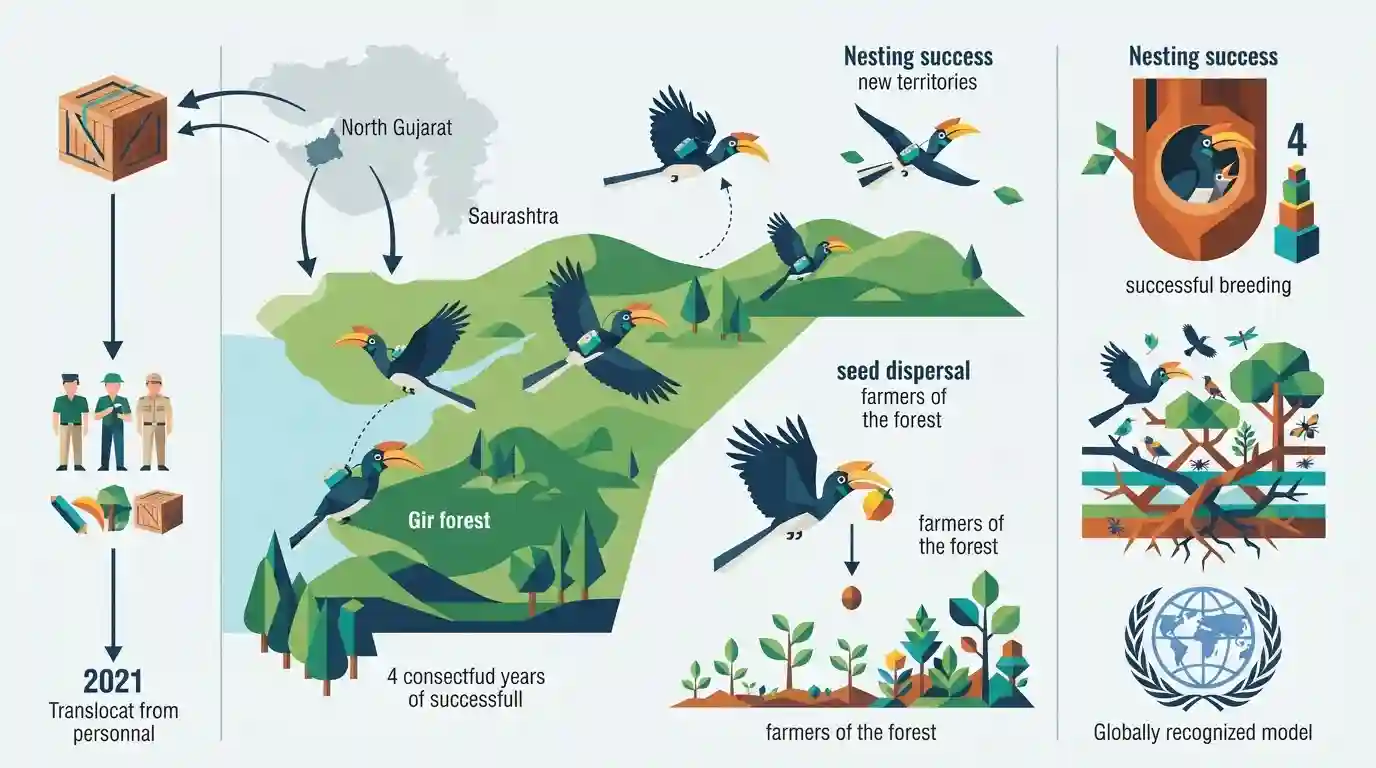
The article details the extraordinary return of the Indian Grey Hornbill to Gujarat's Gir landscape after more than six decades of absence. Driven by a scientifically planned translocation programme by the Gujarat Forest Department starting in 2021, 40 hornbills were carefully reintroduced from North Gujarat into the Saurashtra region. Outfitted with satellite transmitters for close monitoring, these birds have expanded their territory and nested successfully for four consecutive years. The restoration of this key species, known as the 'farmers of the forest', revives vital seed dispersal mechanisms that sustain the local ecosystem, marking a globally recognized model for wildlife species restoration in India.
મુખ્ય મુદ્દા
- The Indian Grey Hornbill has been successfully reintroduced and has bred for four consecutive years in the Gir landscape of Gujarat after a 60-year absence.
- The Gujarat Forest Department launched the reintroduction programme in 2021, scientifically translocating 40 hornbills from similar ecological habitats in North Gujarat.
- Monitoring via satellite transmitters and field trackers revealed that the birds have adapted to the wild, actively nesting in natural tree cavities such as *Sterculia urens* and *Terminalia bellirica*.
- Referred to as 'farmers of the forest', hornbills play a critical ecological role in natural seed dispersal and the regeneration of forest ecosystems.
- The successful conservation milestone joins other wildlife efforts in the state, such as the survival of a Great Indian Bustard chick through the 'jump-start' technique.
મહત્વપૂર્ણ શબ્દો
Indian Grey Hornbill

A tropical bird (Ocyceros birostris) native to the Indian subcontinent, classified as 'Least Concern' by IUCN. It recently bred successfully in Gujarat's Gir forest following a historic reintroduction program after a 60-year local extinction.
UPSC context
Tests Prelims Environment/Ecology knowledge on species-in-news, IUCN conservation status, and local extinction recoveries.
Gujarat Forest Department
The state government authority responsible for managing and protecting Gujarat's forests and wildlife. It spearheaded the scientifically planned 2021 translocation of 40 Indian Grey Hornbills from the Aravalli forests to Gir.
UPSC context
Relevant for GS Paper 3 (Conservation); highlights the role of state institutional frameworks in successful wildlife recovery programs.
Species Translocation
The deliberate, scientifically guided capture and transfer of animals from one habitat to another. In this project, hornbills were moved from Gujarat's Aravalli forests to the ecologically similar Gir landscape to restore a lost population.
UPSC context
Crucial for GS Paper 3 (Biodiversity). Tests understanding of active conservation strategies, ecosystem restoration, and rewilding techniques.
Farmers of the Forest
An ecological sobriquet for hornbills, reflecting their vital role as apex frugivores. By consuming large fruits and dispersing seeds over long distances, they facilitate natural forest regeneration and maintain plant biodiversity.
UPSC context
Important for Prelims and GS3 (Environment). Tests knowledge of ecological niches, keystone species, and seed dispersal mechanisms.
Gir Landscape
A protected dry deciduous forest region in Gujarat's Saurashtra peninsula. Globally renowned as the last refuge of the Asiatic Lion, it is now celebrated for successfully sustaining the reintroduced Indian Grey Hornbill population.
UPSC context
Tests Geography and Environment mapping for Prelims, specifically protected areas, ecosystem types, and associated flagship/reintroduced species.
Satellite Telemetry
The use of space-based satellite transmitters to track animal movements. Forest officials attached these devices to male hornbills in Gir to study habitat use, ranging patterns, and breeding behavior without disturbing nesting females.
UPSC context
Covers GS3 (Science & Technology / Environment), illustrating the application of modern tracking technology in wildlife monitoring and conservation.
પ્રિલિમ્સ ટ્રેપ
The Indian Grey Hornbill is an endangered species endemic to the wet evergreen rainforests of the Western Ghats and Northeast India.
UPSC often exploits confusion between the endemic/threatened rain forest species (like Malabar Grey or Great Hornbill) and the highly adaptable, widely distributed Indian Grey Hornbill (Least Concern), which thrives in dry deciduous forests and urban plains.
સંલગ્ન સ્થિર ખ્યાલો
What is the ecological significance and unique breeding behavior of Hornbills?
- Seed Dispersal: Known as 'farmers of the forest' due to their critical role in dispersing seeds of large canopy trees over long distances.
- Nesting Dependency: They are obligate cavity-nesters, meaning they rely on natural hollows in mature trees (such as Sterculia or Terminalia species) to breed.
- Symbiotic Breeding: The female seals herself inside the cavity using mud and feces during incubation, shedding feathers and relying entirely on the male to feed her through a slit.
What is Karaya Gum and what is its economic significance?
- Source: It is a natural gum exuded from the trunk of Sterculia urens (Ghost Tree), a tree native to dry deciduous forests of India.
- Industrial Uses: Highly valued as a thickener, laxative, and stabilizer in food, cosmetics, and pharmaceuticals.
- Livelihood Value: Classified as a Minor Forest Produce (MFP), providing critical dry-season livelihoods to tribal communities in central and western India.
આંતર-વિષય પેટર્ન
Botanical Integrity and Avian Restoration
Reintroducing native canopy-dwellers requires specific old-growth cavity trees (like Sterculia urens), proving that botanical conservation is a prerequisite for successful avian repatriation.
Hybrid Conservation in Avian Bottlenecks
The Kutch GIB 'jump-start' strategy bridges ex-situ egg harvesting with in-situ wild fostering, establishing a new operational template for managing critically endangered avian bottlenecks.

Distinction between Least Concern Indian Grey Hornbill and Vulnerable Great Hornbill's habitats likely to feature in UPSC ecological MCQs.
સંલગ્ન PYQ · 2
સંલગ્ન PYQ · 2
- 2026GPSC_PRELIMSGS1
The 'Great Indian Bustard (GIB)' (Ghorad) is frequently seen in the news in the context of wildlife conservation efforts in western India. Consider the following statements regarding this species: 1. Currently, the highest surviving wild population of the Great Indian Bustard in India is located in the semi-arid grasslands of Gujarat. 2. It is a long-distance migratory bird that travels from Central Asia to the Indian subcontinent to escape harsh winters. Which of the above statement(s) is/are correct?
- 2022GPSC_PRELIMSGS1
Which garden of Gujarat has the trees and plants of rare species?
