Petrodollar Hegemony and Global De Dollarisation Trends
Source:The Hindu ↗
Why It Matters
Understanding the 'petrodollar' system and the structural forces of 'de-dollarisation' is crucial for UPSC aspirants. It links geopolitics (US-China rivalry, sanctions on Russia/Venezuela), international trade (currency internationalisation), and environmental transitions (EVs), making it highly relevant for GS2 (IR) and GS3 (Economy/Environment).
Summary
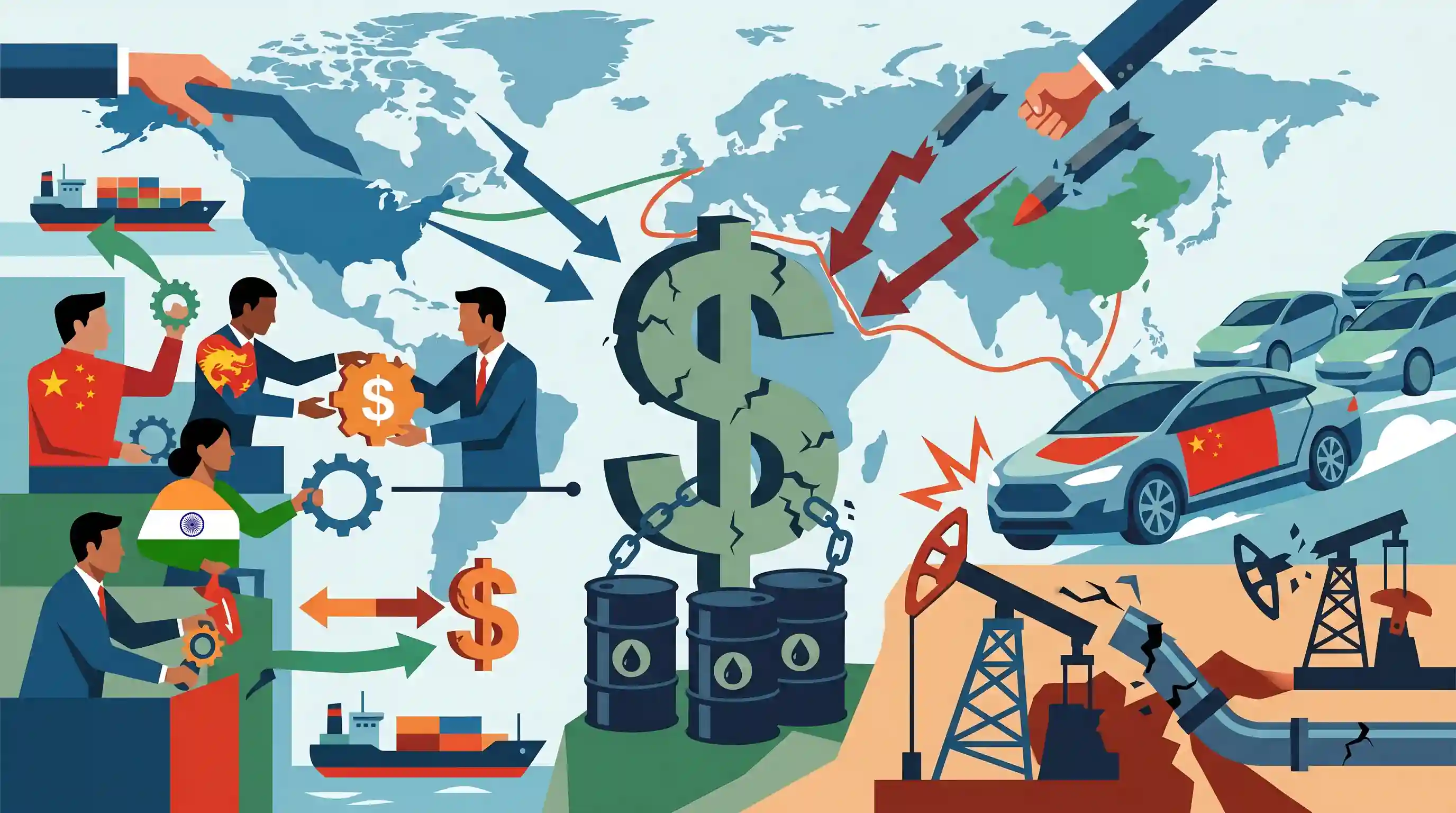
The article analyzes recent aggressive US policies, such as the proposed Russia Sanctions Bill and the capture of Venezuelan President Nicolas Maduro, as attempts to defend the global hegemony of the 'petrodollar'. However, this dominance is increasingly threatened by two major global shifts. First, major energy consumers like China and India are bypassing the dollar to trade in local currencies, while the BRICS bloc explores parallel financial architectures. Second, the rapid global transition to electric vehicles (EVs), heavily led by China, is structurally diminishing the world's reliance on oil. Together, de-dollarisation and the clean energy transition pose a historic challenge to the US-led architecture of global trade and finance.
Key Points
- The US is taking aggressive actions, such as imposing severe sanctions on Russian oil buyers and capturing the Venezuelan President, to safeguard its 'petrodollar' hegemony.
- Major energy importers like China and India are increasingly settling oil trade in non-dollar currencies (such as the yuan, ruble, and rupee) to bypass US financial systems.
- The BRICS bloc's consideration of a parallel currency arrangement directly challenges the established US-dominated global financial architecture.
- The rapid global transition to electric vehicles (EVs), heavily dominated by China, fundamentally threatens the long-term strategic reliance on oil, undermining the foundation of the petrodollar itself.
Important Terms
Petrodollar System

The system where global oil trade is priced and settled exclusively in US dollars, established in the 1970s to ensure consistent global demand for the dollar.
UPSC context
GS Paper II (International Relations) and GS Paper III (Economy); explores US hegemony and global reserve currency dynamics.
De-dollarisation
A strategic process where nations reduce their reliance on the US dollar for international trade, foreign exchange reserves, and financial settlements to enhance economic sovereignty.
UPSC context
GS Paper III (Economy); tests knowledge of international trade, currency internationalization, and India's 'Vostro' account initiatives.
BRICS
A group of emerging economies (Brazil, Russia, India, China, South Africa, and expanded members) developing parallel financial systems to challenge Western-led institutions.
UPSC context
GS Paper II (International Relations); focuses on multilateral groupings and their impact on India’s strategic autonomy.
Sanctioning Russia Act of 2025
A 2025 US legislative proposal (S. 1241) to impose 500% tariffs on countries importing Russian energy, effectively using the dollar as a geopolitical tool.
UPSC context
GS Paper II (International Relations); involves 'weaponization of finance' and secondary sanctions affecting India's trade.
Global Financial Architecture
The framework of rules and institutions (e.g., IMF, SWIFT) governing global capital flows, currently facing structural shifts from unipolarity to multipolarity.
UPSC context
GS Paper II (International Relations); tests understanding of global governance reforms and the rise of non-Western institutions.
Energy Transition
The structural shift from fossil fuels to renewables and EVs, which reduces oil demand and erodes the petrodollar’s foundation.
UPSC context
GS Paper III (Environment/Economy); covers EV adoption, climate goals, and their geopolitical ramifications.
Prelims Trap
The Petrodollar system was established under a formal Bretton Woods agreement mandating oil trade in US dollars.
The petrodollar system is not a formal treaty; it originated from an informal 1970s agreement between the US and Saudi Arabia to price oil exclusively in USD.
Static Concepts Connected
How does local currency settlement (e.g., Rupee-Ruble trade) function?
- Vostro Accounts: A domestic bank opens a Special Rupee Vostro Account (SRVA) for a correspondent foreign bank.
- Settlement Mechanism: Indian importers pay in INR into the Vostro account; Indian exporters are paid from this same account, entirely bypassing the US dollar.
- Trade Deficit Hurdle: It reduces forex risk but faces hurdles if trade deficits cause massive local currency accumulation (e.g., Russia holding excess unusable INR).
What is the SWIFT system and how does it enforce sanctions?
- Messaging Network: SWIFT is a secure global messaging network used by banks to transmit instructions, not a fund transfer system itself.
- Sanctions Leverage: Though based in Belgium, US influence over the global financial system forces SWIFT to disconnect targeted nations, effectively freezing them out of international trade.
- Strategic Alternatives: Systems like Russia's SPFS, China's CIPS, and the proposed BRICS Pay aim to create parallel networks to bypass SWIFT dependency.
Cross-Topic Patterns
EV transition as a geopolitical weapon
The shift to EVs is not just a climate GS-3 topic; it fundamentally dismantles the petrodollar system by drastically reducing the global volume of oil-for-dollar transactions.
Sanctions accelerating financial multipolarity
US weaponization of finance pushes neutral nations like India to accelerate alternate financial mechanisms (e.g., Vostro accounts), merging GS-2 strategic autonomy with GS-3 macroeconomics.

BRICS alternate payments + SWIFT weaponisation + EV impact on the petrodollar is prime for a multi-statement Prelims 2026 question.
Linked PYQs · 4
Linked PYQs · 4
- 2021MainsGS2
“The USA is facing an existential threat in the form of a China, that is much more challenging than the erstwhile Soviet Union.” Explain.
- 2024PrelimsGS1
Consider the following statements : Statement-I : Recently, Venezuela has achieved a rapid recovery from its economic crisis and succeeded in preventing its people from fleeing/emigrating to other countries. Statement-II : Venezuela has the world's largest oil reserves. Which one of the following is correct in respect of the above statements?
- 2023PrelimsGS1
About three-fourths of world's cobalt, a metal required for the manufacture of batteries for electric motor vehicles, is produced by
- 2025MainsGS3
What are the challenges before the Indian economy when the world is moving away from free trade and multilateralism to protectionism and bilateralism? How can these challenges be met?
