India Relaxes FDI Rules to Allow Marginal Chinese Stakes
Source:The Hindu ↗
આ શા માટે મહત્વનું છે
The article highlights a critical shift in India's foreign investment policy, balancing national security concerns regarding Chinese investments with the economic imperative of attracting global capital and improving the ease of doing business.
સારાંશ
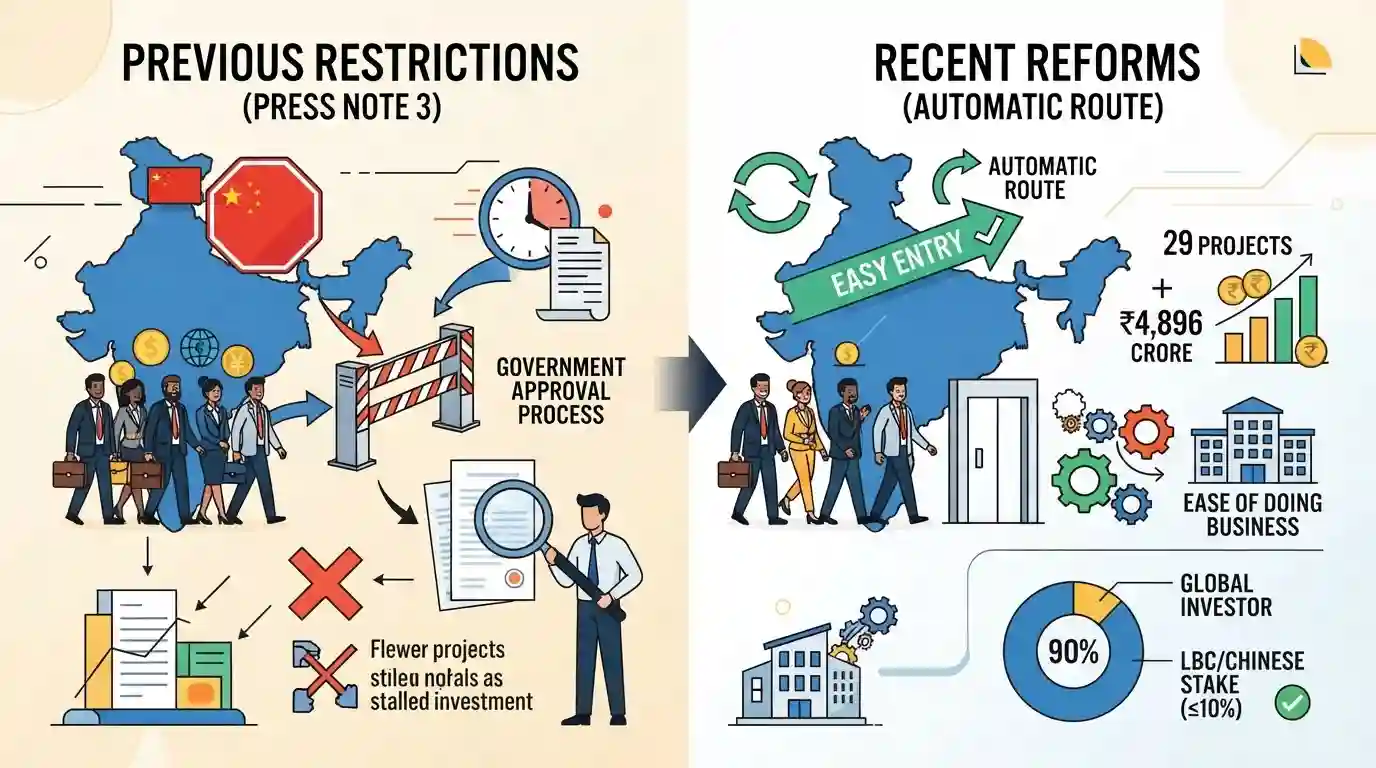
India's recent easing of Foreign Direct Investment (FDI) rules has facilitated 29 projects worth ₹4,896 crore by allowing up to 10% ownership by entities from Land Border Countries (LBCs) under the automatic route. This amends the restrictive Press Note 3 of 2020, which previously mandated government approval for any LBC beneficial ownership, primarily targeting China. The reform aims to enhance the ease of doing business by reducing regulatory delays for global investors with marginal Chinese stakes.
મુખ્ય મુદ્દા
- In March 2026, India amended its FDI policy to allow investments with up to 10% beneficial ownership from Land Border Countries (LBCs) via the automatic route.
- This shift relaxes the stringent Press Note 3 of 2020, which required mandatory government approval for any FDI with LBC linkages to prevent opportunistic takeovers.
- Since the amendment, 29 FDI proposals worth ₹4,895.65 crore have been facilitated from countries like Mauritius, the U.S., and Singapore that had marginal LBC stakes.
- The move is designed to improve the ease of doing business, reduce transaction times, and provide regulatory certainty.
- Only one direct Chinese FDI proposal worth ₹1 crore was approved in FY26, alongside 13 from Hong Kong.
મહત્વપૂર્ણ શબ્દો
Press Note 3 of 2020

A 2020 regulation mandating prior government approval for all Foreign Direct Investment (FDI) from nations sharing a land border with India, primarily aimed at preventing opportunistic takeovers by Chinese entities.
UPSC context
GS Paper 3 (Economy). Tests the intersection of national security, foreign policy, and economic regulation.
Foreign Direct Investment (FDI)
An investment made by a foreign individual or entity into the productive assets or business operations of another country, establishing a lasting interest and managerial influence.
UPSC context
GS Paper 3 (Investment Models). Essential for understanding balance of payments, capital flows, and economic growth.
Automatic Route
An FDI pathway allowing foreign investors to invest in Indian companies without prior approval from the government or the Reserve Bank of India, subject to sectoral caps and subsequent reporting.
UPSC context
GS Paper 3 (Economy). Tests awareness of regulatory frameworks, economic liberalization, and ease of doing business.
Land Border Countries (LBCs)
The seven nations sharing a land border with India: China, Pakistan, Bangladesh, Nepal, Bhutan, Myanmar, and Afghanistan. Investments originating from these nations face stricter FDI regulations due to security concerns.
UPSC context
GS Paper 2 (International Relations). Connects India's neighborhood first policy with strategic economic safeguards.
Beneficial Ownership
The individual or group that ultimately owns, controls, or financially benefits from a corporate entity or investment, even if legal title is registered under a proxy or shell company.
UPSC context
GS Paper 3 (Money Laundering). Crucial for corporate governance, transparency, and the Prevention of Money Laundering Act.
પ્રિલિમ્સ ટ્રેપ
Direct investments from Land Bordering Countries up to 10% are now permitted under the automatic route.
The 10% relaxation applies ONLY to indirect beneficial ownership. Direct investments from LBCs like China still require mandatory government approval regardless of the investment size.
સંલગ્ન સ્થિર ખ્યાલો
What are the primary routes and restrictions for Foreign Direct Investment (FDI) in India?
- Automatic Route: No prior RBI or government approval is needed by foreign investors for specific sectors up to permitted limits.
- Government Route: Prior approval from the respective Ministry or Department is required via the Foreign Investment Facilitation Portal (FIFP).
- Prohibited Sectors: FDI is strictly banned in lottery, gambling, chit funds, atomic energy, and railways (except specific infrastructure projects).
How is 'Beneficial Ownership' defined under India's financial regulatory framework?
- PMLA Definition: Identifies the ultimate natural person who exercises effective control or ownership over a corporate entity or legal arrangement.
- 10% Threshold: Under PMLA Rules (and now FDI policy), beneficial ownership is triggered at a 10% holding of shares, voting rights, or profit entitlement.
આંતર-વિષય પેટર્ન
FDI integration with PMLA rules
Aligning FDI 'Beneficial Owner' benchmarks with the Prevention of Money Laundering Act highlights the convergence of corporate ease-of-doing-business reforms with national security oversight.
Geopolitics vs. Electronics supply chain
The fast-track clearance for LBC capital in critical sectors (polysilicon, electronics) shows India balancing strategic decoupling from China with acute manufacturing capital needs.

Expect a multi-statement question contrasting Press Note 3 (2020) LBC restrictions with the new 10% indirect beneficial ownership rule.
સંલગ્ન PYQ · 3
સંલગ્ન PYQ · 3
- 2021PrelimsGS1
Consider the following : 1. Foreign currency convertible bonds 2. Foreign institutional investment with certain conditions 3. Global depository receipts 4. Non-resident external deposits Which of the above can be included in Foreign Direct Investments?
- 2016MainsGS3
Justify the need for FDI for the development of the Indian economy. Why there is gap between MOUs signed and actual FDIs? Suggest remedial steps to be taken for increasing actual FDIs in India.
- 2012MainsGS2
Do you think that China's emergence as one of the largest trading partners of India has adversely affected the settlement of the outstanding border problem?
