Statewide FDA Action Targets Food Adulteration and Analogue Paneer
Source:The Hindu ↗
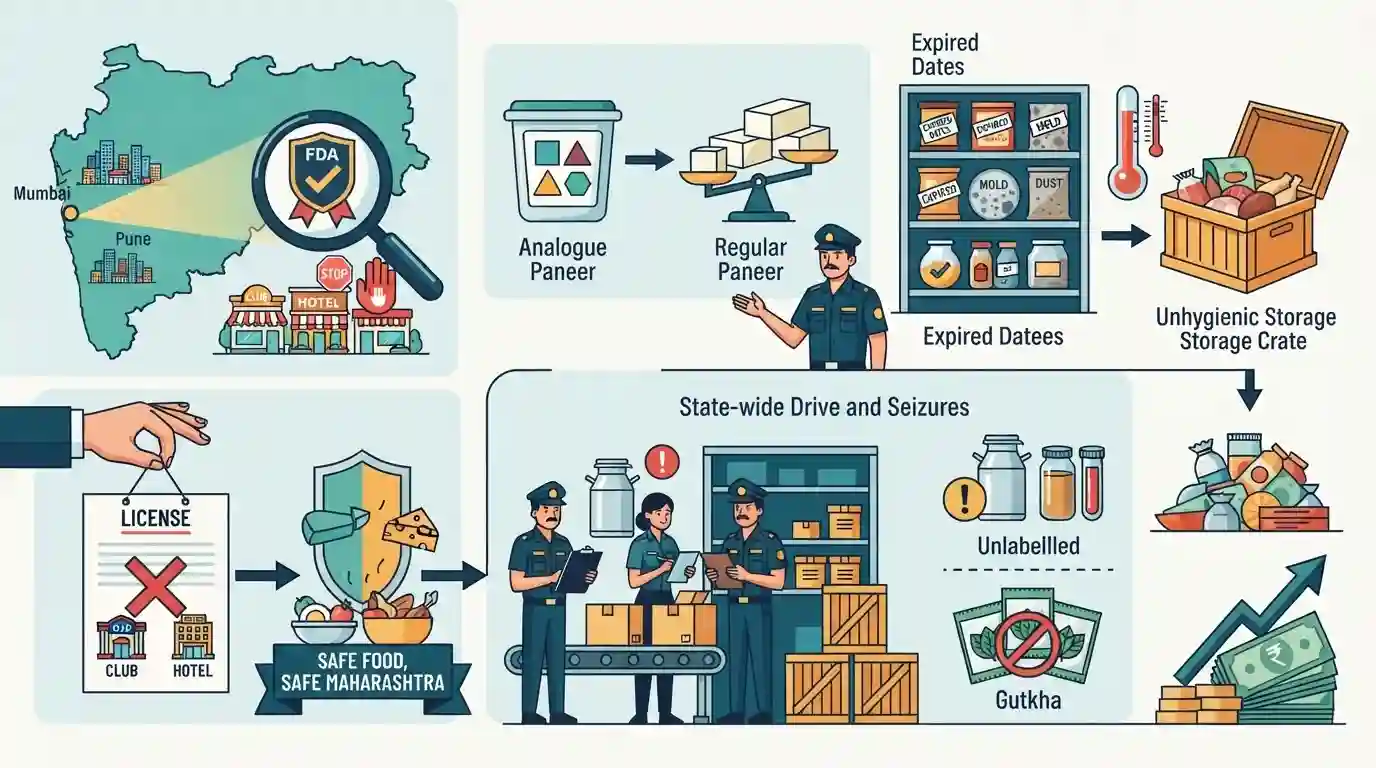
Why It Matters
Food adulteration and breaches in hygiene standards pose critical public health challenges. Recognizing enforcement drives by state authorities underscores the role of regulatory bodies like the FSSAI and FDA in ensuring food safety, an important topic for governance and consumer protection dimensions in the syllabus.
Summary
The Maharashtra Food and Drug Administration (FDA) has intensified its crackdown on food establishments across the state, suspending the licenses of prominent venues like Mumbai's Otters Club and Hotel Chul Mutton in Pune over multiple food safety violations. The suspensions result from the ongoing "Safe Food, Safe Maharashtra" campaign, launched to enforce stringent hygiene standards under the Food Safety and Standards regulations. Specific violations included the sale of proprietary analogue paneer passed off as regular paneer, the presence of expired ingredients, unhygienic storage, and improper temperature control. The state-wide drive has also led to the interception and seizure of adulterated dairy products, unlabelled items, and banned substances such as gutkha, amounting to seizures worth ₹1.07 crore.
Key Points
- The Maharashtra FDA suspended the food license of Mumbai's prominent Otters Club and several other establishments over alleged food safety violations, including the use of analogue paneer.
- The actions are part of the ongoing statewide “Safe Food, Safe Maharashtra” drive initiated by the FDA between July 14 and August 17, 2026.
- The targeted establishments violated Schedule 4 of the Food Safety and Standards regulations, encompassing poor hygiene, inadequate temperature control, and the absence of FSSAI registration display.
- In addition to suspending licenses, FDA authorities intercepted illegal consignments, such as unlabelled colostrum, expired cumin, banned gutkha, and pan masala.
- During the period, banned and unhygienic food products worth approximately ₹1.07 crore were seized by the FDA across the state.
Important Terms
Food Safety and Standards Authority of India (FSSAI)

A statutory body under the Ministry of Health and Family Welfare, responsible for protecting and promoting public health through the regulation and supervision of food safety in India.
UPSC context
Essential for MPSC GS Paper 2 (Statutory Bodies) and GS Paper 3 (Food Security), testing regulatory frameworks.
Food and Drug Administration (FDA) Maharashtra
The state-level regulatory authority responsible for enforcing food safety, drug, and cosmetic regulations across Maharashtra, ensuring product quality, hygiene standards, and public health compliance.
UPSC context
Crucial for MPSC GS Paper 2 (State Administration), highlighting the enforcement of public health regulations and consumer protection.
Safe Food, Safe Maharashtra drive
A statewide enforcement campaign by the Maharashtra FDA to ensure food hygiene, curb adulteration like analogue paneer, and crack down on illegal substances across food establishments.
UPSC context
Relevant for MPSC GS Paper 3 (Health/Food Security) and state current affairs, testing knowledge of state-specific governance initiatives.
Food Safety and Standards Regulations
Comprehensive rules enacted under the Food Safety and Standards Act, detailing mandatory hygiene protocols, precise labeling norms, and manufacturing standards to prevent food adulteration and misrepresentation.
UPSC context
Important for MPSC GS Paper 2 (Governance) and GS Paper 3 (Food Processing Industries), focusing on legal compliance.
Prelims Trap
"FSSAI is a statutory body under the Ministry of Consumer Affairs, Food and Public Distribution."
Despite dealing with food products, FSSAI operates under the Ministry of Health and Family Welfare. Aspirants often logically but incorrectly assume Consumer Affairs.
Static Concepts Connected
What is Analogue Paneer and how is it chemically detected?
- Composition: Manufactured by replacing natural milk fat with cheaper vegetable oils, starches, and emulsifiers, making it a synthetic substitute.
- Health Impact: Lacks dairy protein and calcium; significantly higher in harmful trans-fats compared to authentic dairy.
- Iodine Test: Adding iodine solution to the boiled extract turns it blue or blue-black, confirming the presence of cheap starch.
What is the regulatory framework governing FSSAI and food safety?
- Statutory basis: Established as an autonomous statutory body under the Food Safety and Standards Act (FSSA), 2006.
- Mandate: Consolidated 8 older laws (like the Prevention of Food Adulteration Act, 1954) to shift from reactive anti-adulteration to preventive safety.
- Enforcement Mechanism: While FSSAI sets the science-based standards nationally, enforcement (like the recent Maharashtra crackdown) is executed by State Food and Drug Administrations (FDAs).
Cross-Topic Patterns
Trans-fats and NCD burden
Analogue dairy products rely heavily on hydrogenated vegetable oils. This links food adulteration directly to cardiovascular diseases and India's commitment to WHO’s REPLACE trans-fat elimination targets.
Governance of Food Quality vs. Security
Food safety (Health Ministry/FSSAI) is distinct from food distribution (Consumer Affairs). Initiatives like fortified rice in PDS schemes test the regulatory coordination between these two distinct government wings.

Expect multi-statement questions combining FSSAI's nodal ministry (Health) with chemical detection methods for common food adulterants.
Linked PYQs · 3
Linked PYQs · 3
- 2014MPSC_PRELIMSGS1
Which of the following statements are true ? The guidelines for "the use of chemical additives in food processing" by Food Protection Committee in publication 398 include : (a) Use of antioxidants to maintain nutritional value. (b) Use of anti microbial agents and inert gases for food stability. (c) Use of colouring and flavouring agents to enhance the attractiveness. (d) Use of buffers in food processing.
- 2024MPSC_PRELIMSGS1
Food security includes following stages : (a) Adequate availability of food grains to all. (b) Adequate availability of food grains and pulses to all. (c) Adequate availability of food grains, pulses, milk and vegetables to all. (d) Adequate availability of food grains, pulses, milk products, vegetables, fruits, meat and fish etc. Answer options :
- 2026MPSC_PRELIMSGS1
Which of the following statement/s is/are correct regarding National Food Security Act - 2013 ? (a) Women empowerment is a feature of the National Food Security Act - 2013. (b) State Food Commission is monitoring, reviewing and implementing authority of this Act - 2013. Answer options :
