Maharashtra FDA E-Commerce License Suspensions and FSSA Rules
Source:ommcomnews ↗
Why It Matters
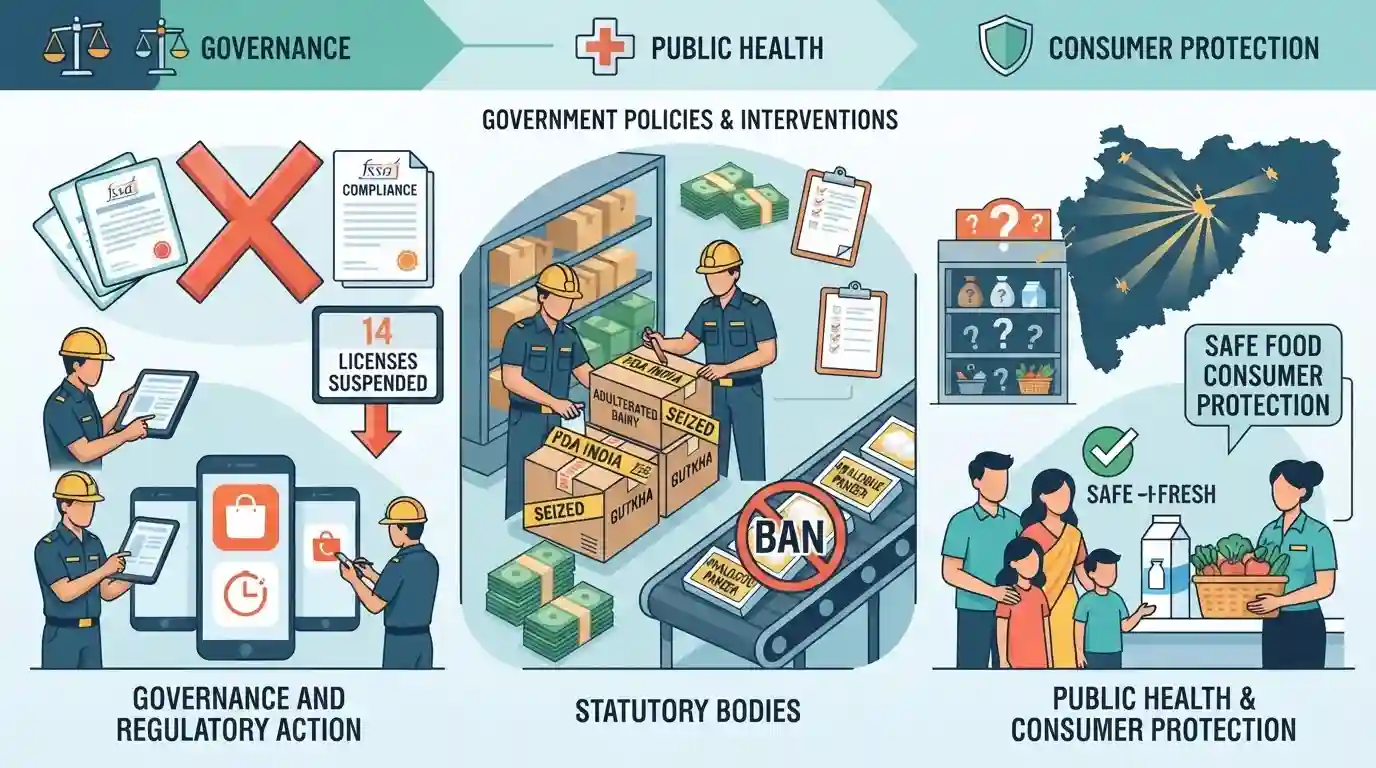
Highlighting the role of state regulatory bodies (like FDA) in enforcing statutory laws (like FSSA, 2006) to safeguard public health and regulate the fast-growing e-commerce/quick-commerce sectors. Important for questions on food safety, adulteration, and governance in Maharashtra.
Summary
The Maharashtra Food and Drug Administration (FDA) launched a massive statewide inspection drive targeting e-commerce and quick-commerce platforms for non-compliance with the Food Safety and Standards Act, 2006. The operation resulted in the suspension of 14 licenses belonging to major platforms like Blinkit, Zepto, and Instamart. In addition to acting against unlicensed operations, the FDA seized large quantities of adulterated dairy products and banned items like gutkha. The raids also strictly enforced Maharashtra's recent blanket ban on analogue paneer, making it the second state to do so after Chhattisgarh.
Key Points
- The Maharashtra FDA suspended 14 licenses of quick-commerce platforms (Blinkit, Zepto, Instamart) during a statewide inspection drive.
- Action was taken against establishments for failing to comply with the Food Safety and Standards Act, 2006, specifically operating without proper licenses.
- The FDA stringently enforced Maharashtra's recent complete ban on analogue paneer, making it the second state after Chhattisgarh to implement such a ban.
- Authorities seized substantial quantities of adulterated dairy products, fake ghee, and banned substances like gutkha and pan masala.
Important Terms
Food Safety and Standards Act, 2006

An integrated central legislation establishing the FSSAI to lay down science-based standards for food. It regulates the manufacturing, storage, distribution, sale, and import of food, aiming to ensure safe and wholesome consumption across India.
UPSC context
GS Paper 2 (Governance/Statutory Bodies). Tests knowledge of India’s regulatory frameworks for public health and food safety.
State Food and Drug Administration (FDA)
The state-level statutory authority tasked with enforcing the Food Safety and Standards Act, 2006. It conducts facility inspections, issues improvement notices, seizes unsafe products, and suspends licenses of non-compliant food businesses.
UPSC context
GS Paper 2 (State Executive/Statutory Bodies). Highlights the critical role of state agencies in executing national public health regulations.
Quick-Commerce (Q-Commerce) Platforms
E-commerce models (e.g., Blinkit, Zepto) delivering groceries within minutes via localized micro-fulfillment centers. They are increasingly scrutinized by state regulators for violating food storage, temperature control, and hygiene standards.
UPSC context
GS Paper 3 (Indian Economy). Tests understanding of digital economy models, supply chain logistics, and emerging consumer protection issues.
Analogue Paneer
A synthetic, non-dairy substitute mimicking paneer, manufactured using vegetable oils, starches, and additives rather than milk fat. It is nutritionally inferior, and its undisclosed sale is penalized as food adulteration.
UPSC context
GS Paper 2 (Public Health) & GS 3 (Food Processing). Important for topics concerning food adulteration and health regulations.
Prelims Trap
"E-commerce platforms acting as intermediaries are exempt from requiring FSSAI licenses for food products sold by third-party sellers."
Under the FSS Act, 2006, e-commerce platforms dealing in food are classified as Food Business Operators (FBOs) and must obtain active central FSSAI licenses.
Static Concepts Connected
What is the constitutional and statutory framework for food safety in India?
- Statutory Body: FSSAI was established under the Food Safety and Standards Act, 2006, consolidating older laws like the Prevention of Food Adulteration Act.
- Nodal Ministry: It functions under the Ministry of Health and Family Welfare, not the Ministry of Consumer Affairs.
- Concurrent List: The subject 'Adulteration of foodstuffs and other goods' is listed in Entry 18 of the Concurrent List (Schedule VII).
How does Indian law regulate e-commerce platforms selling food?
- FBO Classification: Platforms like Blinkit and Zepto are legally classified as Food Business Operators (FBOs) under the FSS Act, overriding standard IT intermediary exemptions.
- Direct Liability: They are legally accountable for the safety, compliance, and proper licensing of all food products stored or distributed via their platforms.
Cross-Topic Patterns
Quick commerce & Intermediary liability
The clash between the IT Act's 'safe harbor' protections and FSSAI's strict classification of q-commerce apps as directly liable Food Business Operators.
Federal enforcement of food safety laws
While FSSAI is a central body, state-led FDA actions (like banning analogue paneer) highlight the Concurrent List nature of food adulteration enforcement.

Expect a multi-statement question integrating FSSAI's statutory mandate, e-commerce FBO classification, and Concurrent List entries.
Linked PYQs · 2
Linked PYQs · 2
- 2026MPSC_PRELIMSGS1
Which of the following statement/s is/are correct regarding National Food Security Act - 2013 ? (a) Women empowerment is a feature of the National Food Security Act - 2013. (b) State Food Commission is monitoring, reviewing and implementing authority of this Act - 2013. Answer options :
- 2024MPSC_PRELIMSGS1
Food security includes following stages : (a) Adequate availability of food grains to all. (b) Adequate availability of food grains and pulses to all. (c) Adequate availability of food grains, pulses, milk and vegetables to all. (d) Adequate availability of food grains, pulses, milk products, vegetables, fruits, meat and fish etc. Answer options :
