FCRA Bill 2026 and Impacts on Civil Society Organizations
Source:The Hindu ↗
हे का महत्त्वाचे आहे
The balance between regulating foreign contributions for national security and maintaining an enabling environment for civil society is a critical governance issue. It directly ties into the UPSC syllabus on the role of NGOs and civil society in India's democracy and development process.
सारांश
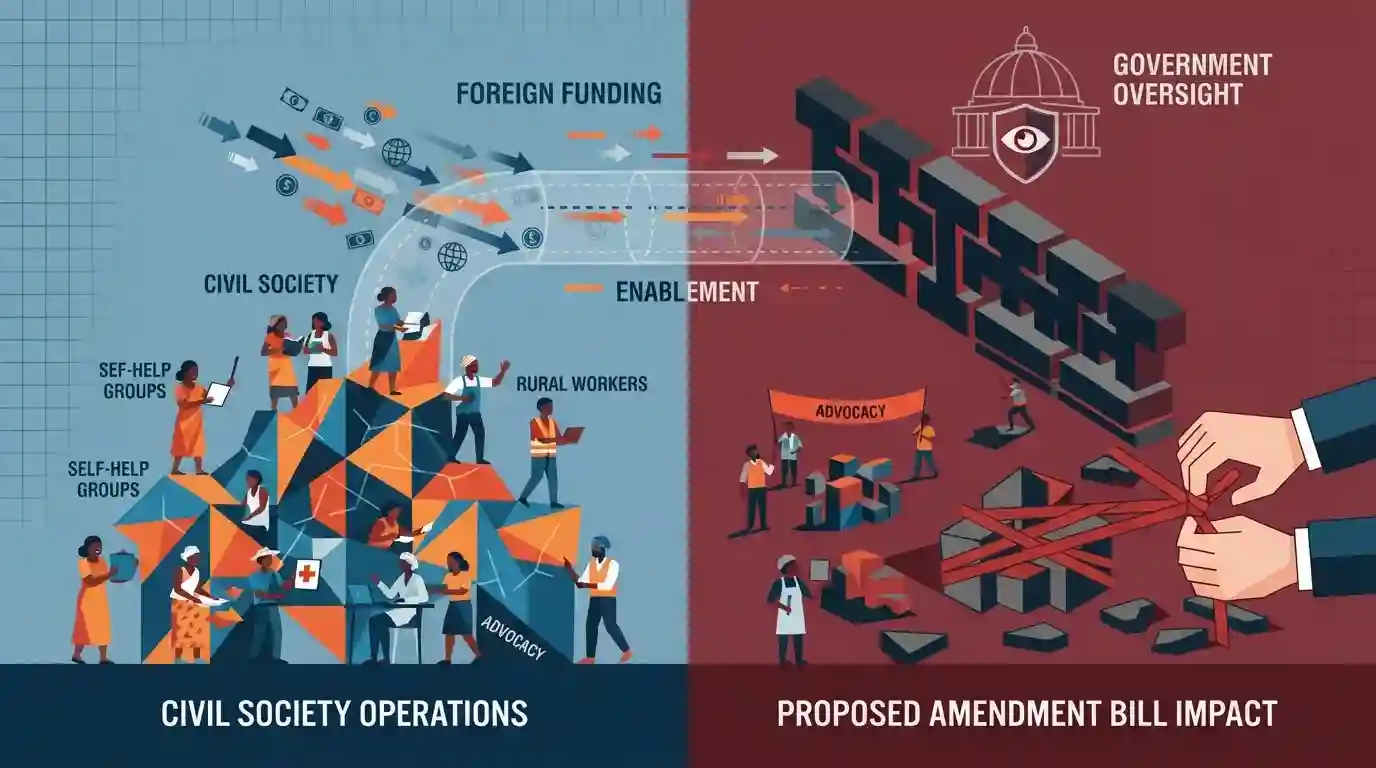
The article critically examines the proposed Foreign Contribution (Regulation) Amendment Bill, 2026, characterizing it as a severe threat to civil society organizations (CSOs) in India. It argues that by imposing stringent compliance measures and tightening the rules around foreign funding, the state is effectively stifling the operational capacity of NGOs, particularly those involved in advocacy, rights-based work, and grassroots development. While the government cites national security and transparency as justifications, the author warns that such restrictive legislative frameworks risk shrinking the democratic space for non-state actors, thereby hampering their crucial role in supplementing public service delivery and championing marginalized causes.
मुख्य मुद्दे
- The FCRA Bill 2026 proposes further tightening of regulations concerning the receipt and utilization of foreign contributions by non-governmental and civil society organizations in India.
- Critics argue that the enhanced compliance burdens, increased administrative discretion, and potential for arbitrary cancellations of FCRA licenses pose an existential threat to grassroots NGOs.
- There is apprehension that the amendments could be weaponized to stifle dissent and target organizations engaged in advocacy, human rights, and environmental activism.
- The government's rationale typically revolves around preventing the misuse of foreign funds for anti-national activities, terror financing, and ensuring transparency.
- A crippled civil society could negatively impact inclusive development, as NGOs play a pivotal role in public service delivery, reaching marginalized communities, and supplementing state welfare efforts.
महत्त्वाच्या संज्ञा
Foreign Contribution (Regulation) Amendment Bill, 2026

A proposed legislation that intensifies government oversight over foreign-funded NGOs. It notably creates a "Designated Authority" to manage and potentially seize assets of organizations whose FCRA registrations are cancelled or remain unrenewed.
UPSC context
GS Paper II (Government Policies). Evaluates the balance between state regulatory control and civil society autonomy.
Foreign Contribution (Regulation) Act (FCRA)
An Indian law regulating the acceptance and utilization of foreign contributions by individuals and NGOs. It ensures that foreign funds do not negatively impact India's sovereignty, security, public order, or democratic processes.
UPSC context
GS Paper II & III (Internal Security). Tests understanding of external funding regulation and national security.
Civil Society Organizations (CSOs)
Non-state, non-profit entities operating independently of the government and markets. They mobilize citizens voluntarily to pursue shared social, ethical, or philanthropic goals, effectively bridging the gap between citizens and the state.
UPSC context
GS Paper II (Role of NGOs, associations). Tests knowledge of participatory democracy and grassroots governance.
Non-Governmental Organizations (NGOs)
Independent, citizen-led voluntary organizations operating without government control. They are crucial for addressing social disparities, delivering grassroots public services, and championing the rights of marginalized communities.
UPSC context
GS Paper II (Development processes). Tests their impact on social welfare, service delivery, and policy formulation.
Ministry of Home Affairs (MHA)
The central government ministry tasked with internal security and domestic policy. It administers the FCRA, verifying compliance, granting or cancelling registrations, and monitoring foreign funds received by NGOs.
UPSC context
GS Paper II & III. Assesses understanding of internal security architecture and regulatory enforcement mechanisms.
पूर्वपरीक्षा सापळा
Receiving foreign contributions is a fundamental right protected under Article 19(1)(c) as part of the freedom of association.
In Noel Harper (2022), the Supreme Court ruled that receiving foreign donations is not an absolute or fundamental right, but a regulated statutory permission.
संबंधित स्थिर संकल्पना
What constitutional principles govern the regulation of foreign contributions to NGOs?
- No Absolute Right: The Supreme Court in Noel Harper (2022) held that receiving foreign donations is not a fundamental or absolute constitutional right.
- Reasonable Restrictions: Foreign funding can be restricted under Article 19(4) to safeguard national sovereignty, public order, and national security.
- Sovereignty Protection: The state has a legitimate interest in ensuring domestic politics and policy-making are not influenced by foreign capital.
How does the administrative framework of FCRA differ from FEMA?
- Nodal Ministry: FCRA is administered by the Ministry of Home Affairs (internal security focus), while FEMA is under the Ministry of Finance (economic focus).
- Nature of Inflow: FEMA regulates commercial and business-driven foreign exchange, whereas FCRA strictly governs voluntary, charitable, or donor-driven foreign contributions.
- Compliance Mandates: FCRA requires NGOs to register, renew licenses every 5 years, and receive all foreign funds solely through a designated SBI branch in New Delhi.
आंतर-विषय नमुने
NGO funding + Internal Security
Strict FCRA compliance links national security concerns (preventing foreign-funded developmental disruptions) to the legal boundaries of democratic dissent.
State-CSO synergy + Welfare delivery
Curtailed NGO funding directly shrinks the delivery capacity of non-state actors in marginalized regions, impacting India's inclusive development and SDG outcomes.

2026 Mains will likely test the delicate balance between internal security mandates and civil society's role in inclusive development.
संबंधित PYQ · 4
संबंधित PYQ · 4
- 2015MainsGS2
Examine critically the recent changes in the rules governing foreign funding of NGOs under the Foreign Contribution (Regulation) Act (FCRA), 1976.
- 2025MainsGS2
Civil Society Organizations are often perceived as being anti-State actors than non-State actors. Do you agree? Justify.
- 2021MainsGS2
Can Civil Society and Non-Governmental Organizations present an alternative model of public service delivery to benefit the common citizen? Discuss the challenges of this alternative model.
- 2024MainsGS2
Public charitable trusts have the potential to make India's development more inclusive as they relate to certain vital public issues. Comment.
