Foreign Currency Non Resident Deposits and Currency Risk
Source:The Hindu ↗
ఇది ఎందుకు ముఖ్యం
Understanding how FCNR(B) deposits work and who bears currency risk is crucial for UPSC aspirants studying India's external sector, capital accounts, forex management, and banking risks.
సారాంశం
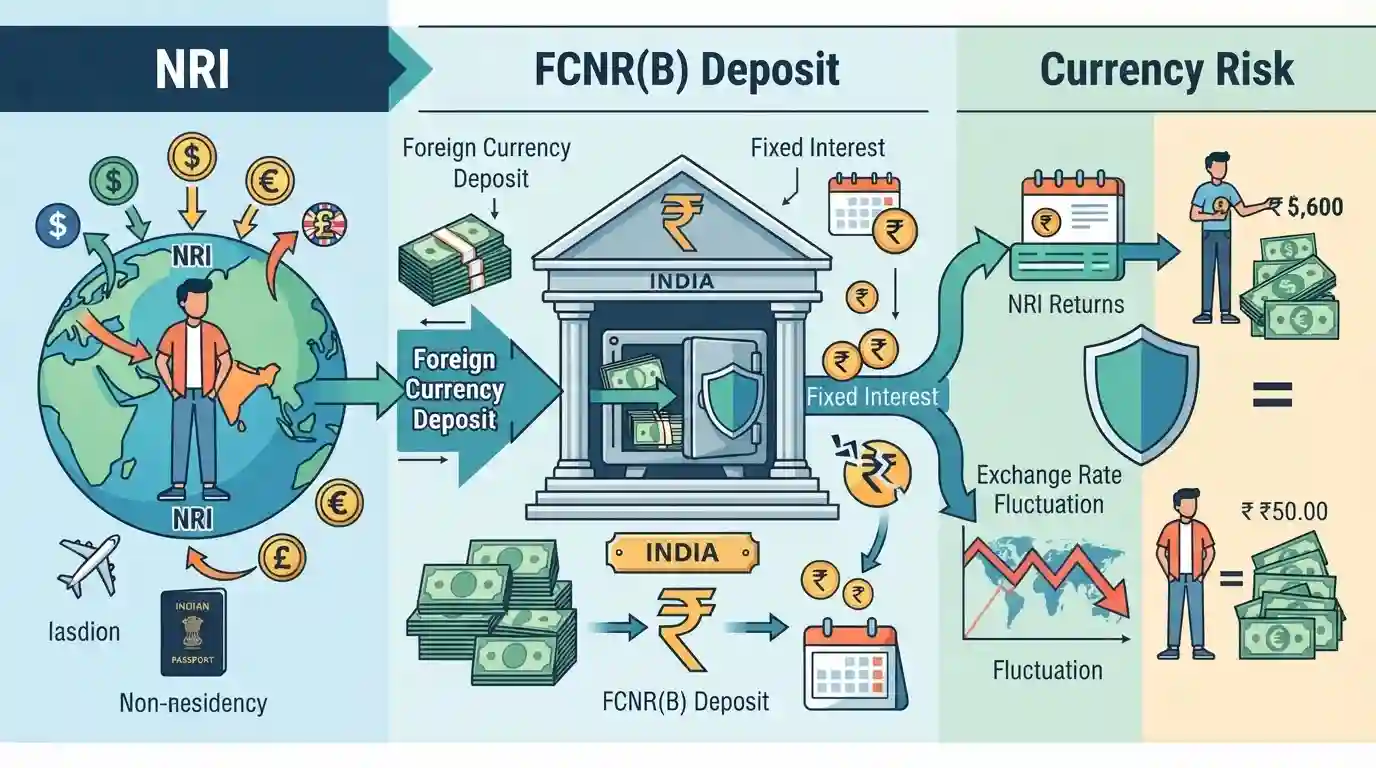
The article explains the mechanics of Foreign Currency Non-Resident [FCNR(B)] deposits, highlighting how Non-Resident Indians (NRIs) can park foreign currency funds in India without taking on currency depreciation risks, as the exchange rate risk is borne by the banks.
ముఖ్య అంశాలు
- FCNR(B) deposits are term deposits held by Non-Resident Indians (NRIs) in foreign currencies, shielding them from rupee depreciation.
- Under FCNR(B) schemes, the currency risk (exchange rate risk) is borne by the banks (and ultimately absorbed or managed via hedging by the authorized dealer banks / RBI), rather than the depositor.
- These deposits help India bolster its foreign exchange reserves and manage capital flows, though they pose interest rate and hedging costs for commercial banks.
ముఖ్యమైన పదాలు
Foreign Currency Non-Resident (Bank) [FCNR(B)] deposits

Fixed deposit accounts permitted by the RBI allowing Non-Resident Indians (NRIs) and Overseas Citizens of India (OCIs) to maintain deposits in specified foreign currencies, shielding depositors from rupee exchange rate fluctuations.
UPSC context
UPSC GS Paper III (Indian Economy & Mobilization of Resources, External Sector). Tests understanding of NRI deposit mobilization, forex reserves, and currency risk management.
Reserve Bank of India
India's central banking institution, which controls monetary policy, regulates the banking system, manages foreign exchange reserves, and issues currency.
UPSC context
UPSC GS Paper III (Banking and Monetary Policy). Tests institutional framework, macroeconomic management, and central bank interventions in forex markets.
అనుసంధానమైన స్థిర భావనలు
What are the key differences between FCNR(B), NRE, and NRO accounts for NRIs in India?
- FCNR(B) Deposits: Maintained in designated foreign currencies; both principal and interest are repatriable, and exchange rate risk is borne entirely by the bank.
- NRE Accounts: Rupee-denominated accounts where funds are freely repatriable; the exchange rate risk and depreciation loss fall squarely on the NRI depositor.
- NRO Accounts: Rupee-denominated accounts for income earned *within* India (rent, dividends); repatriation is subject to RBI limits and taxes, with full currency risk on the depositor.
అంతర-అంశ నమూనాలు
Forex Inflows + Capital Account Convertibility
FCNR(B) deposits act as a critical macroeconomic stabilizer during BoP crises, directly tying foreign capital flows to RBI's monetary management and sterilization operations.
Banking Balance Sheets + RBI Hedging Costs
When commercial banks absorb exchange rate risks on FCNR(B) deposits, their balance sheets face hedging and interest rate vulnerabilities that intersect directly with RBI's liquidity management.

Expect statements on who bears currency risk in FCNR(B) vs NRE/NRO accounts in a multi-statement Prelims question.
అనుసంధాన PYQలు · 2
అనుసంధాన PYQలు · 2
- 2021PrelimsGS1
Consider the following : 1. Foreign currency convertible bonds 2. Foreign institutional investment with certain conditions 3. Global depository receipts 4. Non-resident external deposits Which of the above can be included in Foreign Direct Investments?
- 2015MainsGS3
Craze for gold in Indians has led to a surge in import of gold in recent years and put pressure on balance of payments and external value of rupee. In view of this, examine the merits of the Gold Monetization Scheme.
