RBI Swap Schemes and FCNR Deposits Fortify India Foreign Reserves
Source:Indian Express ↗
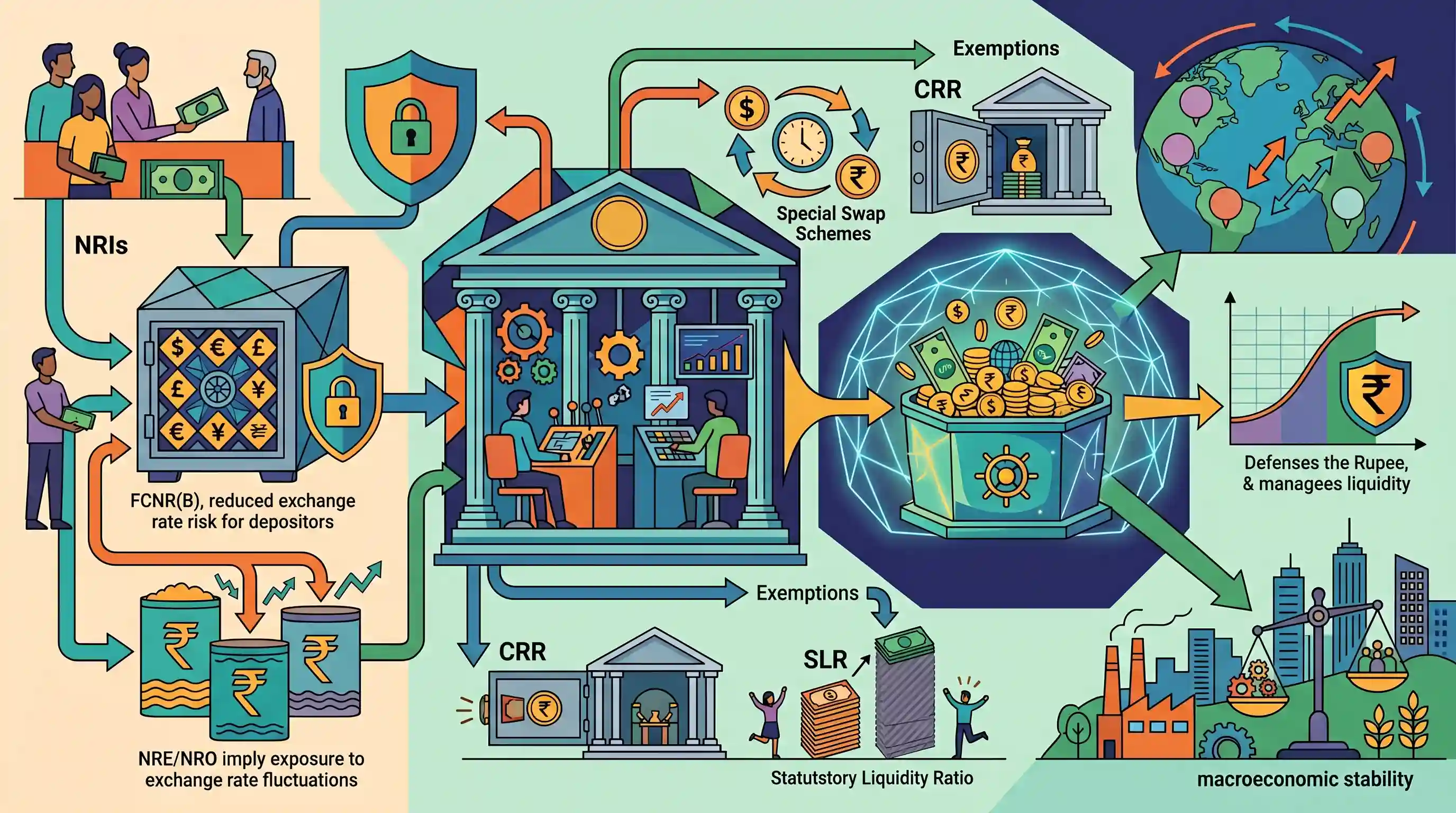
Why It Matters
NRI deposits form a major pillar of India's capital account and forex reserves. Understanding the different types of NRI accounts and the RBI's regulatory levers (like CRR/SLR exemptions and swap schemes) is crucial for analyzing India's balance of payments dynamics and its resilience against external economic shocks.
Summary
The article unpacks the mechanics of Foreign Currency Non-Resident (Bank) or FCNR(B) deposits and their critical role in shoring up India's foreign exchange reserves. It distinguishes FCNR(B) accounts, which are foreign-currency denominated to shield depositors from exchange rate risks, from Rupee-denominated NRE and NRO accounts. Furthermore, it details how the Reserve Bank of India (RBI) strategically utilizes tools like special swap schemes and exemptions from Cash Reserve Ratio (CRR) and Statutory Liquidity Ratio (SLR) to attract NRI inflows. These monetary interventions are essential for managing liquidity, defending the Rupee against depreciation, and maintaining macroeconomic stability in the face of fluctuating global interest rates.
Key Points
- Foreign Currency Non-Resident (Bank) [FCNR(B)] accounts allow Non-Resident Indians (NRIs) to maintain term deposits in foreign currencies, protecting them from exchange rate volatility.
- Unlike FCNR(B) accounts, NRE and NRO accounts are maintained in Indian Rupees. NRE accounts are fully repatriable, whereas NRO accounts are primarily for managing income earned in India.
- The RBI uses measures like special swap windows and regulatory exemptions (e.g., exempting incremental FCNR(B) deposits from CRR and SLR) to incentivize banks to attract NRI inflows.
- These NRI deposits are a vital component of India's capital account, helping to bolster foreign exchange reserves, stabilize the domestic currency, and manage macroeconomic risks amidst global monetary tightening.
Important Terms
FCNR(B) Account

Foreign-currency denominated term deposits for NRIs. These accounts allow depositors to earn interest in global currencies (like USD), shielding them from Rupee depreciation while remaining tax-free and fully repatriable.
UPSC context
GS-3 Indian Economy; relevant for Balance of Payments and forex management strategies during Rupee volatility.
Non-Resident External (NRE) Account
A Rupee-denominated account for NRIs to park foreign earnings. While the interest is tax-free and funds are fully repatriable, the account holder bears the risk of exchange rate fluctuations.
UPSC context
GS-3 Banking; tests distinction between repatriable/non-repatriable flows and currency risk exposure.
Non-Resident Ordinary (NRO) Account
A Rupee-denominated account for NRIs to manage income earned in India (e.g., rent, dividends). Unlike NRE accounts, interest is taxable and repatriation of the principal is limited to $1 million annually.
UPSC context
GS-3 Indian Economy; focuses on FEMA regulations and domestic income management for non-residents.
RBI Special Swap Window
A mechanism where the RBI exchanges foreign currency for Rupees with banks at a fixed rate. This reduces bank hedging costs, incentivizing them to attract NRI deposits to stabilize reserves.
UPSC context
GS-3 Monetary Policy; a critical tool used by the RBI to manage liquidity and defend the Rupee.
Foreign Exchange (Forex) Reserves
Assets held by the central bank in foreign currencies, gold, and SDRs. They act as a cushion against external shocks and help maintain the value of the national currency.
UPSC context
GS-3 Economy; fundamental for understanding external sector stability and Balance of Payments.
Capital Account Convertibility
The freedom to convert local financial assets into foreign financial assets and vice versa at market-determined exchange rates. India currently has full convertibility on the current account only.
UPSC context
GS-3 Economy; tests depth of financial market reforms and risks associated with volatile capital flows.
Prelims Trap
"NRI bank deposits like FCNR(B) and NRE are recorded under the Current Account of India's BoP."
NRI bank deposits create a repayment liability for Indian banks, classifying them under the Capital Account. Only non-debt creating personal remittances fall under the Current Account.
Static Concepts Connected
What are the core differences between NRE, NRO, and FCNR(B) accounts?
- Denomination: NRE and NRO are maintained in Indian Rupees (INR), whereas FCNR(B) accounts are held in designated foreign currencies (like USD, GBP).
- Repatriability: NRE and FCNR(B) balances are fully repatriable. NRO accounts have restricted repatriability (typically capped at USD 1 million per financial year).
- Taxation: Interest earned on NRE and FCNR(B) accounts is entirely tax-exempt in India. Interest on NRO accounts is taxable at source.
How do RBI forex swaps impact domestic liquidity and currency?
- Mechanism: The RBI buys or sells dollars to banks with a simultaneous agreement to reverse the transaction at a future date and a predetermined rate.
- Liquidity impact: When RBI sells dollars via a swap, it absorbs equivalent Rupee liquidity from the banking system; buying dollars injects Rupee liquidity.
- Currency defense: These swaps help manage near-term dollar availability, curbing speculative attacks and defending the Rupee against sharp depreciation during capital outflows.
Cross-Topic Patterns
Taper Tantrum + BoP Defense Tools
FCNR swap windows are the RBI's primary defense during US Fed tightening cycles, echoing the 2013 taper tantrum response that rapidly built up India's forex reserves without depleting domestic dollar supply.
Monetary Policy + External Sector Shocks
Exempting specific deposits from CRR/SLR shows how RBI uses reserve ratios not just for domestic credit control, but as micro-prudential tools to manage external sector shocks and exchange rates.

Expect a multi-statement 2026 prelims question distinguishing NRI deposits (Capital A/c), NRO taxation, and remittances (Current A/c).
Linked PYQs · 3
Linked PYQs · 3
- 2013PrelimsGS1
Which one of the following groups of items is included in India's foreign-exchange reserves?
- 2014PrelimsGS1
With reference to Balance of Payments, which of the following constitutes/constitute the Current Account? 1. Balance of trade 2. Foreign assets 3. Balance of invisibles 4. Special Drawing Rights Select the correct answer using the code given below.
- 2018MainsGS3
How would the recent phenomena of protectionism and currency manipulations in world trade affect macroeconomic stability of India?
