Fazil Nagar town in Kushinagar renamed as Pawagarh in Uttar Pradesh
Source:The Hindu ↗
Why It Matters
This renaming bridges contemporary regional administrative decisions in Uttar Pradesh with ancient Indian history, specifically the geography of the 16 Mahajanapadas (Malla Republic) and the lives of key spiritual figures like Lord Mahavir and Lord Buddha. For UPPSC aspirants, it underscores how governance and public policy intersect with cultural heritage and ancient religious history.
Summary
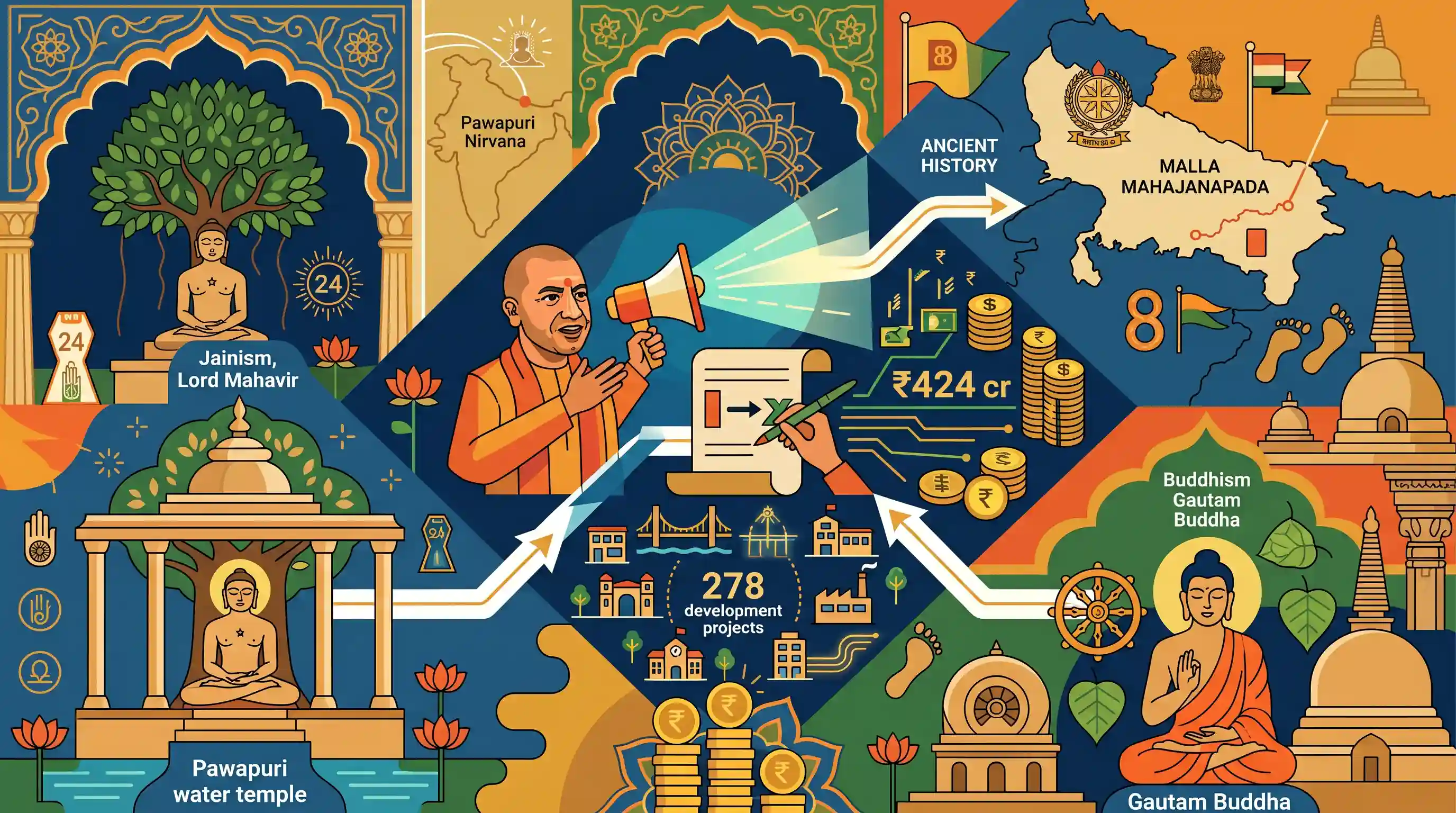
Uttar Pradesh Chief Minister Yogi Adityanath announced that the town of Fazil Nagar in Kushinagar district will be renamed 'Pawagarh' to honour the 24th Jain Tirthankar, Lord Mahavir. The name is derived from Pawapuri in Bihar, where Lord Mahavir attained Nirvana. This announcement was made during a public function in Kushinagar where 278 development projects worth over ₹424 crore were launched. The renaming serves to revive the area's rich religious and historical identity, aligning with its ancient roots under the Malla Mahajanapada, which was closely associated with both Gautam Buddha and Lord Mahavir.
Key Points
- Uttar Pradesh Chief Minister Yogi Adityanath announced the renaming of Fazil Nagar town in Kushinagar district to 'Pawagarh' in honour of the 24th Jain Tirthankar, Lord Mahavir.
- The name 'Pawagarh' is derived from Pawapuri in Bihar, the highly revered Jain pilgrimage site where Lord Mahavir attained Nirvana (salvation).
- The renaming occurred during a government function in Kushinagar, where 278 development projects worth over ₹424 crore were dedicated and welfare benefits were distributed to the public.
- The move aligns with the state's cultural revival efforts to connect modern administrative names with their ancient roots and spiritual heritage.
- Historically, Kushinagar and its vicinity belonged to the ancient Malla Mahajanapada, which had two main capitals: Kushinara (where Gautama Buddha attained Mahaparinirvana) and Pawa (where Lord Mahavir attained Nirvana). This renaming establishes a stronger regional link to Lord Mahavir's legacy.
Important Terms
Malla Mahajanapada

One of the sixteen ancient Indian Gana-Sanghas (oligarchic republics) of the 6th century BCE, located in present-day eastern Uttar Pradesh, with centers at Kushinara and Pava.
UPSC context
GS Paper I: Ancient History. Tests knowledge of the 16 Mahajanapadas, ancient republican administration, and links to heterodox religions.
Tirthankara
In Jainism, a spiritual teacher or 'Ford-Maker' who has conquered worldly existence, attained omniscience (Kevala Jnana), and established the religious order to guide souls to liberation.
UPSC context
GS Paper I: Art & Culture. Tests understanding of Jain philosophy, core spiritual tenets, and major ancient religious traditions.
Vardhamana Mahavira
The 24th and final Jain Tirthankara (c. 540–468 BCE) who codified key principles of Jainism, including extreme non-violence (Ahimsa) and asceticism, after attaining complete detachment.
UPSC context
GS Paper I: Ancient History and Indian Culture. Tests life, core doctrines, and historical impacts of major heterodox philosophers.
Pawapuri
A highly revered Jain pilgrimage site in Nalanda district, Bihar, where Lord Mahavir delivered his final sermon, attained liberation (Nirvana/Moksha), and was cremated.
UPSC context
GS Paper I: Art & Culture. Tests familiarity with key religious pilgrimage sites, sacred geography, and regional architectural landmarks.
Kushinagar
An ancient town in eastern Uttar Pradesh and capital of the Malla Mahajanapada, globally renowned as the sacred site of Gautama Buddha's Mahaparinirvana.
UPSC context
GS Paper I: Indian Culture and History. Tests knowledge of Buddhist pilgrimage circuits, sacred art, and ancient political geography.
Chief Minister's Office (CMO)
The administrative secretariat that assists the state's chief executive in policy formulation, decision-making, inter-departmental coordination, and tracking developmental projects.
UPSC context
GS Paper II: Polity and Governance. Tests understanding of state executive machinery and institutional governance frameworks.
Prelims Trap
Ancient Pawa of the Malla Mahajanapada is geographically identical to the modern Pawapuri temple site in Nalanda, Bihar.
While both claim connection to Mahavira's Nirvana, the Malla capital Pawa (Fazilnagar) is in UP, whereas the modern Pawapuri pilgrimage site is in Bihar.
Static Concepts Connected
What characterized the political and religious significance of the Malla Mahajanapada?
- Republican Polity: It was a Gana-sangha (oligarchical republic) ruled by a general assembly rather than a hereditary monarch.
- Dual Capitals: It had two distinct administrative centers: Kushinara (modern Kushinagar) and Pawa (modern Fazilnagar).
- Spiritual Nexus: Both Buddha (attained Mahaparinirvana at Kushinara) and Mahavira (attained Nirvana at Pawa) are intrinsically linked to this territory.
Which eight of the sixteen Mahajanapadas were located in modern Uttar Pradesh?
- Western Group: Panchala, Kuru, and Surasena covered the western and central zones.
- Eastern Group: Kosala, Kashi, and Malla occupied the eastern and northeastern plains.
- Southern Group: Vatsa and Chedi represented the southern and Bundelkhand regions of modern UP.
Cross-Topic Patterns
Ancient Gana-sanghas and constitutional values
UPSC connects ancient oligarchies (Malla, Vajji) to modern democratic values, focusing on their consensus-based Santhagaras (assemblies).
Cultural tourism and regional development
Infrastructure in Kushinagar connects spiritual history with economic development via the Swadesh Darshan Scheme.

Ancient Gana-sanghas like Malla, their dual-capital structures, and intersecting Buddhist/Jain events at Pawa/Kushinara are highly probable for 2026.
Linked PYQs · 3
Linked PYQs · 3
- 2003UPPSC_PRELIMSGS1
Consider the following statements and select the correct answer from the code given below: Assertion (A): Kushinagar was the capital of Malla Republic. Reason (R): Mahatma Buddha got Mahaparinirvana at Kushinagar.
- 2011UPPSC_PRELIMSGS1
Gautam Buddha has attained Mahaparinirvana in the State of:
- 2002UPPSC_PRELIMSGS1
Which of the following places is considered a Jain siddha-Kshetra on account of its Association with Parsvanatha
