Ganges Water Sharing Treaty Renewal and Bilateral Hydro Politics
Source:Indian Express ↗
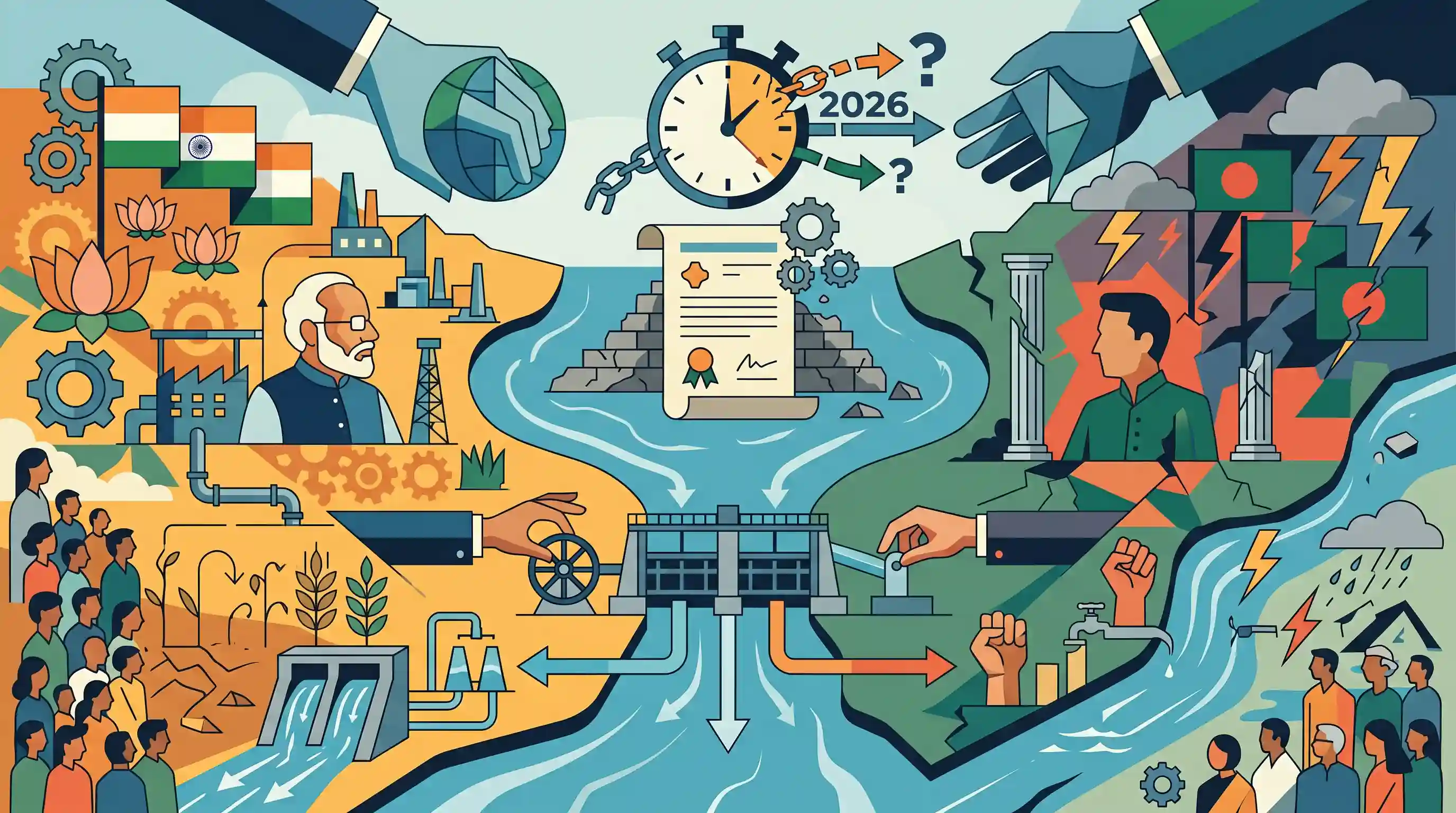
Why It Matters
The expiration of the Ganges Water Treaty in 2026 is a looming geopolitical flashpoint in South Asia. Understanding the intersection of transboundary water sharing and bilateral diplomacy is critical for answering questions on India's 'Neighbourhood First' policy and border dispute management in GS Paper 2.
Summary
The article examines the uncertain future of the 1996 Ganges Water Sharing Treaty between India and Bangladesh, which expires in 2026. Its renewal is heavily contingent on the state of bilateral relations, which have become complicated following recent political shifts and regime change in Dhaka. The piece highlights the broader challenges of hydro-politics in South Asia, illustrating how transboundary river agreements—such as those involving the Ganges and Teesta rivers—are intricately tied to both domestic political pressures and international diplomatic ties.
Key Points
- The 1996 Ganges Water Sharing Treaty between India and Bangladesh is scheduled to expire in 2026, making its renewal a pressing diplomatic issue.
- The fate of the treaty's renewal is clouded by strained bilateral ties and changing political dynamics following the recent regime change in Dhaka.
- Transboundary river management, including the unresolved Teesta water dispute, remains highly sensitive and intricately linked to the broader geopolitical relationship between the two nations.
- The situation underscores the complexities of hydro-politics in South Asia, where domestic political interests (such as the involvement of state governments in India) deeply influence international water diplomacy.
Important Terms
Ganges Water Sharing Treaty (1996)

A 30-year bilateral agreement (expiring 2026) governing the sharing of the Ganges' waters at Farakka Barrage during the lean season (January–May) based on a specific volumetric formula.
UPSC context
GS Paper II/International Relations; essential for analyzing water diplomacy and the impact of domestic federalism on bilateral treaties.
Teesta River Dispute
A major bilateral conflict regarding the sharing of Teesta River waters; a 2011 interim agreement was stalled due to objections from the West Bengal state government.
UPSC context
GS Paper II; tests understanding of India-Bangladesh relations and the role of state-level stakeholders in foreign policy.
Hydro-politics
The study of how water resource management and riparian status (upstream vs. downstream) influence international relations, political power dynamics, and domestic policy decisions.
UPSC context
GS Paper II/International Relations; relevant for discussing regional hegemony, cooperation, and conflict over shared natural resources in South Asia.
Farakka Barrage
A barrage in West Bengal built to divert Ganges water into the Hooghly River to flush out silt at Kolkata Port; it is the physical focal point of India-Bangladesh water sharing.
UPSC context
GS Paper I/Geography and GS II; critical for understanding the environmental and diplomatic fallout of transboundary river infrastructure.
Neighborhood First Policy
A primary pillar of India’s foreign policy that prioritizes active engagement, connectivity, and stable relations with immediate neighbors like Bangladesh to ensure regional security and prosperity.
UPSC context
GS Paper II; central to questions regarding India’s strategic autonomy and its ability to manage regime changes in the neighborhood.
Transboundary Rivers
Rivers that cross international borders; India and Bangladesh share 54 such rivers, necessitating joint management through bodies like the Joint Rivers Commission (JRC).
UPSC context
GS Paper II/I; fundamental for discussing international water law, regional ecology, and the 'riparian rights' of lower-stream nations.
Prelims Trap
The 1996 Ganges Treaty permanently allocates specific eastern rivers to Bangladesh and western rivers to India.
Unlike the Indus Water Treaty which partitions entire river systems, the Ganges Treaty only determines a volumetric sharing formula for dry-season flow at a specific location (Farakka).
Static Concepts Connected
How does the Constitution balance international treaties with state powers over water?
- Article 253: Empowers Parliament to enact laws on any subject (even State List) to implement international treaties or agreements.
- State List (Entry 17): Water supplies, irrigation, and canals fall under Entry 17 of the State List, making state governments vital stakeholders.
- Political convention: Despite constitutional supremacy via Art 253, the Union rarely bypasses riparian states (e.g., West Bengal on Teesta) to prevent federal friction.
What is the geographical trajectory and significance of the Teesta River?
- Origin: Originates from the Pauhunri glacier and Tso Lhamo lake in the Himalayas of Sikkim.
- Course: Flows swiftly through the mountains of Sikkim and the plains of West Bengal before crossing into Bangladesh.
- Confluence: Acts as a major right-bank tributary to the Brahmaputra River (known locally as the Jamuna) in Bangladesh.
Cross-Topic Patterns
Upstream hydro-hegemony & neighborhood first
India's downstream concerns regarding China's run-of-the-river projects on the Brahmaputra structurally mirror Bangladesh's downstream anxieties regarding India's control over the Ganges and Teesta rivers.
Glacial retreat altering historical water treaties
Static volumetric water agreements like the 1996 Ganges pact face structural threats from Himalayan glacial melt and erratic monsoons, which fundamentally alter historical lean-season river flows.

Expect a comparative Prelims question in 2026 contrasting the specific sharing mechanisms of the Indus Water Treaty and the Ganges Treaty.
Linked PYQs · 3
Linked PYQs · 3
- 2012MainsGS2
The situation today is far different to that prevalent fifty years back when the Indus Water Treaty was signed." Highlight the complexity of the current challenges on both sides of the border in this regard. Do you think that a review of the Treaty is in India's best interests?
- 2015MainsGS2
Project 'Mausam' is considered a unique foreign policy initiative of the Indian Government to improve relationship with its neighbours. Does the project have a strategic dimension? Discuss.
- 2025MainsGS1
Discuss the distribution and density of population in the Ganga River Basin with special reference to land, soil and water resources.
