Andhra Pradesh industrial nodes infrastructure projects and logistics
Source:Indian Express ↗
Why It Matters
Logistics and infrastructure development are critical themes in GS3. This approval serves as a prime case study of the PM Gati Shakti approach linking industrial nodes via multi-modal transport networks, useful for answers on infrastructure investment, regional development, and reducing logistics costs.
Summary
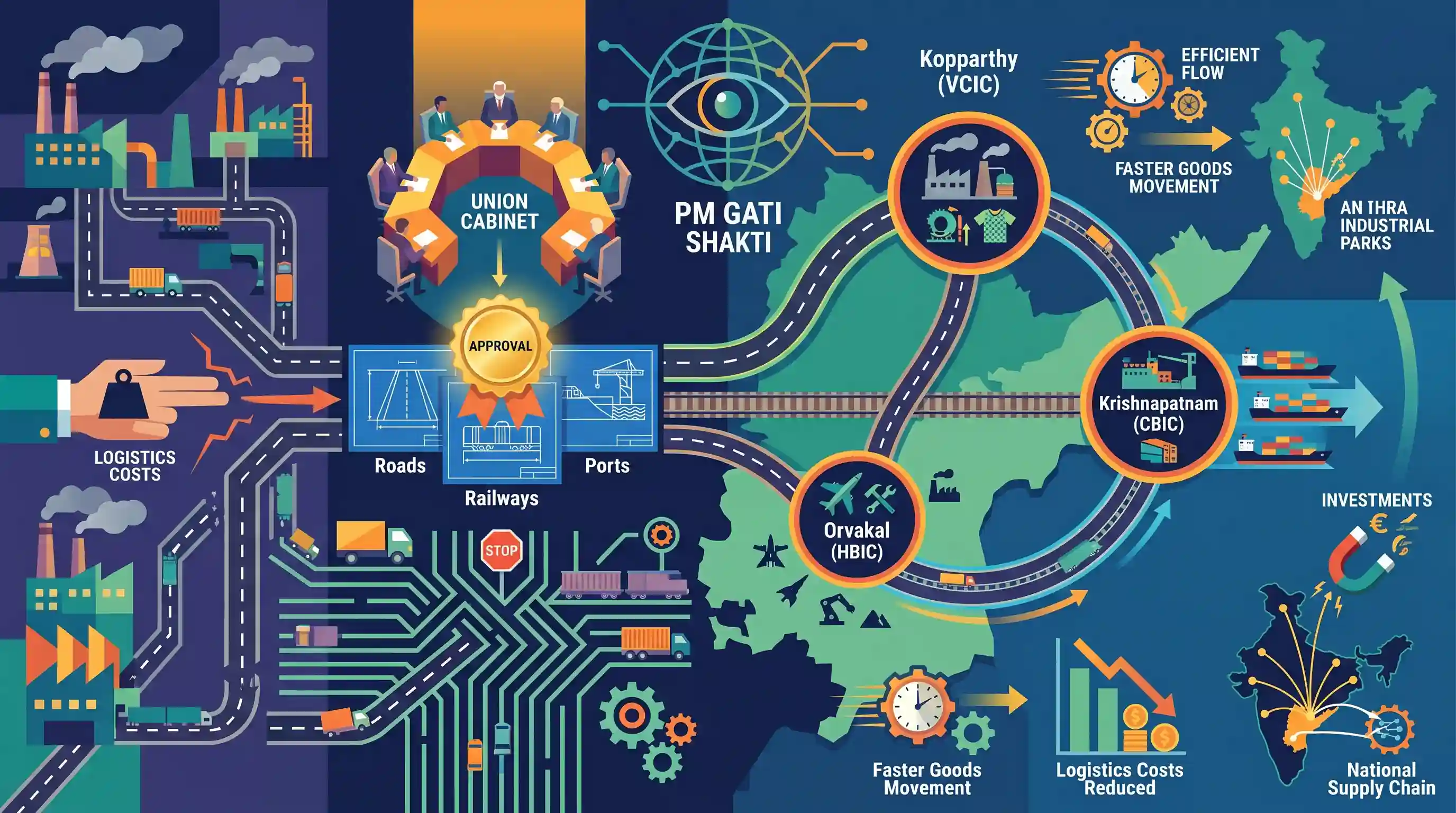
The Union Cabinet recently approved three major infrastructure projects in Andhra Pradesh aimed at enhancing connectivity among three key industrial nodes. Designed to facilitate faster and more efficient goods movement, the projects are expected to significantly reduce logistics costs and alleviate supply chain bottlenecks. Aligning with the PM Gati Shakti framework for multi-modal connectivity, these initiatives will integrate transport networks to spur regional industrialization, attract investments, and reinforce Andhra Pradesh's role in national supply chains.
Key Points
- The Union Cabinet has approved three new infrastructure projects in Andhra Pradesh to connect three key industrial nodes.
- The projects aim to facilitate faster movement of goods, improve logistics efficiency, and reduce supply chain bottlenecks in the region.
- The infrastructure push aligns with the PM Gati Shakti National Master Plan for multi-modal connectivity, integrating various modes of transport.
- By enhancing regional connectivity and reducing logistics costs, the initiatives are expected to spur industrial growth, attract investments, and support the broader economic development of Andhra Pradesh.
Important Terms
PM Gati Shakti National Master Plan

A GIS-based digital platform for integrated planning and coordinated execution of infrastructure projects across 16 ministries to ensure multi-modal connectivity and reduced logistics costs.
UPSC context
GS Paper III: Infrastructure and Economy; tests understanding of integrated transport planning and logistics efficiency.
Cabinet Committee on Economic Affairs (CCEA)
A high-level standing committee chaired by the Prime Minister that reviews economic trends and approves major investment proposals (typically exceeding ₹1,000 crore) and economic policies.
UPSC context
GS Paper II & III: Governance and Economy; tests knowledge of executive decision-making bodies and economic management.
National Infrastructure Pipeline (NIP)
A comprehensive roadmap for infrastructure development (initially ₹111 lakh crore) from 2020–25 to improve project preparation, attract investment, and boost economic growth toward a $5 trillion economy.
UPSC context
GS Paper III: Economy and Infrastructure; essential for questions on long-term capital expenditure and sectoral investment targets.
Industrial Corridors
Planned integrated networks of infrastructure (rail, road, ports) designed to foster industrial development and urban clusters along high-speed transport routes, such as CBIC and VCIC.
UPSC context
GS Paper III: Industrial Growth and Infrastructure; tests understanding of regional development strategies and manufacturing hubs.
Multi-modal Connectivity
The integration of different modes of transport (road, rail, air, and sea) into a unified system to ensure seamless movement of goods and passengers with high efficiency.
UPSC context
GS Paper III: Infrastructure; critical for discussions on supply chain optimization and lowering the national cost of logistics.
Prelims Trap
"PM Gati Shakti is a financial scheme providing direct budgetary grants to states for developing new industrial corridors."
PM Gati Shakti is not a funding scheme; it is a GIS-based digital platform for integrated planning and coordinated implementation among multiple ministries.
Static Concepts Connected
What are the core pillars of the PM Gati Shakti Master Plan?
- Comprehensiveness: Integrates all planned and existing infrastructure initiatives of various ministries onto one centralized GIS portal.
- Optimization: Assists different ministries in mapping and planning the most cost-effective and efficient routes for goods movement.
- Synchronization: Coordinates individual department timelines to prevent delays and siloed infrastructure execution.
How are Industrial Corridors executed and developed in India?
- Nodal Agency: The National Industrial Corridor Development Corporation (NICDC) acts as the central implementing and monitoring agency.
- SPV Model: Projects are executed via Special Purpose Vehicles (SPVs) formed jointly by Central and respective State governments.
- Plug-and-play infrastructure: Focuses on delivering pre-cleared, ready-to-use infrastructure like power, water, and roads to attract rapid investments.
Cross-Topic Patterns
NLP + PM Gati Shakti synergy
The National Logistics Policy (focusing on process/digital reforms) complements PM Gati Shakti (focusing on physical infrastructure) to drive India's logistics costs down to global averages (around 8% of GDP).
Peninsular Economic Geography & Ports
Enhancing the Visakhapatnam-Chennai and Chennai-Bengaluru corridors leverages India's eastern coastline, seamlessly integrating port-led development (Sagarmala) with hinterland manufacturing nodes.

Multi-statement questions in 2026 will likely test the functional distinction between PM Gati Shakti (GIS planning) and NLP (process reform).
Linked PYQs · 3
Linked PYQs · 3
- 2021MainsGS3
“Investment in infrastructure is essential for more rapid and inclusive economic growth.” Discuss in the light of India's experience.
- 2022MainsGS3
Why is Public Private Partnership (PPP) required in infrastructural projects ? Examine the role of PPP model in the redevelopment of Railway Stations in India.
- 2025PrelimsGS1
India is one of the founding members of the International North-South Transport Corridor (INSTC), a multimodal transportation corridor, which will connect
