MP fast-tracks Ken-Betwa rehabilitation and welfare delivery
Source:times-of-india ↗
Why It Matters
The Ken-Betwa Link Project is a landmark national infrastructure initiative with significant implications for the geography and economy of Madhya Pradesh. Understanding its benefits (like irrigation in Bundelkhand) versus its socio-environmental costs (tribal displacement, ecological impact) is crucial for MPPSC Prelims, as questions frequently cover major river valley projects, state geography, and tribal welfare schemes.
Summary
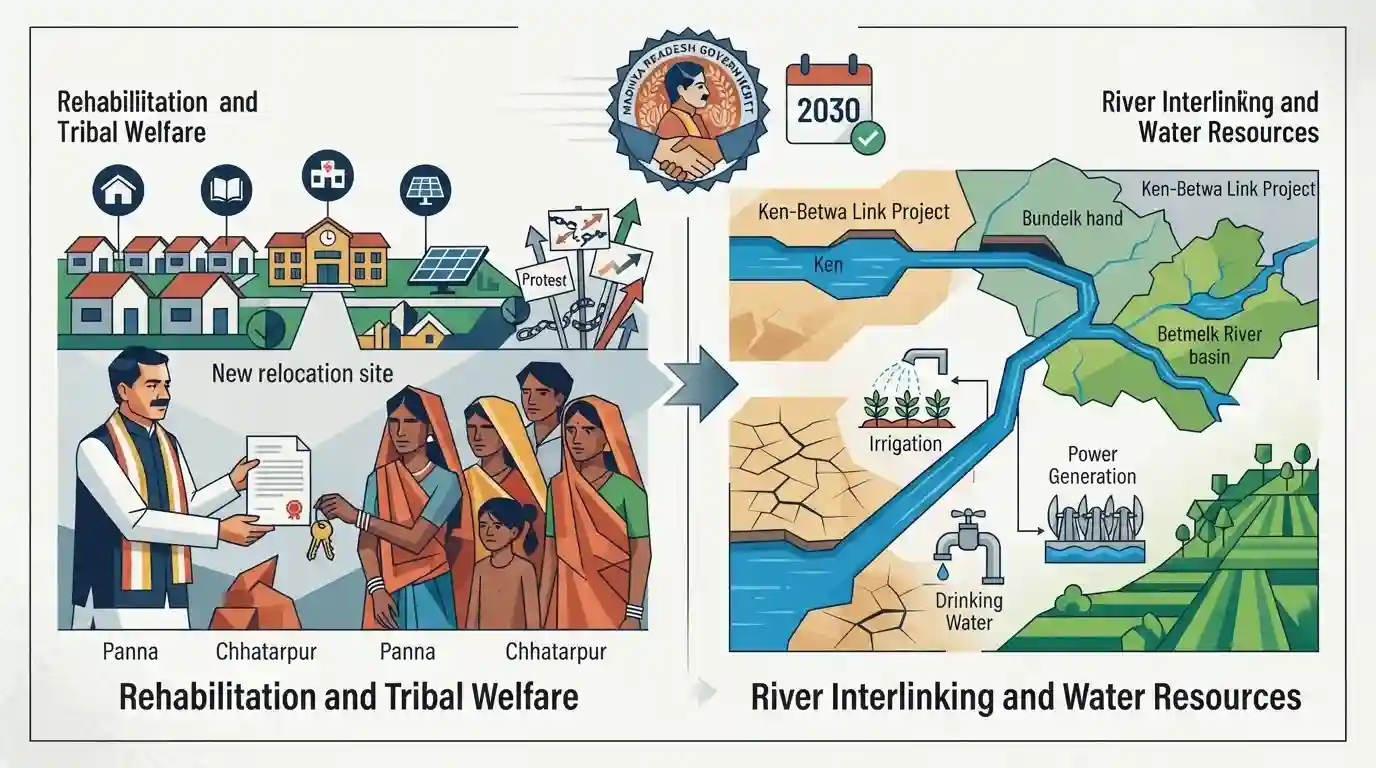
Madhya Pradesh Chief Minister Mohan Yadav has directed officials to accelerate the rehabilitation process for tribal families displaced by the Ken-Betwa Link Project in Panna and Chhatarpur. Emphasizing doorstep delivery of government schemes and infrastructure development at relocation sites, the move addresses recent tribal protests over displacement and compensation. The Ken-Betwa Link Project, India's first river interlinking endeavor targeting completion by 2030, aims to significantly boost irrigation, drinking water, and power generation in the parched Bundelkhand region.
Key Points
- MP CM Mohan Yadav has instructed officials to fast-track the rehabilitation of tribals displaced by the Ken-Betwa Link Project and ensure doorstep delivery of welfare schemes in Panna and Chhatarpur districts.
- The Ken-Betwa Link Project is India's first river interlinking initiative, jointly executed by the central government, Madhya Pradesh, and Uttar Pradesh.
- The project is slated for completion by 2030 and is designed to provide irrigation to 8.11 lakh hectares, drinking water to 44 lakh people, and generate hydroelectric and solar power in the Bundelkhand region.
- The rehabilitation directives follow recent tribal protests against displacement, which garnered political attention and support from opposition figures.
Important Terms
Ken-Betwa Link Project (KBLP)

India's first major river interlinking project. It aims to transfer surplus water from Madhya Pradesh's Ken River to Uttar Pradesh's Betwa River via the Daudhan Dam to address water scarcity.
UPSC context
Tests MP geography, National Water Perspective Plan, and environment-development debates in MPPSC Mains.
Runj-Majhgaon Project
Two medium irrigation projects located in Madhya Pradesh's Panna district. They recently made news due to the state government's decision to disburse enhanced rehabilitation packages to displaced families following protests.
UPSC context
Important for MP state-specific current affairs on tribal welfare, local irrigation infrastructure, and rehabilitation policies.
Bundelkhand Region
A drought-prone, semi-arid plateau region spanning northern Madhya Pradesh and southern Uttar Pradesh. It is the primary target area for irrigation and water supply under the Ken-Betwa project.
UPSC context
Highly relevant for MPPSC Geography regarding regional water scarcity, topography, and socioeconomic development.
Panna Tiger Reserve
A critical wildlife sanctuary in Madhya Pradesh facing severe ecological threats and partial submergence from the Daudhan Dam constructed as part of the Ken-Betwa river interlinking project.
UPSC context
Crucial for MPPSC Environment topics detailing biodiversity conservation, tiger habitats, and infrastructure impact.
Prelims Trap
"The project transfers surplus water from the Betwa river basin to the Ken river."
Aspirants often confuse the direction. Ken has the surplus water, which is transferred to the deficit Betwa basin to irrigate Bundelkhand.
Static Concepts Connected
What are the origin points and geographical profiles of the Ken and Betwa rivers?
- Ken River: Originates from the Ahirgawan village in the Kaimur Range (Katni district) and joins the Yamuna in UP.
- Betwa River: Originates from Kumra village in the Vindhyan Range (Raisen district) and joins the Yamuna at Hamirpur in UP.
- Drainage Pattern: Both are north-flowing, right-bank tributaries of the Yamuna River, shaping the geography of the Bundelkhand plateau.
How does the Ken-Betwa Link Project impact local biodiversity and tribal populations?
- Panna Tiger Reserve: The Daudhan Dam, the project's primary reservoir, is being built inside the core area of the Panna Tiger Reserve, causing major habitat loss.
- Tribal Displacement: Submergence heavily affects indigenous communities of the Panna and Chhatarpur districts, primarily the Gond and Kol tribes.
- Landscape Mitigation: To compensate for habitat loss, Nauradehi and Rani Durgavati wildlife sanctuaries are being integrated into the tiger reserve network.
Cross-Topic Patterns
River linking vs. Core Wildlife Habitats
The KBLP's submergence of Panna's core area tests the balance between the National Perspective Plan for water security and the Wildlife Protection Act's mandate for inviolate sanctuary spaces.
Infrastructure displacement & Tribal Welfare
Large MP irrigation projects (like Narmada Valley and now KBLP) repeatedly highlight the governance challenge of effectively implementing Rehabilitation and Resettlement (R&R) policies for vulnerable Gond and Kol communities.

Expect a multi-statement question combining Ken-Betwa river origins, Panna Tiger Reserve submergence, and displaced Gond/Kol tribes.
Linked PYQs · 4
Linked PYQs · 4
- 2021MPPSC_PRELIMSGS1
| List-I (Tributaries) | List-II (Rivers) | |---------------------|----------------| | A. Betwa | ii. Yamuna | | B. Kshipra | iii. Narmada | | C. Vainganga | iv. Godavari | | D. Tawa | i. Chambal | Codes:
- 2024MPPSC_PRELIMSGS1
In which of the following irrigation projects do four states have partnership?
- 2022MPPSC_PRELIMSGS1
Which of the following pairs of irrigation projects and their location is incorrect? Irrigation Project District
- 2025MPPSC_PRELIMSGS1
How many total major and medium Integrated Tribal Development Projects are in existence in Madhya Pradesh in 2023-24?
