VIP Security Protocols and Jammu Attack Incident
Source:The Hindu ↗
Why It Matters
Highlights critical vulnerabilities in VIP security protocols (like Z+ NSG cover) and underscores the persistent internal security and extremism challenges in Jammu and Kashmir. It demonstrates the need for robust intelligence gathering and seamless coordination among security forces to prevent targeted political violence.
Summary
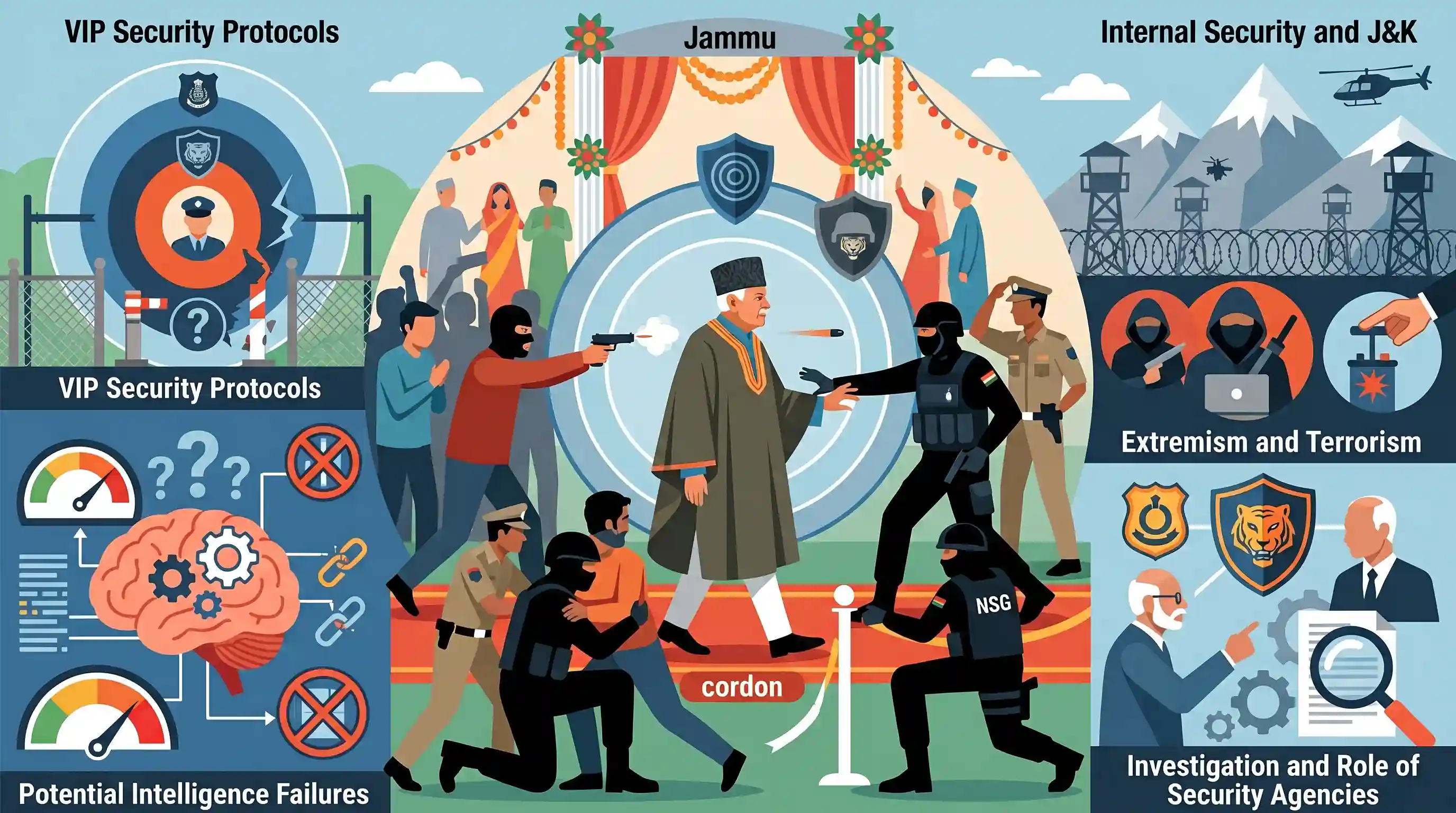
Former Jammu and Kashmir Chief Minister Farooq Abdullah narrowly survived an assassination attempt after an armed assailant breached his Z+ security cordon at a wedding in Jammu. The attacker, identified as Kamal Singh, fired a shot from point-blank range but was thwarted by Abdullah's close protection team. The glaring security breach around an NSG-protected leader has drawn sharp criticism from current J&K Chief Minister Omar Abdullah, prompting calls for an investigation into potential intelligence failures and the efficacy of VIP security protocols in the sensitive region.
Key Points
- Former J&K Chief Minister Farooq Abdullah survived an assassination attempt at a wedding ceremony in Jammu.
- An armed assailant, Kamal Singh, breached the security cordon and fired a shot from point-blank range, which was deflected by the close protection team.
- The incident has sparked widespread concerns over a major security lapse, as Farooq Abdullah is a Z+ NSG protectee.
- J&K Chief Minister Omar Abdullah and other leaders have demanded a thorough investigation into how the attacker bypassed stringent VIP security protocols.
Important Terms
Z+ Security

The highest tier of personal security in India (excluding the Prime Minister's SPG), comprising approximately 55 personnel, including elite commandos and local police.
UPSC context
Relevant for GS Paper III (Internal Security); tests knowledge of the multi-tier security framework and threat assessment protocols.
National Security Guard (NSG)
A federal contingency force under the Ministry of Home Affairs, specialized in counter-terrorism, hostage rescue, and protecting high-risk individuals (Black Cats).
UPSC context
GS Paper III (Internal Security); focuses on the role, mandate, and evolution of specialized security agencies in India.
National Conference (NC)
The oldest regional political party in Jammu and Kashmir, founded in 1932; it plays a critical role in the region's mainstream democratic process.
UPSC context
GS Paper II (Polity); essential for understanding regional political dynamics and the history of J&K's integration.
Advance Security Liaison (ASL)
A protocol involving a physical survey and sanitization of a venue by security agencies 24-48 hours before a VVIP's visit to prevent security breaches.
UPSC context
GS Paper III (Security Challenges); tests understanding of tactical protocols for VIP protection and inter-agency coordination.
Jammu and Kashmir Police (JKP)
The primary law enforcement agency of the Union Territory, responsible for internal security, counter-insurgency, and local intelligence gathering (HUMINT).
UPSC context
GS Paper III (Internal Security); highlights the role of state/UT police in conflict zones and intelligence-led policing.
Prelims Trap
Z+ security is provided to former Chief Ministers of sensitive states as a statutory mandate under the SPG Act.
VIP security (Z+) is an executive provision based on MHA threat perception, not a statutory right. SPG cover is restricted exclusively to the current Prime Minister.
Static Concepts Connected
How is VIP civilian security categorized and governed in India?
- Threat perception: The Ministry of Home Affairs assigns security levels based on continuous threat perception reports from central intelligence agencies like the IB.
- Security tiers: Categories range from X (lowest) to Z+ (highest civilian), determining the troop deployment scale. The SPG is an exclusive category reserved only for the Prime Minister.
- Executive action: Protection protocols are governed by the MHA's "Yellow Book," making it an executive decision rather than a legislative mandate.
What is the core mandate of the National Security Guard (NSG)?
- Federal contingency: Raised under the NSG Act 1986 as a Federal Contingency Force for specialized anti-terror, anti-hijacking, and hostage rescue operations.
- Mandate shift: The Union Government is actively withdrawing NSG "Black Cat" commandos from VIP security details to refocus them strictly on core counter-terrorism missions.
Cross-Topic Patterns
NSG restructuring & CAPF deployment
The withdrawal of NSG from VIP duties shifts the protective burden entirely to Central Armed Police Forces (like CRPF and CISF), expanding their operational footprint.
Targeted violence in post-370 J&K
Assassination attempts on prominent mainstream leaders reflect ongoing efforts by non-state actors to destabilize the democratic and political processes in the Union Territory.

Expect a prelims statement on SPG vs Z+ security, specifically testing the 2019 SPG Act amendment and NSG's shifting non-VIP mandate.
Linked PYQs · 3
Linked PYQs · 3
- 2023MainsGS3
Winning of 'Hearts and Minds' in terrorism-affected areas is an essential step in restoring the trust of the population. Discuss the measures adopted by the Government in this respect as part of the conflict resolution in Jammu and Kashmir.
- 2023MainsGS3
What are the internal security challenges being faced by India? Give out the role of Central Intelligence and Investigative Agencies tasked to counter such threats.
- 2021MainsGS3
Analyse the multidimensional challenges posed by external state and non-state actors, to the internal security of India. Also discuss measures required to be taken to combat these threats.
