Security Lapse Incident Sparks Outrage in Jammu and Kashmir Assembly
Source:Indian Express ↗
Why It Matters
The security of prominent political figures is a crucial component of maintaining democratic stability in sensitive regions like J&K. This incident is highly relevant for UPSC aspirants as it bridges GS-3 (Internal Security challenges, role of non-state actors) and GS-2 (Centre-State relations, powers of the Lieutenant Governor vs. elected legislature concerning public order).
Summary
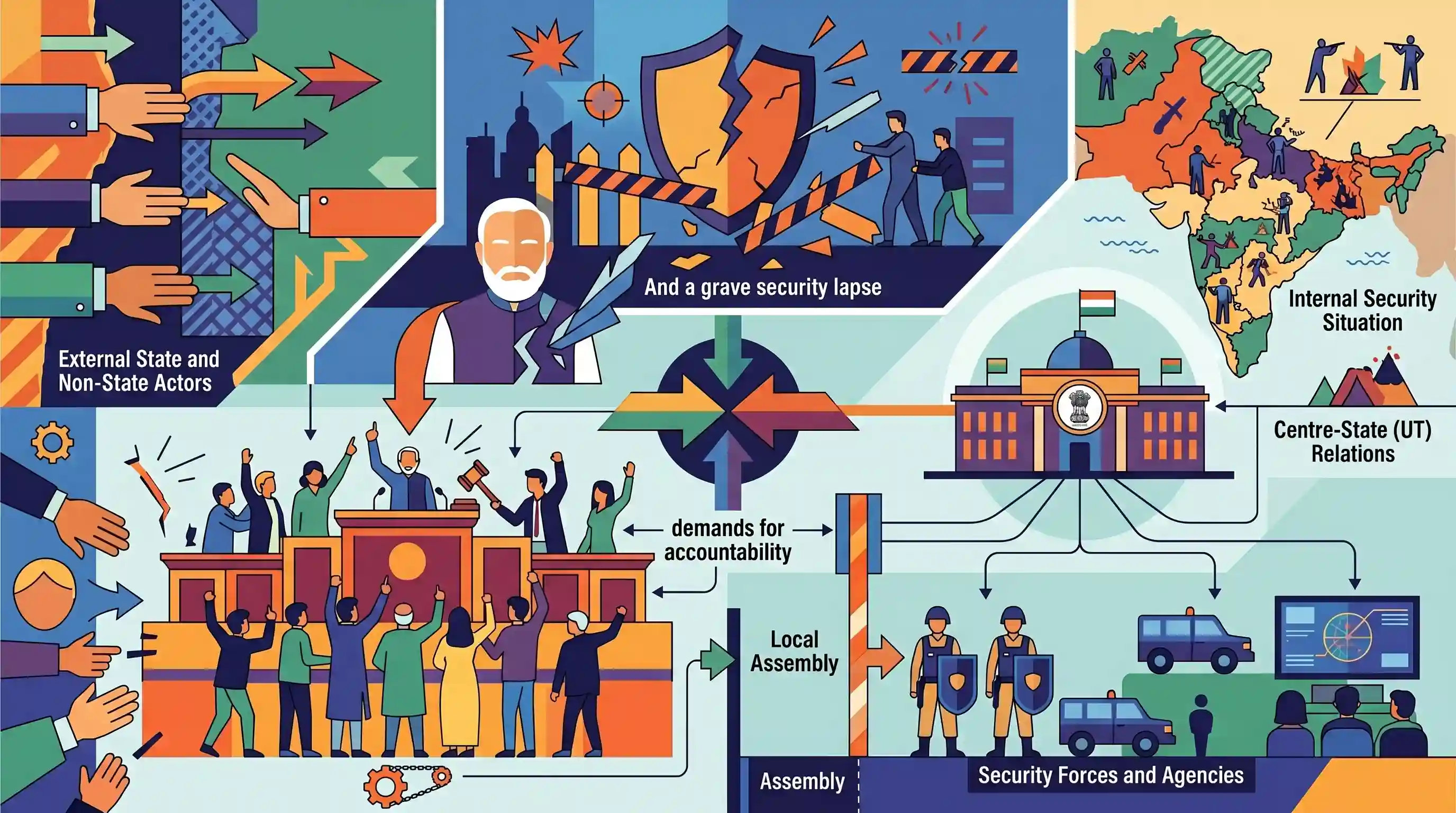
An attack on former Chief Minister Farooq Abdullah has triggered intense outrage in the Jammu and Kashmir Legislative Assembly, with legislators condemning the event as a "grave security lapse." The uproar brings into sharp focus the broader internal security situation in the Union Territory and the vulnerability of political leaders to extremist threats. Additionally, the incident highlights a governance dilemma: while the elected Assembly demands accountability for law and order, the policing and security apparatus remain under the control of the Lieutenant Governor and the Union Government, illustrating the complexities of Centre-State (UT) relations in J&K.
Key Points
- An attack on veteran political leader Farooq Abdullah has sparked widespread outrage in the newly elected J&K Assembly, with lawmakers describing it as a grave security lapse.
- The incident raises serious concerns regarding the safety protocols and threat assessments for high-profile political figures in a sensitive, conflict-prone region.
- Because 'public order' and 'police' in the Union Territory of J&K fall under the jurisdiction of the Lieutenant Governor (and the Union Home Ministry), the assembly's uproar highlights the structural friction between the elected local government and the Centre's security apparatus.
- This event underscores the persistent internal security challenges in J&K, demanding flawless intelligence and coordination among security forces to protect democratic processes and leaders.
Important Terms
Jammu and Kashmir Legislative Assembly

The unicameral legislature for the Union Territory of Jammu and Kashmir, reconstituted after 2024 elections. It has powers to legislate on most State List subjects except 'Police' and 'Public Order'.
UPSC context
GS II: Functions and responsibilities of the Union and the States; issues related to the federal structure of Union Territories.
Lieutenant Governor (LG)
The Union-appointed administrator of Jammu and Kashmir who exercises discretionary powers over 'Police', 'Public Order', and 'Services' (bureaucracy) under the J&K Reorganisation Act, 2019.
UPSC context
GS II: Role of the Governor/LG and the friction between elected governments and central appointees in UTs.
Jammu & Kashmir National Conference (JKNC)
A major regional political party in J&K founded in 1932. It currently heads the elected government and historically champions the region's autonomy and the restoration of statehood.
UPSC context
GS II: Political parties and pressure groups; regionalism and its impact on Indian federalism.
Union Ministry of Home Affairs (MHA)
The nodal central ministry responsible for India's internal security and the administration of Union Territories. It directly oversees J&K's security apparatus via the Lieutenant Governor.
UPSC context
GS III: Internal security challenges and the role of various security forces and agencies.
Public Order
A constitutional category (Seventh Schedule, List II) concerning the prevention of crime and maintenance of peace. In J&K UT, this subject is reserved for the Union Government.
UPSC context
GS II: Seventh Schedule; distribution of legislative powers; and the unique constitutional status of certain regions.
Z+ Security
The highest level of security detail in India, provided to high-risk individuals. It includes a multi-layered shield of personnel from the NSG, CRPF, and local police.
UPSC context
GS III: Security challenges and their management in border and conflict-prone areas.
Prelims Trap
"The Chief Minister of Jammu and Kashmir has joint executive authority over the police and public order."
Section 32 of the J&K Reorganisation Act, 2019 explicitly removes "Police" and "Public Order" from the Assembly's purview, placing them entirely under the LG.
Static Concepts Connected
How does the legislative jurisdiction of the J&K UT Assembly compare to Delhi?
- Police & Order: Both the J&K and Delhi legislative assemblies are constitutionally barred from legislating on 'Police' and 'Public Order'.
- Land Control: Unlike Delhi (where 'Land' is under Central jurisdiction via the LG), the J&K Assembly retains legislative competence over 'Land' matters.
- Executive Routing: Recent J&K Transaction of Business rules mandate that police and anti-corruption proposals route directly via the Chief Secretary to the LG, completely bypassing the CM.
How is VIP security structurally managed and categorized in India?
- Threat Assessment: Categorization into tiers (X, Y, Y+, Z, Z+) is strictly based on continuous threat perception reports generated by central intelligence agencies (IB/R&AW).
- SPG Mandate: Following the 2019 amendment to the SPG Act, the Special Protection Group is strictly mandated to protect only the Prime Minister.
- Guarding Forces: High-risk VIP protection is increasingly handled by the CRPF's dignitary protection wing and CISF, freeing the elite NSG to focus solely on counter-terrorism.
Cross-Topic Patterns
Asymmetric federalism & UT governance
The constitutional friction in J&K mirrors Delhi's Article 239AA struggles, connecting Union Territory governance structures to broader GS2 Mains debates on asymmetric federalism and the limits of representative government.
CAPF mandate realignments
Shifting Z/Z+ security burdens to the CRPF links political violence threats in conflict zones with the ongoing structural optimization of Central Armed Police Forces.

Compare-and-contrast statements mapping J&K's 2019 Reorganisation Act boundaries against Delhi's Article 239AA are highly likely in 2026.
Linked PYQs · 4
Linked PYQs · 4
- 2020MainsGS3
Analyze internal security threats and transborder crimes along Myanmar, Bangladesh and Pakistan borders including Line of Control (LoC). Also discuss the role played by various security forces in this regard.
- 2021MainsGS3
Analyse the multidimensional challenges posed by external state and non-state actors, to the internal security of India. Also discuss measures required to be taken to combat these threats.
- 2024MainsGS2
What changes has the Union Government recently introduced in the domain of Centre-State relations ? Suggest measures to be adopted to build the trust between the Centre and the States and for strengthening federalism.
- 2023MainsGS2
Discuss the role of Presiding Officers of state legislatures in maintaining order and impartiality in conducting legislative work and in facilitating best democratic practices.
