Agrivoltaics Integration and Crop Yield Impacts in India
Source:Indian Express ↗
આ શા માટે મહત્વનું છે
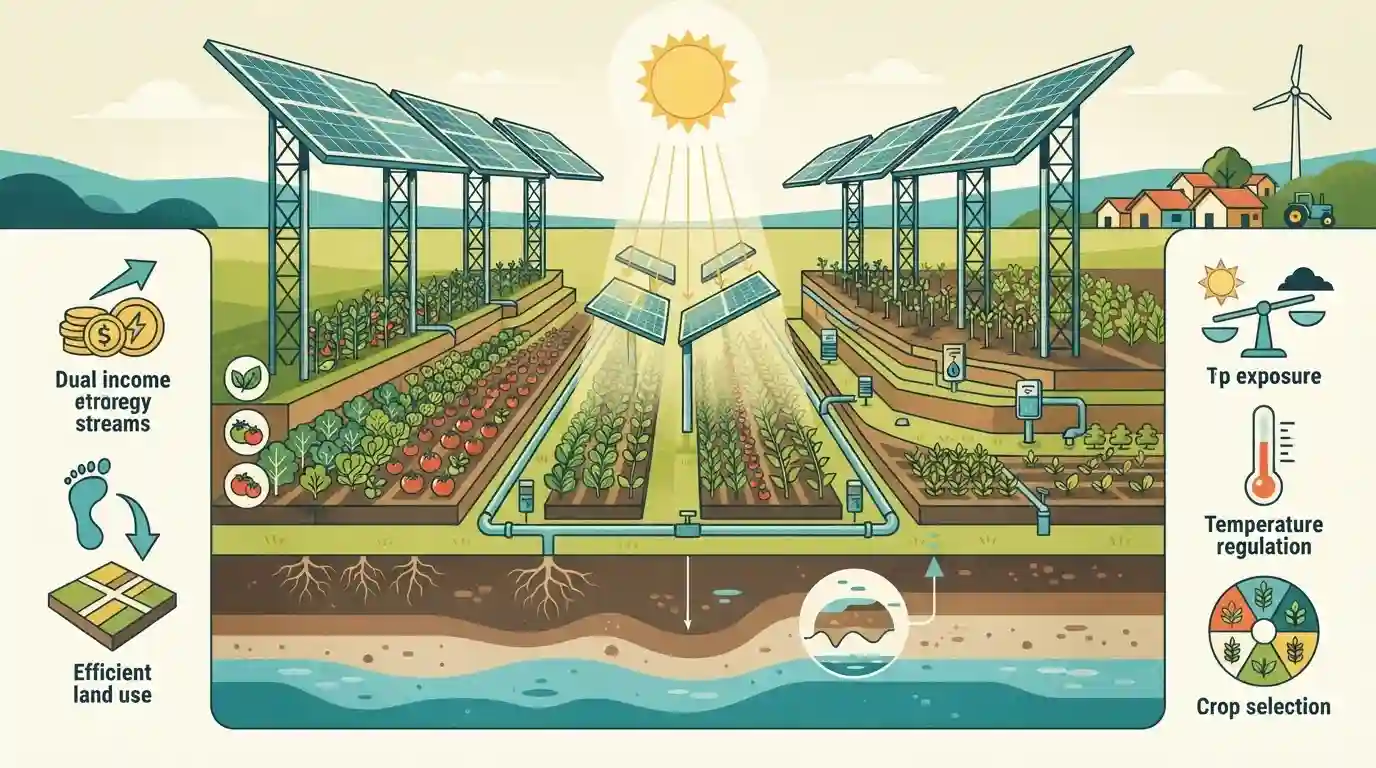
Agrivoltaics presents a novel solution to land scarcity, balancing India's aggressive renewable energy targets with food security and farmers' income enhancement.
સારાંશ
The article explores the concept of agrivoltaics in India—the simultaneous use of land for both agricultural production and solar energy generation. It highlights how agrivoltaics provides dual income and land-use efficiency, but also discusses challenges like shading impacts on crop yields, requiring careful design and crop selection to ensure agricultural sustainability.
મુખ્ય મુદ્દા
- Agrivoltaics combines agricultural crop production with solar photovoltaic energy generation on the same piece of land.
- While it offers dual land-use benefits and additional income for farmers, improper implementation or excessive shading can sometimes hurt crop yields.
- Optimizing panel height, spacing, and crop selection (shade-tolerant crops) is essential for balancing renewable energy generation and food security in India.
મહત્વપૂર્ણ શબ્દો
Agrivoltaics

The simultaneous use of agricultural land for both crop cultivation and solar photovoltaic energy generation, optimizing land use efficiency and providing dual income streams for farmers.
UPSC context
GS Paper III (Agriculture & Infrastructure / Renewable Energy). Tests integration of sustainable energy solutions with food security and land-use planning.
PM-KUSUM Scheme
A central scheme aimed at ensuring energy security for farmers in India through decentralized solar power generation, solar pumps, and the solarization of grid-connected agricultural pumps.
UPSC context
GS Paper III (Government Policies & Interventions / Renewable Energy). Important for questions on farmer income enhancement and solar transition.
પ્રિલિમ્સ ટ્રેપ
agrivoltaics universally boosts agricultural yields alongside solar power generation on the same land parcel
Aspirants often assume agrivoltaics benefits all crops equally; however, full-sunlight staples like wheat and rice suffer 15-20% yield losses due to panel shading.
સંલગ્ન સ્થિર ખ્યાલો
What are the primary objectives and components of the PM-KUSUM scheme in India?
- Triple Component: Three components focus on installation of decentralized solar pumps, setting up grid-connected solar power plants on barren lands, and solarizing grid-connected agricultural pumps.
- Farmer Income: Aims to provide energy security to farmers while increasing their income by utilizing unproductive or agricultural land for solar generation.
- Financial Support: Provides central financial assistance alongside state subsidies and bank financing to reduce the diesel subsidy burden on the exchequer.
આંતર-વિષય પેટર્ન
Agrivoltaics + PM-KUSUM + Land Use Law
Agrivoltaics intersects renewable energy expansion (PM-KUSUM) with agrarian distress mitigation, highlighting how land-use laws regulate dual-purpose innovations.
Solar Panels + Microclimate + Climate-Smart Agriculture
Water-saving micro-climate effects of panels connect renewable energy infrastructure directly to climate-smart agriculture adaptation strategies.

Agrivoltaics (dual land use) will likely appear as a statement-based question combining energy efficiency, crop yield, and capex barriers.
સંલગ્ન PYQ · 2
સંલગ્ન PYQ · 2
- 2021MainsGS3
What are the present challenges before crop diversification? How do emerging technologies provide an opportunity for crop diversification?
- 2019MainsGS3
How far is Integrated Farming System (IFS) helpful in sustaining agricultural production?
