World Bank Backs Agricultural Transformation Project in Uttar Pradesh
Source:worldbank ↗
Why It Matters
The intersection of agricultural technology, digital infrastructure (UP-AGRIVERSE), and foreign investment in UP's primary sector represents a major shift toward climate-smart farming. For UPPSC, understanding state-specific schemes (UP-AGREES), technical agrarian concepts like Direct Seeded Rice (DSR) and their ecological benefits (reducing methane emissions compared to traditional waterlogged paddies), and aquaculture advancements is crucial for both prelims and mains.
Summary
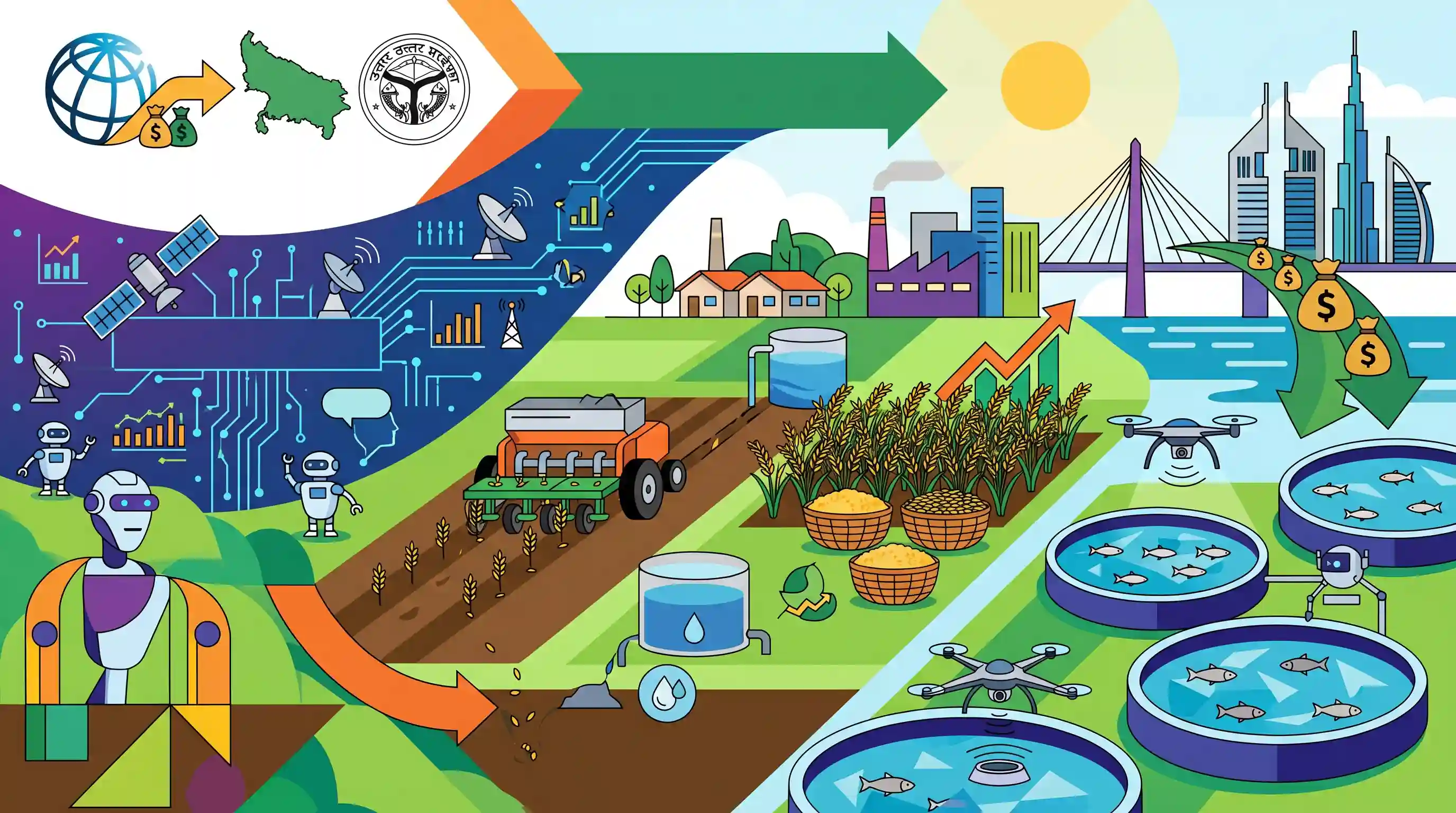
The World Bank Group, in partnership with the Government of Uttar Pradesh, is implementing the UP-AGREES project under its AgriConnect initiative to transform the state's rural economy. The project features climate-resilient technologies such as Direct Seeded Rice (DSR) to lower costs and water consumption while boosting rice yields. It is supported by 'UP-AGRIVERSE' (a digital platform running 'small AI' models) and a major $461 million foreign investment from Dubai's Aqua Bridge to modernize UP's aquaculture (pisciculture) sector through drone and AI technologies.
Key Points
- AgriConnect is a World Bank Group global initiative aiming to help 300 million smallholder farmers transition from subsistence to surplus.
- In Uttar Pradesh, the initiative is implemented through the UP-AGREES project, which promotes Direct Seeded Rice (DSR) as a low-emission, cost-efficient, and high-yield cultivation alternative.
- Direct Seeded Rice (DSR) involves planting seeds directly into fields instead of transplanting seedlings into water-logged paddies. It reduces cultivation costs by up to INR 10,000 (~$120) per hectare, boosts yields to up to 9 tonnes/ha, and saves significant water while curbing methane emissions.
- UP-AGRIVERSE is the project's digital backbone that integrates market info, advisory services, and financial tools using 'small AI' models operable on basic smartphones, built in collaboration with partners like Google and Networks for Humanity.
- Dubai-based firm Aqua Bridge is investing $461 million in Uttar Pradesh's aquaculture (pisciculture) sector, marking the state's largest foreign investment in modernizing fish and shrimp farming using AI-driven drones.
- A regional tech partnership involving the World Bank, EkStep Foundation, and the Maharashtra government is developing multilingual, open-source AI tools for real-time agricultural advisory.
Important Terms
UP-AGREES

A $325 million, six-year World Bank-assisted initiative (2025–2031) in Uttar Pradesh aimed at boosting farmers' incomes through climate-resilient practices, digital services, and modernized agricultural value chains in Eastern UP and Bundelkhand.
UPSC context
GS Paper III (Agriculture & Climate-Smart Farming); tests state-led developmental projects and rural economy transformation.
AgriConnect Initiative
A global flagship initiative by the World Bank Group designed to connect smallholder farmers to markets, infrastructure, digital networks, and finance to boost productivity, climate resilience, and transition them from subsistence to surplus farming.
UPSC context
GS Paper III (Agricultural Marketing & Technology); tests knowledge of international development frameworks and multilateral initiatives.
UP-AGRIVERSE
A state-wide digital agriculture ecosystem serving as the technology backbone of UP-AGREES. It integrates market data, AI-driven advisory, and financial services accessible on basic smartphones in low-bandwidth rural areas.
UPSC context
GS Paper III (E-technology in aid of farmers); tests understanding of Digital Public Infrastructure (DPI) and AI in agriculture.
UPDASP
The state nodal agency and Project Coordination Unit in Uttar Pradesh responsible for monitoring, planning, and implementing agricultural diversification programs, including the World Bank-assisted UP-AGREES project.
UPSC context
GS Paper III (Agriculture & State Agencies); tests institutional mechanisms for crop diversification and development project execution.
Aqua Bridge
A Dubai-based aquaculture company that signed a $461 million partnership under UP-AGREES to establish a major intensive aquaculture farm, hatchery, and research center in Unnao to modernize Uttar Pradesh's fisheries sector.
UPSC context
GS Paper III (Economics of Animal Rearing/Blue Economy); tests foreign direct investment, private partnerships, and tech adoption in allied sectors.
Networks for Humanity
A global non-profit organization funded by Google.org that builds universal open-source digital infrastructure (such as the Beckn protocol) to deploy interoperable networks for agriculture, healthcare, and skilling in emerging markets.
UPSC context
GS Paper III (Science & Technology/DPI); tests open-source public networks, global non-profit partnerships, and inclusive digital technologies.
Prelims Trap
Direct Seeded Rice (DSR) inherently reduces herbicide requirements compared to traditional transplanting due to the absence of early-stage flooding.
DSR actually increases weed growth because the lack of standing water allows weeds to germinate alongside rice, making herbicide dependency higher than in conventional puddling.
Static Concepts Connected
What is Direct Seeded Rice (DSR) and how does it differ from traditional transplanting?
- No nursery stage: Seeds are sown directly into the main field using tractor-mounted drills, completely bypassing the nursery raising and manual transplanting phases.
- Water savings: Saves up to 15-20% irrigation water by eliminating the need for puddling (soil churning under flooded conditions) and continuous ponding.
- Emission reduction: Significantly lowers methane emissions as anaerobic, waterlogged soil conditions are minimized during the crop's early vegetative growth stages.
- Weed challenge: Weed management is a major challenge; absence of standing water allows weeds to grow aggressively, requiring chemical or manual weed control.
What are the core objectives and features of the Pradhan Mantri Matsya Sampada Yojana (PMMSY)?
- Infrastructure boost: Modernizes the fisheries supply chain, focusing on genetic improvement of fish seed, post-harvest infrastructure, and establishing robust cold chains.
- Productivity target: Enhances productivity to help double fishers' incomes while driving sustainable exploitation of both marine and inland water resources.
- Tech integration: Encourages adoption of technology like Recirculating Aquaculture Systems (RAS), biofloc, and drone-based feeding and water-monitoring.
Cross-Topic Patterns
Agri-tech & Digital Public Infrastructure (DPI)
Leveraging open-source 'small AI' platforms like UP-AGRIVERSE mirrors India's DPI strategy, linking GS3 agricultural extension with digital governance and inclusive technology adoption.
Climate Smart Agriculture & International Finance
World Bank-assisted projects like UP-AGREES showcase how multilateral climate finance targets local adaptation, directly connecting international environmental commitments to grassroot state-level agricultural policies.

Multi-statement questions in 2026 may test DSR's water/methane-saving trade-offs alongside multilateral agri-finance projects like UP-AGREES.
Linked PYQs · 3
Linked PYQs · 3
- 2014UPPSC_PRELIMSGS1
Methane gas emanates from
- 2016UPPSC_PRELIMSGS1
Match List-I with List-II and select the correct answer from the codes given below the lists: List-I: (A) Viticulture (B) Olericulture (C) Pisciculture (D) Arboriculture List-II: 1. Vegetable farming 2. Fish farming 3. Tree farming 4. Grapes farming
- 2023UPPSC_PRELIMSGS1
The aquatic plant commonly used as bio fertilizer in the water-logged rice field is -
