Agrarian Protests Against Electricity Amendment Bill
Source:Indian Express ↗
Why It Matters
This article reflects the persisting resistance from agrarian and labour groups against sweeping structural reforms. It covers overlapping GS3 themes—such as the Seed Bill, the Electricity Amendment Bill, FTAs in agriculture, and labour codes—illustrating the socioeconomic friction caused by moves toward corporatization and privatization.
Summary
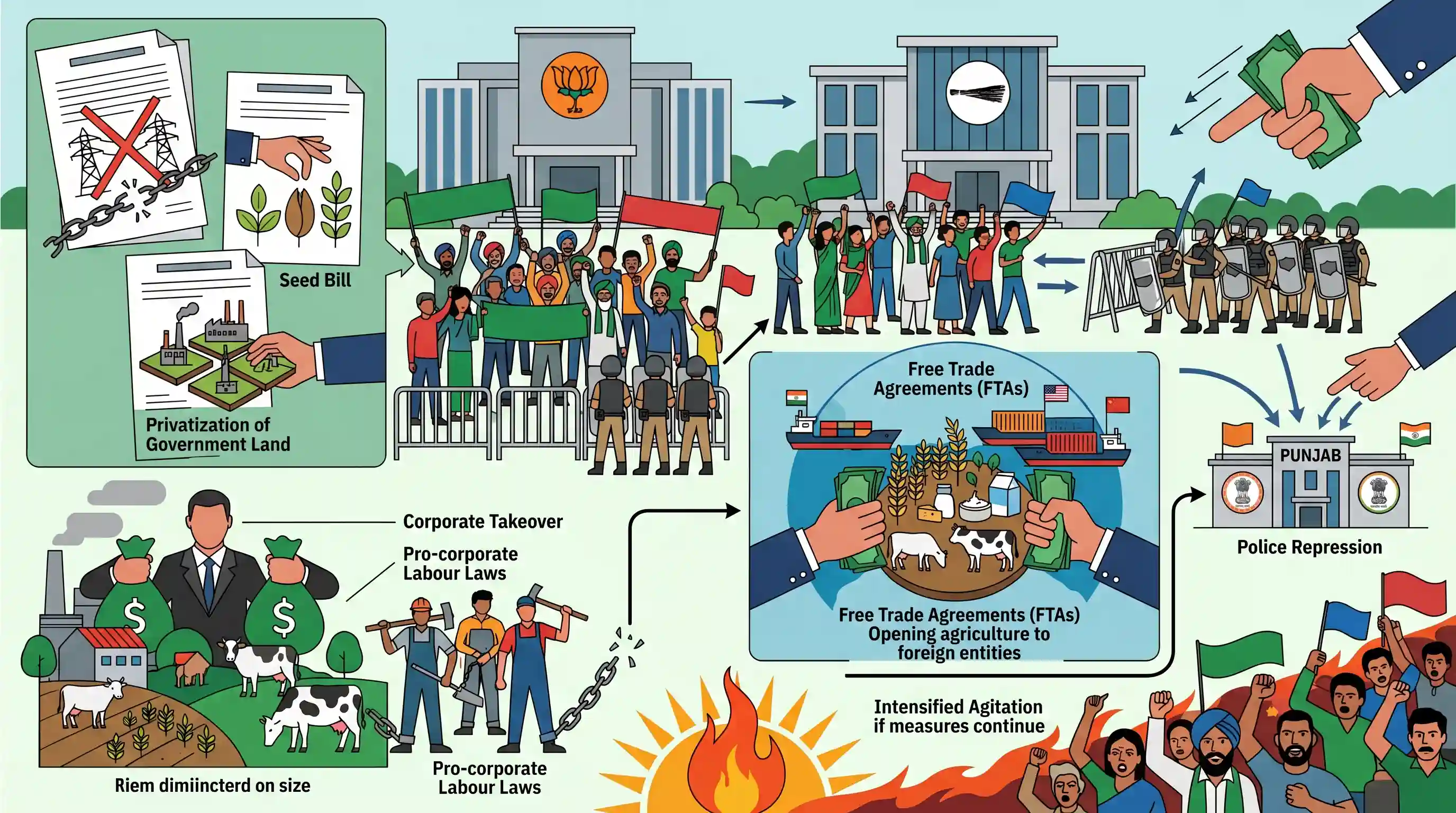
Responding to a call by the Samyukt Kisan Morcha, farmers and trade union members staged joint protests in Mohali outside the offices of the BJP and an AAP MLA. They voiced strong opposition to the Electricity Amendment Bill 2025 and a proposed Seed Bill, arguing these policies facilitate a corporate takeover of agriculture. The demonstrators also condemned government attempts to open the agriculture and dairy sectors to foreign entities via Free Trade Agreements (FTAs), the privatization of government land, and recent pro-corporate amendments to labour laws. They accused the Punjab government of acting on central directives using police repression and warned of intensified agitation if the measures are not withdrawn.
Key Points
- Farmers and trade union members, led by the Samyukt Kisan Morcha, held protests outside AAP and BJP offices in Mohali.
- Protesters are opposing the Electricity Amendment Bill 2025 and a newly proposed Seed Bill, alleging they facilitate corporate control over Indian agriculture.
- Demonstrators criticized the government's push for Free Trade Agreements (FTAs), arguing they will hand over the agriculture and dairy sectors to foreign corporations.
- The protests also condemned the selling off of government land and recent amendments to labour laws, which are perceived to favor corporate interests at the expense of workers.
- Unions accused the Punjab government of deploying police repression to implement these pro-corporate policies and warned of intensified agitations.
Important Terms
Electricity Amendment Bill 2025

A proposed law (Draft 2025) to reform the power sector by introducing competition in distribution, mandating cost-reflective tariffs, and rationalizing cross-subsidies to improve DISCOM financial health.
UPSC context
GS-3 Infrastructure (Energy); tests understanding of federalism in the Concurrent List and power sector reforms.
Seeds Bill 2025
Proposed legislation replacing the Seeds Act 1966, mandating compulsory registration of seed varieties to ensure quality, while sparking concerns over corporate control and traditional seed-saving rights.
UPSC context
GS-3 Agriculture; relates to farm inputs, intellectual property rights, and the balance between corporate innovation and farmer sovereignty.
Samyukt Kisan Morcha (SKM)
An umbrella coalition of over 400 Indian farmers' unions formed in 2020 to lead protests against market-oriented agricultural reforms and demand legal guarantees for Minimum Support Price (MSP).
UPSC context
GS-2 Pressure Groups; tests knowledge of agrarian movements and their influence on democratic policy-making processes.
Free Trade Agreements (FTAs)
Agreements between countries to reduce or eliminate trade barriers. In agriculture, these are sensitive due to competition from high-productivity foreign dairy and grain markets.
UPSC context
GS-2/GS-3 International Relations/Economy; focuses on trade's impact on domestic livelihoods and sensitive sectors like dairy.
Cross-subsidy
A tariff mechanism where higher-paying consumers (industrial/commercial) subsidize lower-paying ones (farmers/households). The 2025 Bill proposes its gradual elimination for certain sectors.
UPSC context
GS-3 Economy; tests understanding of fiscal policy, equity in utility pricing, and DISCOM viability.
Prelims Trap
Farmers in India are legally barred from saving and resowing protected plant and seed varieties.
Under the PPV&FR Act 2001, farmers can save, exchange, and sell seeds of protected varieties. The restriction only applies to selling them as "branded" packaged seeds.
Static Concepts Connected
What are the key farmers' rights under the PPV&FR Act, 2001?
- Seed saving: Farmers can save, use, exchange, and sell seeds of protected varieties, provided they do not sell them under a commercial brand name.
- Compensation right: Farmers can claim compensation if the propagating material of a registered variety fails to provide the expected yield under specified conditions.
- Innocent infringement: Protects farmers from prosecution if they can prove they were unaware of the existence of the breeder's right at the time of the infringement.
What are the major structural changes introduced by the new Labour Codes?
- Law consolidation: Simplifies and merges 29 central labour laws into four distinct codes covering Wages, Industrial Relations, Social Security, and Occupational Safety.
- Strike regulations: Mandates a 14-day advance notice before a strike in any establishment, extending a rule previously restricted only to public utility services.
- Retrenchment threshold: Raises the employee threshold from 100 to 300 for establishments needing prior government permission for closure, lay-offs, or retrenchment.
Cross-Topic Patterns
FTAs and domestic dairy protectionism
India's caution in FTAs (like the EU or past RCEP) is heavily driven by agrarian pressure groups aiming to protect smallholder dairy cooperatives from heavily subsidized, cheap foreign imports.
Power subsidies and the water-energy nexus
Resistance to the Electricity Amendment Bill's push for Direct Benefit Transfers over flat free power exposes the tension between state fiscal health, groundwater conservation, and agrarian populism.

Expect a 2026 GS3 question evaluating how agricultural pressure groups influence structural economic reforms across FTAs, power, and labour.
Linked PYQs · 3
Linked PYQs · 3
- 2024MainsGS3
Discuss the merits and demerits of the four 'Labour Codes' in the context of labour market reforms in India. What has been the progress so far in this regard?
- 2023MainsGS3
What are the direct and indirect subsidies provided to farm sector in India? Discuss the issues raised by the World Trade Organization (WTO) in relation to agricultural subsidies.
- 2016MainsGS3
Discuss the role of land reforms in agricultural development. Identify the factors that were responsible for the success of land reforms in India.
