US-India Trade Deal Sparks Farmer Protests Over MSP and GM Crops
Source:Indian Express ↗
Why It Matters
The issue underscores the critical intersection of domestic agricultural policy and international trade. It is highly relevant for UPSC aspirants as it illustrates the vulnerabilities of Indian farmers to global market forces, the importance of protective measures like MSP, and the ongoing international pressures from developed nations and WTO frameworks on India's agricultural subsidies.
Summary
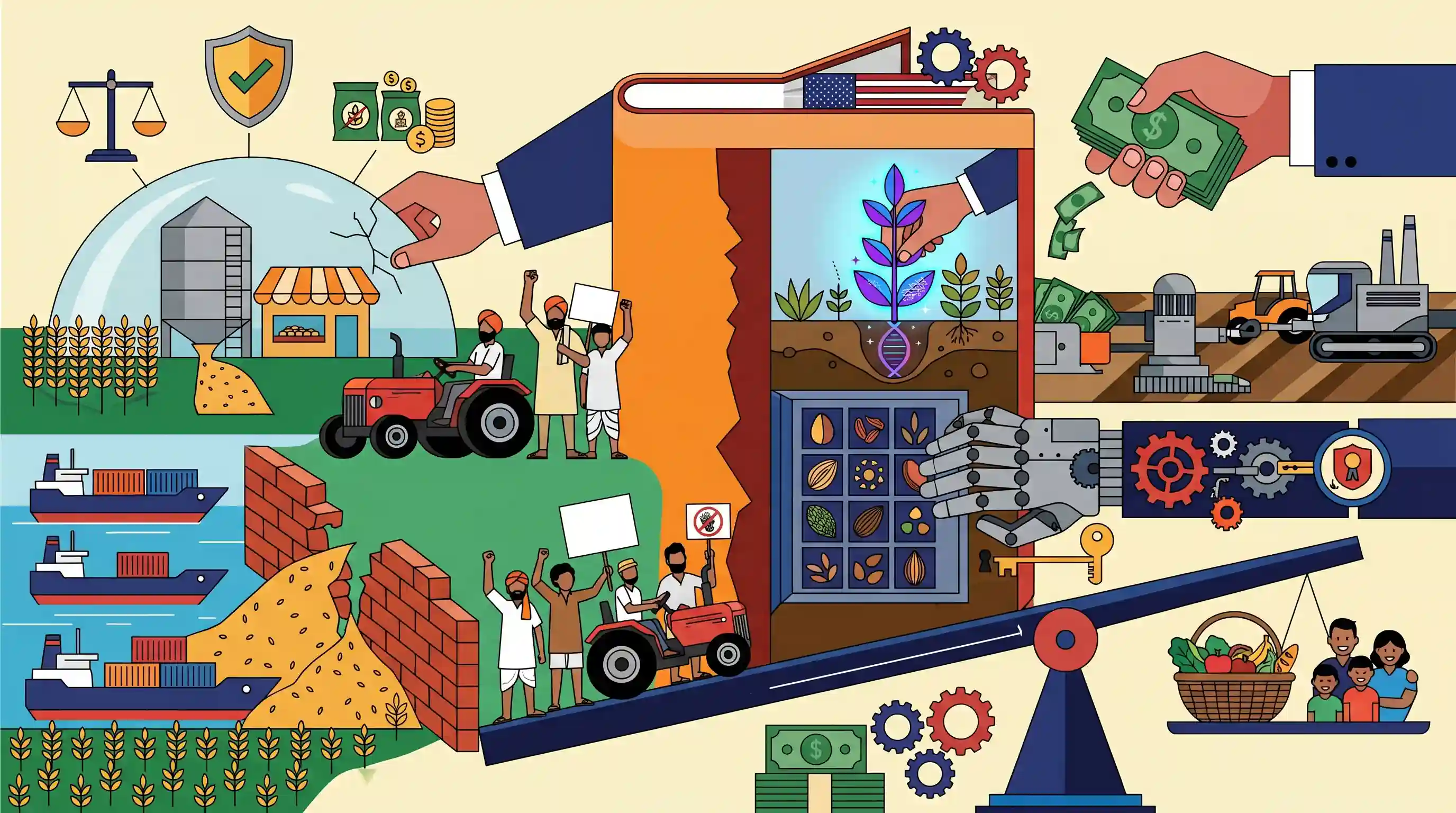
Indian farmer unions are organizing strikes against a proposed US-India trade deal framework, expressing deep concerns over its potential impact on domestic agriculture. Farmers fear that the deal will necessitate a reduction in import tariffs, exposing India to cheap, highly subsidized agricultural imports from the US that could undercut local prices. Furthermore, there is anxiety that such bilateral agreements might force India to accept Genetically Modified (GM) crops, compromise on seed sovereignty through stricter intellectual property laws, and dilute essential safety nets like the Minimum Support Price (MSP) and agricultural subsidies. The protests highlight the ongoing tension between global trade liberalization and the protection of domestic food security and farmer livelihoods.
Key Points
- Indian farmer unions have called for a strike protesting the proposed US-India trade deal framework over fears that it will negatively impact the domestic agricultural sector.
- Protesters are concerned that reducing import tariffs would lead to the dumping of highly subsidized US agricultural products in Indian markets, threatening the livelihoods of small and marginal farmers.
- There are apprehensions that the trade deal might push for the entry of Genetically Modified (GM) crops and enforce stricter intellectual property rights on seeds.
- The negotiations could put pressure on India to alter its agricultural subsidy regime and the Minimum Support Price (MSP) system, echoing long-standing disputes at the WTO.
Important Terms
Minimum Support Price (MSP)

A government-guaranteed floor price for specific crops, protecting farmers against market price volatility and ensuring remunerative returns for their harvest.
UPSC context
GS Paper-3: Agriculture/Subsidies. Essential for analyzing farmer distress, procurement systems, and legal price guarantees.
Agreement on Agriculture (AoA)
A WTO treaty regulating global agricultural trade through three pillars: market access (reducing tariffs), domestic support (limiting subsidies), and export subsidies.
UPSC context
GS Paper-3: WTO & Agriculture. Tests understanding of global trade rules and India's stance on food security.
Seed Sovereignty
The right of farmers to control their own seed systems, including saving, sharing, and selling traditional seeds, protected in India under the PPV&FR Act.
UPSC context
GS Paper-3: Intellectual Property Rights (IPR). Crucial for discussing corporate monopolies and farmers' traditional rights.
Genetically Modified (GM) Crops
Crops with DNA altered via genetic engineering for specific traits like pest resistance. Only Bt cotton is commercially approved in India currently.
UPSC context
GS Paper-3: Science & Technology/Agriculture. Significant for biotechnology debates, environmental safety, and trade negotiations.
Amber Box Subsidies
A WTO category for trade-distorting domestic support, such as MSP. Developing countries must keep these below 10% of their total production value.
UPSC context
GS Paper-3: Agriculture Subsidies. Vital for understanding international disputes over India’s food security programs.
Public Stockholding (PSH)
A policy of procuring and storing food grains from farmers at administered prices to provide food security via the Public Distribution System (PDS).
UPSC context
GS Paper-3: Food Security. A major point of contention at the WTO regarding subsidy limits and international trade.
Prelims Trap
The WTO Peace Clause provides permanent immunity for India's MSP regime against all international trade agreements.
The Peace Clause only shields public stockholding programs from WTO dispute settlement under the AoA. It does not grant immunity from new bilateral FTA commitments.
Static Concepts Connected
How does the WTO categorize agricultural subsidies under the Agreement on Agriculture?
- Amber Box: Trade-distorting measures like MSP and fertilizer subsidies. Subject to a 10% de minimis limit of the total value of agricultural production for developing countries.
- Blue Box: Amber Box subsidies with conditions designed to limit production, thereby reducing trade distortion.
- Green Box: Non-trade distorting support like R&D, pest control, and decoupled direct income support. Exempt from reduction commitments.
How does India balance plant breeder IPR with farmers' seed sovereignty?
- PPV&FR Act 2001: Grants farmers the right to save, use, sow, exchange, and sell non-branded farm-saved seeds, prioritizing food security.
- UPOV Convention: An international framework heavily favoring corporate plant breeders. India resists joining the stricter 1991 version to protect domestic farmer seed rights.
Cross-Topic Patterns
RCEP to US-India: Agriculture stalls FTAs
India's withdrawal from RCEP and friction in Western FTAs both stem from protecting smallholder farmers against highly mechanized, subsidized foreign dairy and crop imports.
Biosafety regulations as Trade Barriers
Trade pacts increasingly target domestic environmental protections. Bilateral pressure to import US GM crops directly challenges India's GEAC appraisals under the Environment Protection Act 1986.

Expect a 2026 prelims question interlinking the PPV&FR Act, seed sovereignty, and WTO Agreement on Agriculture's subsidy constraints.
Linked PYQs · 5
Linked PYQs · 5
- 2023MainsGS3
What are the direct and indirect subsidies provided to farm sector in India? Discuss the issues raised by the World Trade Organization (WTO) in relation to agricultural subsidies.
- 2018MainsGS3
What do you mean by Minimum Support Price (MSP)? How will MSP rescue the farmers from the low income trap?
- 2025MainsGS3
What are the challenges before the Indian economy when the world is moving away from free trade and multilateralism to protectionism and bilateralism? How can these challenges be met?
- 2015PrelimsGS1
The terms 'Agreement on Agriculture', 'Agreement on the Application of Sanitary and Phytosanitary Measures' and 'Peace Clause' appear in the news frequently in the context of the affairs of the
- 2017MainsGS3
How do subsidies affect the cropping pattern, crop diversity and economy of farmers? What is the significance of crop insurance, minimum support price and food processing for small and marginal farmers?
