Sugarcane Pricing Disparities and Agricultural Policy Needs
Source:The Hindu ↗
Why It Matters
The article underscores the complexities of agricultural pricing, specifically the dual pricing structure of sugarcane (FRP and SAP), and the ongoing demand for transparency in yield assessments. It also touches upon the economic potential of ethanol production in rural areas, making it highly relevant for GS3 topics covering agricultural economics, farmer incomes, and renewable energy.
Summary
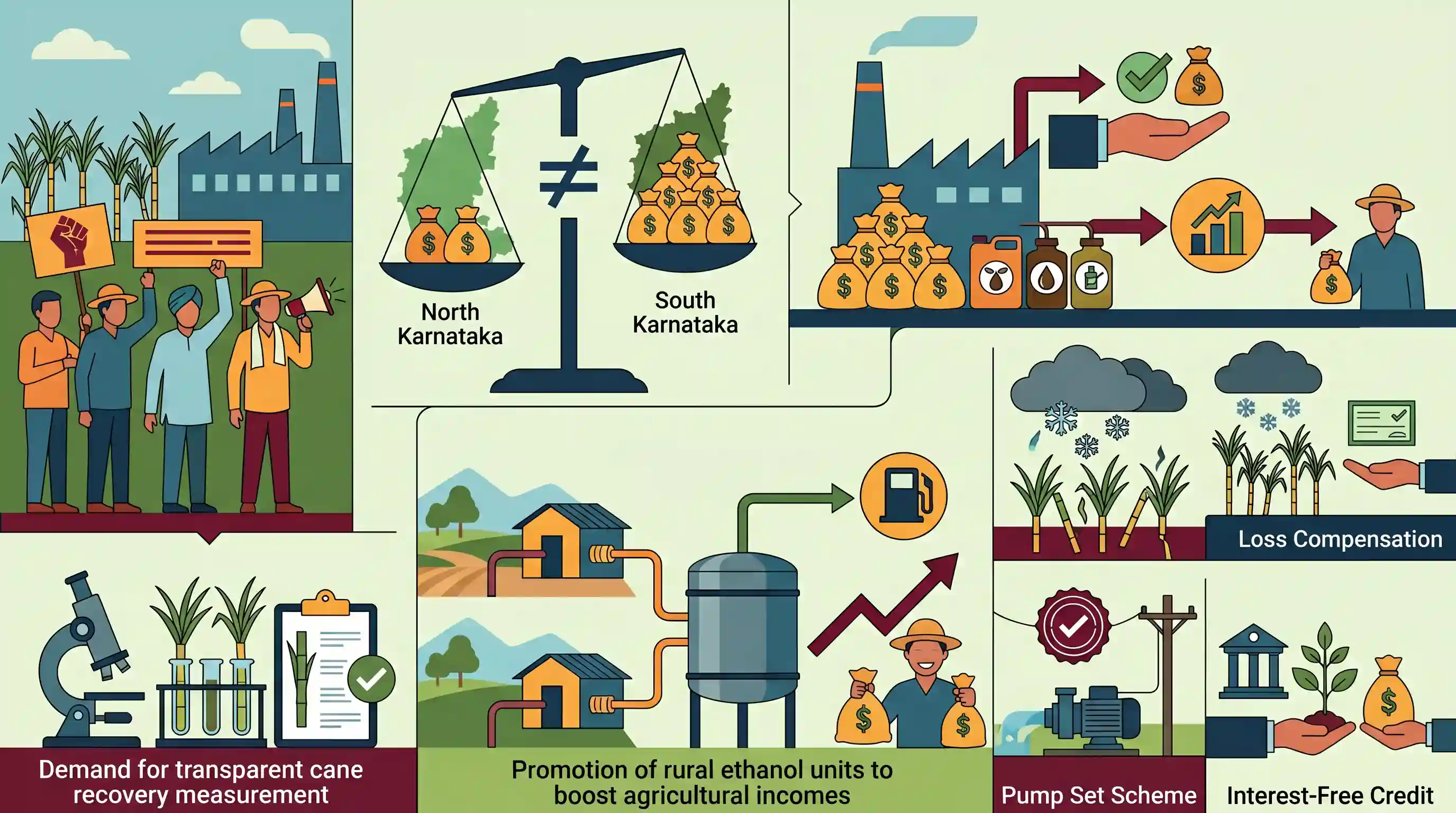
Sugarcane farmers in Mysuru staged protests demanding a uniform sugarcane pricing policy, citing a disparity of ₹800 per tonne between north and south Karnataka. Led by the Sugarcane Growers' Association, they demanded the clearance of pending dues from factories, additional payments from by-product profits, and on-site laboratories for transparent cane recovery measurement. The farmers also called for the promotion of rural ethanol production units to boost agricultural incomes and reduce import dependence. Furthermore, they urged the state government to provide compensation for crop loss due to hailstorms, revive the Akrama-Sakrama scheme for agricultural pump sets, and offer interest-free crop loans.
Key Points
- Sugarcane farmers in Mysuru are protesting the absence of a uniform pricing policy, highlighting an ₹800 per tonne gap between north and south Karnataka.
- Farmers demand an additional ₹100 per tonne from by-product profits, equally shared between sugar factories and the state government.
- Protesters seek on-site laboratories in sugar factories for transparent cane recovery measurement and the implementation of bipartite agreements to prevent harvesting delays.
- They urge the government to promote rural ethanol production units, modeled after dairy cooperatives, to boost income and reduce import dependence.
- Other demands include compensation for unseasonal hailstorm crop loss, revival of the Akrama-Sakrama scheme for pump sets, and interest-free crop loans up to ₹10 lakh.
Important Terms
Fair and Remunerative Price (FRP)

The minimum price sugar mills are legally mandated to pay farmers, fixed annually by the Central Government based on CACP recommendations.
UPSC context
GS Paper III: Agriculture/Pricing. Tests understanding of statutory price mechanisms for commercial crops vs. MSP for cereals.
State Advised Price (SAP)
The sugarcane price announced by individual state governments (e.g., Uttar Pradesh, Karnataka) that typically exceeds the Centre's FRP to provide higher farmer returns.
UPSC context
GS Paper III: Federalism in Agriculture. Tests knowledge of state-level interventions in agricultural markets and legal pricing authority.
Akrama-Sakrama scheme
A Karnataka state regularisation policy; in an agricultural context, it refers to legalising unauthorized irrigation pump sets to improve water and power management.
UPSC context
GS Paper II: Governance. Relevant for state-specific administrative reforms and the regularisation of informal agricultural infrastructure.
Ethanol Blending Programme (EBP)
A national initiative blending sugarcane-derived ethanol with petrol to reduce oil imports, lower vehicular emissions, and bolster agricultural income.
UPSC context
GS Paper III: Economy/Environment. Key for energy security, biofuels policy, and achieving climate commitments like E20 by 2025.
Cane Recovery Rate
The ratio of sugar produced to the weight of sugarcane crushed, used as a benchmark to determine the premium paid to farmers.
UPSC context
GS Paper III: Agriculture. Tests technical understanding of crop quality assessment and its impact on farm-gate pricing.
Sugarcane Procurement Board (Karnataka)
A statutory body in Karnataka that regulates sugarcane purchase, ensures transparent weighing, and determines revenue-sharing prices from by-products.
UPSC context
GS Paper II: Statutory Bodies. Relevant for regional administrative mechanisms that mediate between agro-industries and farmers.
Prelims Trap
"The Fair and Remunerative Price (FRP) for sugarcane is fixed and approved by the Commission for Agricultural Costs and Prices (CACP)."
The CACP only recommends the FRP. It is the Cabinet Committee on Economic Affairs (CCEA), chaired by the PM, that approves and announces it.
Static Concepts Connected
How does FRP differ from SAP in sugarcane pricing?
- Central FRP: Recommended by CACP and approved by CCEA. It is the minimum legal price sugar mills must pay across India, structurally linked to a base sugar recovery rate.
- State SAP: State Advised Price is declared by specific state governments under the Sugarcane (Control) Order, 1966. It is generally higher than FRP to account for regional input costs.
What is the 'Recovery Rate' and Rangarajan Committee's formula?
- Recovery Rate: The percentage of sugar produced relative to cane crushed. The base FRP is linked to a specific baseline recovery rate, with financial premiums given for higher recovery.
- Revenue Sharing Formula: The Rangarajan Committee (2012) recommended farmers receive 70% of mill revenues from sugar and major by-products (or 75% from sugar alone) to align pricing with market realities.
Cross-Topic Patterns
Ethanol Blending + Rural Cooperatives
Farmers demanding cooperative-model rural ethanol units link the E20 target (20% blending by 2025) directly with the Ministry of Cooperation's mandate to boost alternative rural incomes.
SAPs + WTO Trade Disputes
High State Advised Prices (SAPs) distort market dynamics and have historically triggered WTO challenges from Brazil and Australia over India's aggregate measurement of support (AMS).

Expect a Prelims question interlinking sugarcane FRP mechanisms, recovery rates, and B-heavy molasses diversion for the E20 ethanol mandate.
Linked PYQs · 5
Linked PYQs · 5
- 2015PrelimsGS1
The Fair and Remunerative Price (FRP) of sugarcane is approved by the
- 2018MainsGS3
What do you mean by Minimum Support Price (MSP)? How will MSP rescue the farmers from the low income trap?
- 2009PrelimsGS1
In the context of alternative sources of energy, ethanol as a viable bio-fuel can be obtained from
- 2023MainsGS3
What are the direct and indirect subsidies provided to farm sector in India? Discuss the issues raised by the World Trade Organization (WTO) in relation to agricultural subsidies.
- 2017MainsGS3
How do subsidies affect the cropping pattern, crop diversity and economy of farmers? What is the significance of crop insurance, minimum support price and food processing for small and marginal farmers?
