India Pulse Production Deficit and Food Security Challenges
Source:The Hindu ↗
Why It Matters
Understanding the gap between agricultural policy targets (like self-sufficiency) and ground realities (low procurement, lack of MSP support) is crucial for GS3 answers on cropping patterns, farm subsidies, and food security. The intersection of domestic agricultural interests with international trade agreements is a highly probable Mains topic.
Summary
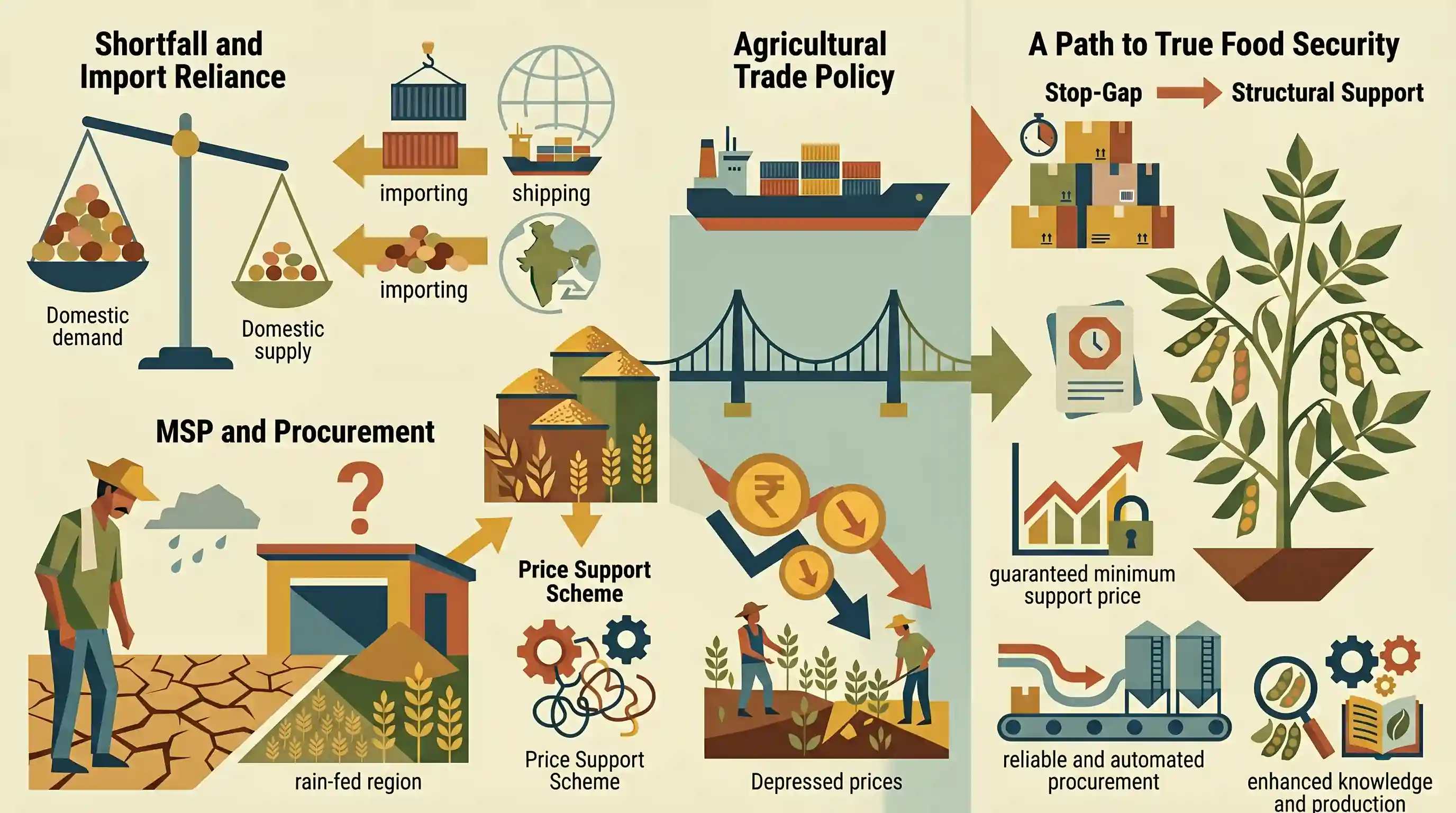
The editorial highlights India's persistent shortfall in pulse production compared to its domestic demand, driving a heavy reliance on imports. Despite ambitious government targets for self-sufficiency by 2025 and 2030, poor implementation of the Price Support Scheme (PSS) and lack of robust MSP guarantees deter farmers from cultivating pulses in rain-fed regions. Concerns have further been amplified by a recent trade pact reportedly assuring imports from the U.S., which threatens to depress domestic prices and harm local farmers. The article argues that prioritizing structural support, guaranteed procurement, and yield enhancement for domestic farmers is essential to achieving true food security rather than relying on stop-gap import measures.
Key Points
- India consumes around 3 crore tonnes of pulses annually, but domestic output is only about 2.5 crore tonnes, leading to an over-reliance on imports.
- Despite an October 2025 self-sufficiency mission aiming to reach 350 lakh tonnes by 2030-31, actual procurement of pulses under the Price Support Scheme (PSS) remained dismal (2.9% to 12.4%) between 2019 and 2024.
- Lack of genuine Minimum Support Price (MSP) guarantees prevents farmers from investing in better yields and forces them to shift to other crops, exacerbating domestic shortages.
- A controversial trade pact seemingly committing to pulse imports from the U.S. has triggered fears that domestic farmers will face uncompetitive prices.
- Sustainable self-sufficiency requires shifting focus from import-based inflation management to structural reforms, productivity boosts in rain-fed areas, and robust domestic procurement networks.
Important Terms
Minimum Support Price (MSP)

A government-guaranteed price for 22 mandated crops (and FRP for sugarcane) aimed at protecting farmers from market price volatility. Since 2018-19, it is set at 1.5 times the production cost.
UPSC context
GS Paper 3: Agriculture, cropping patterns, and farm subsidies. Key for understanding price-led incentives and food security.
Price Support Scheme (PSS)
A component of PM-AASHA where central nodal agencies like NAFED physically procure pulses, oilseeds, and copra at MSP when market prices fall below the support level.
UPSC context
GS Paper 3: Procurement mechanisms and buffer stock management for non-cereal crops like pulses.
Mission for Aatmanirbharta in Pulses
A six-year central initiative (2025-26 to 2030-31) with a ₹11,440 crore outlay targeting 350 lakh tonnes of domestic pulse production to end import dependency.
UPSC context
GS Paper 3: Food security and self-reliance. Tests knowledge of specific agricultural missions and production targets.
PM-AASHA
An umbrella scheme launched in 2018 to ensure remunerative prices for farmers; it includes PSS for pulses, the Price Deficiency Payment Scheme (PDPS), and private procurement pilots.
UPSC context
GS Paper 3: Institutional framework for agricultural pricing and income support schemes.
NAFED
The apex organization under the Ministry of Agriculture that acts as the central nodal agency for implementing pulse and oilseed procurement under the PSS.
UPSC context
GS Paper 3: Role of marketing federations in stabilizing agricultural markets and supporting farmers.
World Trade Organization (WTO)
The international body regulating global trade; its Agreement on Agriculture (AoA) influences India's ability to provide subsidies and set tariffs for pulse imports.
UPSC context
GS Paper 2 & 3: International trade policies and the impact of global trade rules on domestic agriculture.
Prelims Trap
"Since India is the world's largest producer of pulses, it is a consistent net exporter in global agricultural trade."
India is indeed the largest global producer (~25%), but it is also the largest consumer (~27%), making it a structural net importer. Aspirants often wrongly equate "top producer" with "exporter".
Static Concepts Connected
What is the Price Support Scheme (PSS) under PM-AASHA?
- Procurement scope: It specifically mandates the physical procurement of pulses, oilseeds, and copra at the Minimum Support Price (MSP).
- Nodal agencies: Central agencies like NAFED, FCI, and SFAC undertake the procurement directly from registered farmers.
- Financial backing: The Central Government provides the working capital guarantee and bears the procurement losses up to a stipulated limit.
Why are leguminous pulses critical for sustainable agriculture in rain-fed areas?
- Nitrogen fixation: Their root nodules host Rhizobium bacteria, which convert atmospheric nitrogen into a usable form, naturally enhancing soil fertility.
- Climate resilience: They possess a low water footprint and deep root systems, making them highly adaptable to dryland/rain-fed farming (where 80% of Indian pulses are grown).
- Crop rotation: Alternating pulses with cereal crops like wheat breaks pest life cycles and heavily reduces the need for synthetic chemical fertilizers.
Cross-Topic Patterns
Food inflation vs. domestic MSP
Import pacts and tariff cuts aimed at curbing short-term food inflation frequently depress domestic prices below MSP, disincentivizing pulse cultivation and worsening the structural supply gap.
Crop diversification + WTO subsidy limits
Shifting farmers from water-guzzling paddy to pulses requires robust procurement. However, expanding MSP procurement could threaten India's compliance with WTO's 10% de minimis agricultural subsidy limits.

Expect a multi-statement question linking India's pulse import dependency, PM-AASHA's PSS component, and biological nitrogen fixation.
Linked PYQs · 5
Linked PYQs · 5
- 2018MainsGS3
What do you mean by Minimum Support Price (MSP)? How will MSP rescue the farmers from the low income trap?
- 2017MainsGS3
How do subsidies affect the cropping pattern, crop diversity and economy of farmers? What is the significance of crop insurance, minimum support price and food processing for small and marginal farmers?
- 2020PrelimsGS1
Consider the following statements: 1. In the case of all cereals, pulses and oil-seeds, the procurement at Minimum Support Price (MSP) is unlimited in any State/UT of India. 2. In the case of cereals and pulses, the MSP is fixed in any State/UT at a level to which the market price will never rise. Which of the statements given above is/are correct?
- 2023MainsGS3
What are the direct and indirect subsidies provided to farm sector in India? Discuss the issues raised by the World Trade Organization (WTO) in relation to agricultural subsidies.
- 2023MainsGS3
Explain the changes in cropping pattern in India in the context of changes in consumption pattern and marketing conditions.
