Bilateral Trade Pacts and Domestic Farmer Livelihoods
Source:The Hindu ↗
Why It Matters
It reflects the ongoing anxieties of the domestic agricultural sector regarding globalization and bilateral free trade agreements. Farmers fear that unequal market access and cheap agricultural imports could disrupt local livelihoods, a recurring theme when India negotiates FTAs with developed nations.
Summary
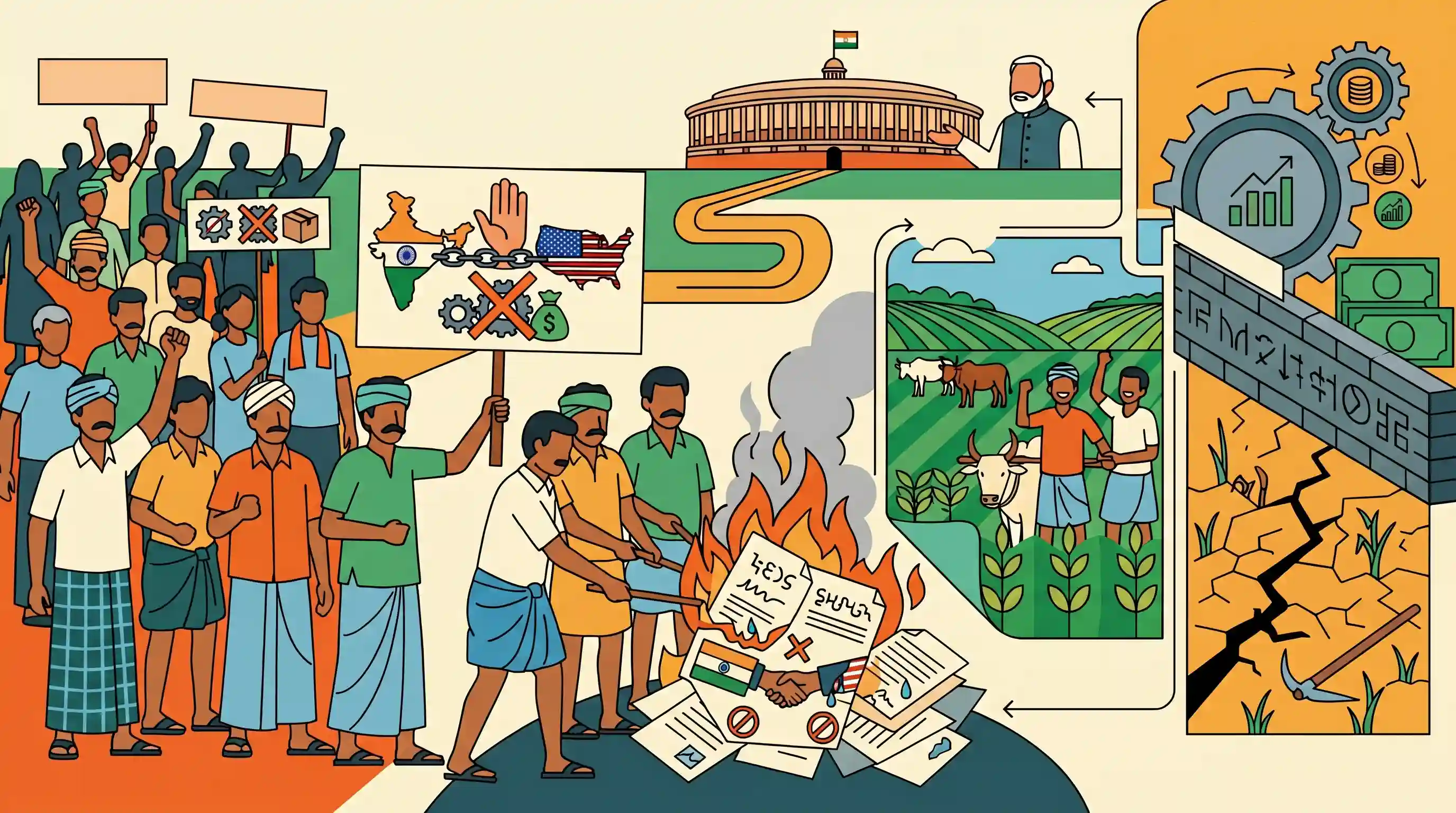
Farmers belonging to the Tamil Nadu Cauvery Farmers' Association and the United Farmers Association held demonstrations opposing the proposed India-U.S. free trade agreement. Protesting at Thiruthuraipoondi in Tiruvarur district, they burned copies of the draft pact and demanded its withdrawal by the Centre, arguing that such bilateral trade liberalization would severely undermine their agricultural livelihoods.
Key Points
- Members of the Tamil Nadu Cauvery Farmers' Association protested against the proposed India-U.S. free trade agreement.
- Protesters burned copies of the pact in Thiruthuraipoondi, Tiruvarur district, Tamil Nadu.
- Farmers argued that the trade agreement would be detrimental to their agricultural livelihoods and demanded an immediate rollback by the Union government.
- The demonstrations were held following a call by P.R. Pandian, Tamil Nadu coordinator of the United Farmers Association.
Important Terms
India-U.S. Interim Trade Agreement

A 2026 framework pact reducing tariffs and increasing market access between India and the U.S., acting as a precursor to a comprehensive Bilateral Trade Agreement (BTA).
UPSC context
GS Paper II (International Relations) and GS Paper III (External Sector). Tests understanding of bilateral treaties and economic diplomacy.
Tamil Nadu Cauvery Farmers' Association
A prominent regional agricultural body in Tamil Nadu that advocates for delta farmers' interests, focusing on irrigation rights and opposing trade policies perceived as detrimental to livelihoods.
UPSC context
GS Paper III (Agriculture/Farmers' Movements). Tests knowledge of regional pressure groups and their role in agrarian policy.
United Farmers Association (Non-political)
A non-political umbrella organization of farmers in Tamil Nadu, coordinated by P.R. Pandian, that mobilizes rural communities against centralized agricultural and trade reforms.
UPSC context
GS Paper III (Agriculture). Relevant for understanding the diversity of agrarian protest movements in Southern India.
Samyukt Kisan Morcha (SKM)
An umbrella coalition of over 40 Indian farmers' unions that leads national protests against trade liberalization, agricultural deregulation, and the perceived "surrender" of domestic food sovereignty.
UPSC context
GS Paper III (Agriculture). Tests awareness of national-level agrarian pressure groups and their influence on government policy.
Reciprocal Tariff
A trade policy where a country sets import duties at the same rate that a trading partner applies to its own exports; a major point of India-U.S. friction.
UPSC context
GS Paper III (External Sector/Trade). Tests concepts of global trade protectionism and India's response to foreign economic pressures.
Non-Tariff Barriers (NTBs)
Trade constraints besides simple taxes, including sanitary and phytosanitary (SPS) standards, technical regulations, and GM crop restrictions, which frequently hinder agricultural exports between India and the U.S.
UPSC context
GS Paper III (Indian Economy/Trade). Tests technical understanding of market access issues and WTO compliance in international trade.
Prelims Trap
"India's bilateral FTAs legally require the complete elimination of tariffs on agricultural commodities under WTO rules."
Under WTO rules, bilateral FTAs allow countries to maintain "sensitive lists" to shield vulnerable domestic sectors like agriculture from mandatory tariff eliminations.
Static Concepts Connected
What is the role of 'Sensitive Lists' in Free Trade Agreements?
- Definition: A specific inventory of goods exempted from tariff cuts or elimination during FTA negotiations.
- Protective Function: Allows developing nations to protect vulnerable sectors (like smallholder agriculture or MSMEs) from sudden influxes of cheap foreign imports.
- WTO Consistency: Permitted under GATT Article XXIV as long as duties are eliminated on "substantially all the trade," providing legal room for exceptions.
How do SPS measures act as trade barriers in agriculture?
- SPS Agreement: Measures applied to protect human, animal, or plant life from risks arising from additives, pests, or diseases (e.g., rejecting GM crops).
- Non-Tariff Barriers: Strict domestic regulations (like India's rigorous GM clearance or dairy standards) can act as non-tariff barriers (NTBs) limiting agricultural imports.
- Bilateral Friction: Developed nations often pressure developing countries in FTAs to relax SPS norms, terming them disguised protectionism.
Cross-Topic Patterns
FTAs vs Domestic Agriculture
Echoes India's 2019 RCEP withdrawal. Fears of subsidized US dairy and poultry undercutting local farmers mirror past anxieties over cheap New Zealand and Chinese agricultural imports.
GM crops + Trade Diplomacy
The US consistently pushes for genetically modified crop access, making India's environmental GEAC clearance process a de facto non-tariff barrier in bilateral trade negotiations.

Expect a multi-statement question interlinking FTA sensitive lists, WTO's Agreement on Agriculture (AoA), and India's GM crop import rules.
Linked PYQs · 3
Linked PYQs · 3
- 2025MainsGS3
What are the challenges before the Indian economy when the world is moving away from free trade and multilateralism to protectionism and bilateralism? How can these challenges be met?
- 2018MainsGS3
How would the recent phenomena of protectionism and currency manipulations in world trade affect macroeconomic stability of India?
- 2014MainsGS2
WTO is an important international institution where decisions taken affect countries in a profound manner. What is the mandate of WTO and how binding are their decisions ? Critically analyse India's stand on the latest round of talks on Food security.
