Agrarian Concerns and Domestic Opposition to Free Trade Agreements
Source:The Hindu ↗
ఇది ఎందుకు ముఖ్యం
The article integrates several core UPSC syllabus themes under GS3, including MSP, agricultural distress, the impact of international trade (FTAs) on domestic agriculture, and food security infrastructure (FCI buffer stocks). It highlights the ongoing debates around agricultural corporatisation and labour reforms.
సారాంశం
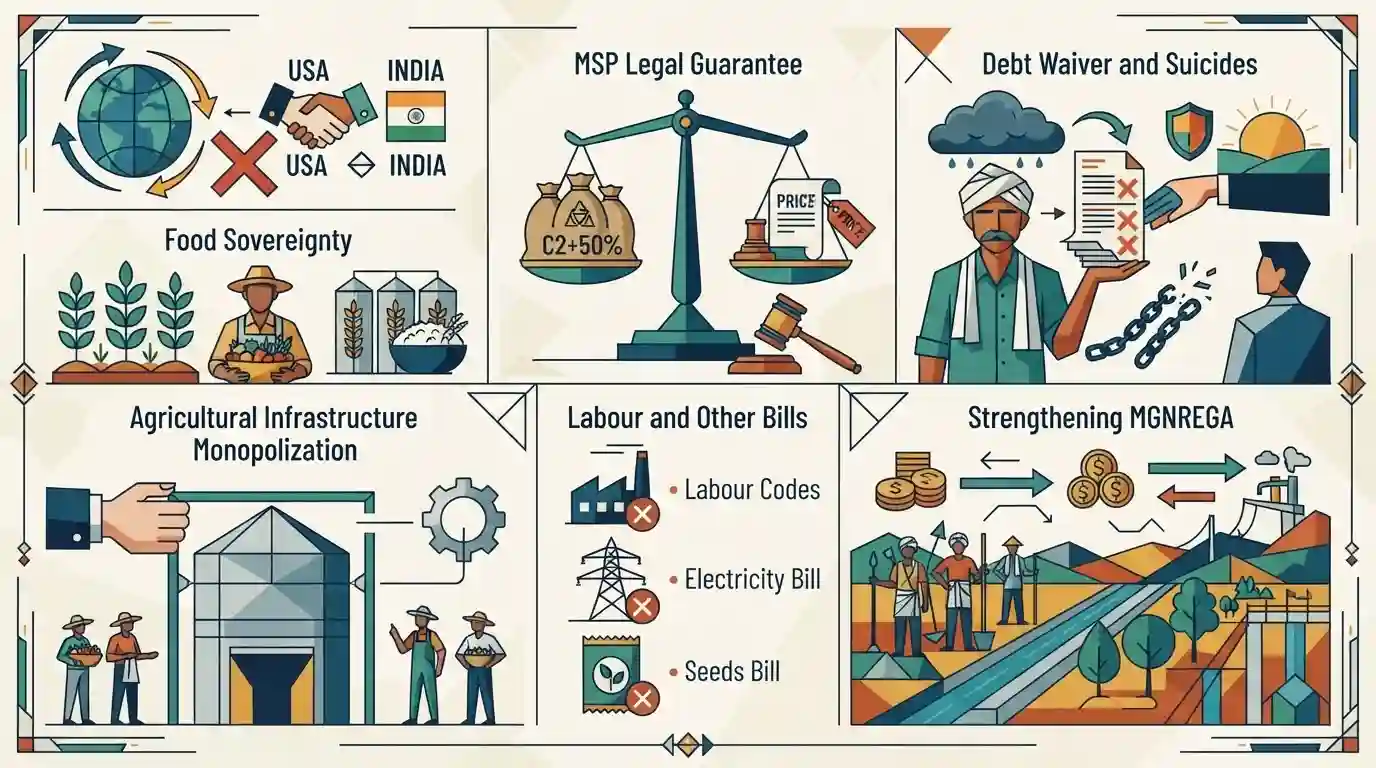
The Samyukt Kisan Morcha (SKM), an umbrella body of farmers' organizations, has appealed to lawmakers to oppose Free Trade Agreements (FTAs), particularly the proposed India-US pact. SKM argues that FTAs threaten agricultural viability and food sovereignty. Among their major demands are a legal guarantee for Minimum Support Price (MSP) as per the Swaminathan Commission's formula, a comprehensive debt waiver to curb rural suicides, and an end to the monopolisation of agricultural infrastructure (FCI silos). Furthermore, they demanded the withdrawal of the new Labour Codes, the draft Electricity and Seeds Bills, and called for the strengthening of MGNREGA.
ముఖ్య అంశాలు
- The Samyukt Kisan Morcha (SKM) has urged MPs and MLAs to oppose all Free Trade Agreements (FTAs), including the proposed India-US FTA, terming them a blueprint for economic colonisation.
- SKM highlighted that FTAs erode agricultural viability, alter cropping patterns, and compromise India's food self-reliance by allowing subsidized agricultural imports.
- Key demands include a legally guaranteed Minimum Support Price (MSP) based on the M. S. Swaminathan committee's recommendations and ensured procurement for all crops.
- Farmers are calling for a comprehensive loan waiver to tackle the severe crisis of rural indebtedness and farmer suicides.
- The SKM raised alarms over the corporatisation of agriculture, pointing to a duopoly of Adani and Leap India controlling 77.5% of Food Corporation of India (FCI) silos.
- Other demands include the scrapping of four Labour Codes, withdrawing draft bills on electricity and seeds, and enhancing MGNREGA to provide 200 days of work at ₹700 per day.
ముఖ్యమైన పదాలు
Samyukt Kisan Morcha (SKM)

An umbrella coalition of over 500 Indian farmer organisations formed in 2020. It coordinates protests to advocate for agrarian reforms, including legally guaranteed Minimum Support Price (MSP) and the withdrawal of anti-farmer trade policies.
UPSC context
GS Paper III: Issues related to direct and indirect farm subsidies, MSP, and farmers' movements.
National Farmers Commission
Set up in 2004 under M.S. Swaminathan, it recommended comprehensive agrarian reforms. Its most critical proposal is calculating Minimum Support Price (MSP) using the C2+50% formula to guarantee a 50% profit margin over comprehensive production costs.
UPSC context
GS Paper III: MSP, farm subsidies, food security, and major agricultural committees.
Labour Codes
A major reform consolidating 29 central labour laws into four comprehensive codes covering Wages, Industrial Relations, Social Security, and Occupational Safety, aimed at simplifying compliance and expanding social security to unorganised and gig workers.
UPSC context
GS Paper III: Employment, industrial relations, and economic growth.
MGNREGA
A rights-based social security scheme enacted in 2005 that guarantees at least 100 days of annual unskilled manual wage employment to rural households, enhancing rural livelihood security and creating durable local assets.
UPSC context
GS Paper II & III: Welfare schemes, rural development, employment generation, and poverty alleviation.
Seeds Bill 2025
A proposed law that modernizes India's seed sector by replacing the 1966 Act. It introduces mandatory seed registration, QR-code-based traceability, and graded penalties, while striving to balance farmers' rights with intellectual property rules.
UPSC context
GS Paper III: Agricultural inputs, biotechnology, intellectual property rights, and farmers' sovereignty.
Electricity Bill
Proposed legislation aimed at reforming power distribution by reducing cross-subsidies, allowing network sharing to foster discom competition, and setting cost-reflective tariffs while preserving state-provided power subsidies for farmers and vulnerable groups.
UPSC context
GS Paper III: Infrastructure (Energy) and federalism issues related to Concurrent List subjects.
National Food Security Act
Landmark 2013 legislation transforming food security into a rights-based entitlement. It guarantees subsidised foodgrains under the Targeted Public Distribution System, covering up to 75% of rural and 50% of urban populations.
UPSC context
GS Paper II & III: Social justice, food security, hunger, and PDS reforms.
ప్రిలిమ్స్ ఉచ్చు
The WTO Bali Peace Clause provides an unconditional, permanent waiver for all domestic agricultural subsidies.
It only shields public stockholding programs for food security (not all subsidies) from being challenged under the AoA, and requires compliance with strict transparency and notification obligations.
అనుసంధానమైన స్థిర భావనలు
What is the difference between A2+FL and C2 formulas in MSP calculation?
- A2 Cost: Covers all paid-out cash and in-kind expenses directly incurred by farmers on seeds, fertilizers, chemicals, hired labor, fuel, and irrigation.
- A2+FL Cost: Adds the imputed value of unpaid family labor (FL) to the direct paid-out costs; this is currently used to calculate MSP at 1.5x.
- C2 Cost: A comprehensive cost factoring in A2+FL plus the rental value of owned land and interest on owned fixed capital.
- Swaminathan Formula: Recommended setting MSP at 50% above the comprehensive C2 cost to ensure fair returns and address agrarian distress.
How does the WTO Agreement on Agriculture classify domestic support subsidies?
- Amber Box: Trade-distorting subsidies (e.g., price support, fertilizer subsidies) capped at 10% of production value for developing nations (de minimis limit).
- Blue Box: Direct payments under production-limiting programs; currently exempt from reduction commitments as long as they meet specific criteria.
- Green Box: Subsidies causing minimal or no trade distortion (e.g., research, pest control, direct income support); permitted without any financial limits.
అంతర-అంశ నమూనాలు
Agricultural FTAs vs Food Sovereignty
Connects external trade liberalization with internal food security. Tariff elimination on agricultural imports can disrupt domestic cropping patterns and threaten smallholder livelihoods.
Infrastructure PPPs and Market Concentration
Links GS3 infrastructure creation (PPP mode) with market competition. Removing anti-monopoly safeguards in state procurement infrastructure risks creating corporate duopolies in food supply chains.

Analytical questions will likely link India's shrinking farm trade surplus with WTO Amber Box limits and the demand for legal MSP.
అనుసంధాన PYQలు · 5
అనుసంధాన PYQలు · 5
- 2018MainsGS3
What do you mean by Minimum Support Price (MSP)? How will MSP rescue the farmers from the low income trap?
- 2025MainsGS3
Elaborate the scope and significance of supply chain management of agricultural commodities in India.
- 2023MainsGS3
What are the direct and indirect subsidies provided to farm sector in India? Discuss the issues raised by the World Trade Organization (WTO) in relation to agricultural subsidies.
- 2025MainsGS3
Examine the scope of the food processing industries in India. Elaborate the measures taken by the government in the food processing industries for generating employment opportunities.
- 2024MainsGS3
Elucidate the importance of buffer stocks for stabilizing agricultural prices in India. What are the challenges associated with the storage of buffer stock? Discuss.
