Kalaburagi farmers protest crop losses due to heavy rains
Source:The Hindu ↗
Why It Matters
The article highlights the vulnerability of rainfed agriculture to extreme weather events and the subsequent socio-economic distress among farmers. It brings focus to pulse cultivation (crucial for India's food security), the importance of swift disaster assessment, and the role of institutional safety nets like crop insurance (PMFBY) and loan waivers in mitigating agrarian crises.
Summary
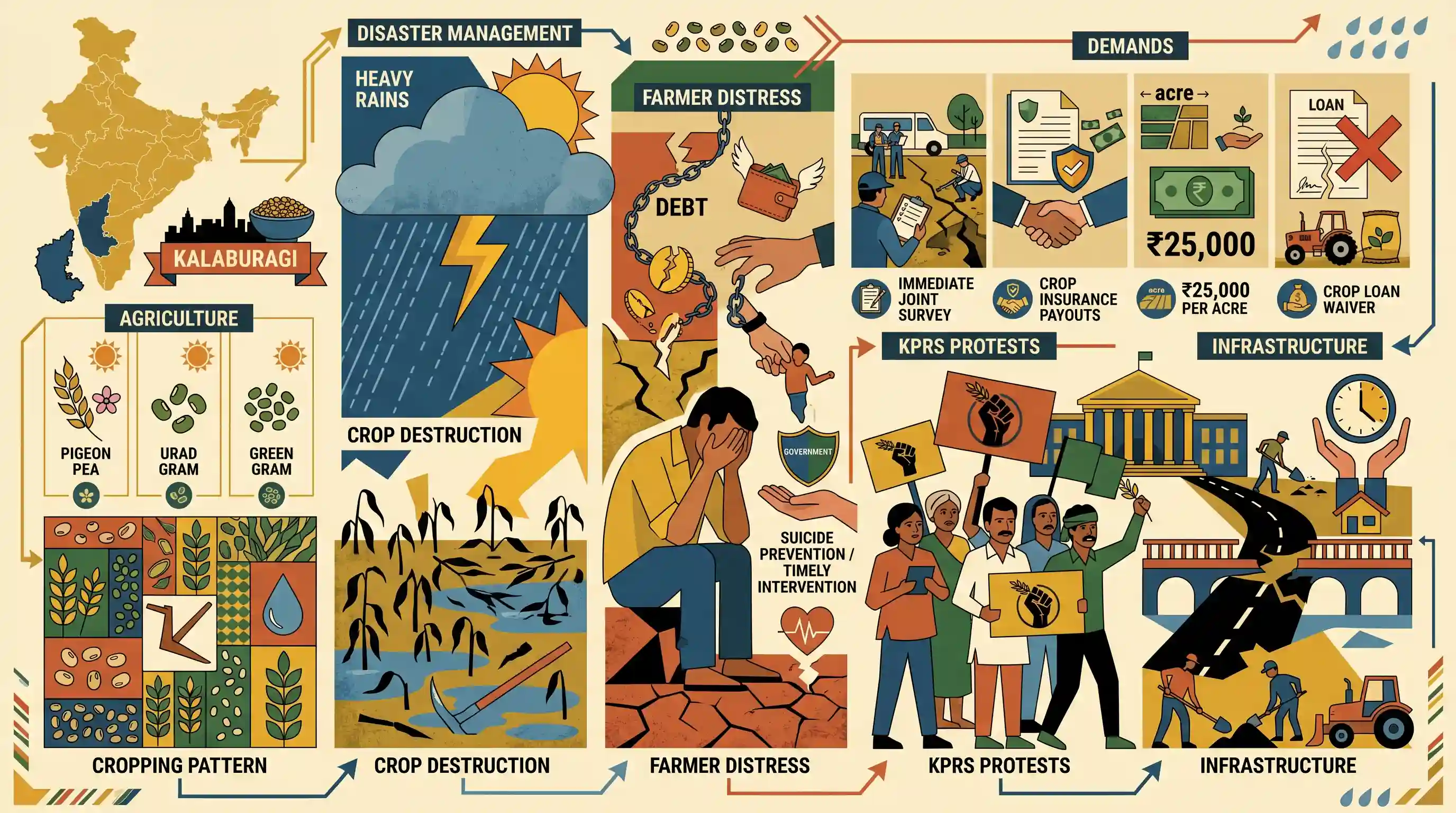
Farmers in Karnataka's Kalaburagi district, widely recognized as the state's 'tur dal bowl', staged protests demanding an immediate joint survey and compensation following massive crop destruction caused by unseasonal, heavy rains. Crucial pulse crops, including pigeon pea (toor), urad, and green gram, have been severely damaged, driving farmers into deep financial distress. Under the banner of the Karnataka Pranta Raitha Sangha (KPRS), the protesters demanded swift release of crop insurance payouts, ₹25,000 per acre in direct relief, and a waiver of crop loans. They also highlighted the urgent need to address infrastructure damage and prevent further debt-driven farmer suicides through timely government intervention.
Key Points
- Farmers in Kalaburagi, the 'tur dal bowl of Karnataka', held protests demanding immediate assessment and relief for massive crop losses due to heavy, incessant rains.
- Extensive damage was reported for major pulse crops, primarily toor (pigeon pea), urad, and green gram across several taluks.
- The Karnataka Pranta Raitha Sangha (KPRS) is demanding a relief of ₹25,000 per acre, swift release of crop insurance, and a complete waiver of crop loans from nationalized and DCC banks.
- Farmers warned that delayed surveys by revenue and agriculture officials will worsen the financial crisis, exacerbating issues like debt-driven farmer suicides.
Important Terms
Pradhan Mantri Fasal Bima Yojana (PMFBY)

A central-sponsored crop insurance scheme (2016) providing financial support to farmers for crop failure due to natural calamities, pests, or diseases, featuring capped premiums.
UPSC context
GS Paper 3 (Agriculture/Economy); relevant for risk mitigation and agricultural safety nets.
District Central Cooperative (DCC) Banks
Intermediate-tier cooperative banks at the district level that link State Cooperative Banks with grassroots Primary Agricultural Credit Societies (PACS) to provide rural and agricultural credit.
UPSC context
GS Paper 3 (Agriculture/Banking); focuses on institutional credit flow and the cooperative model.
Karnataka Pranta Raitha Sangha (KPRS)
A prominent farmers' organization in Karnataka that mobilizes agriculturalists for rights such as fair prices, loan waivers, and effective disaster compensation.
UPSC context
GS Paper 1 (Social Movements) and GS Paper 3 (Agriculture); relevant for studying peasant activism.
Kalaburagi Tur Dal (GI Tag)
The red gram variety from Karnataka’s ‘tur bowl’ which received a Geographical Indication tag in 2019 due to its unique taste and high calcium content.
UPSC context
GS Paper 3 (IPR/Agriculture); tests knowledge of regional products and intellectual property protection.
State Disaster Response Fund (SDRF)
A fund constituted under the Disaster Management Act, 2005, primarily used by states to provide immediate relief for victims of notified natural disasters.
UPSC context
GS Paper 3 (Disaster Management); crucial for understanding disaster relief financing and federal-state relations.
Crop Loan Waiver
The policy of the government to settle outstanding agricultural loans of farmers with banks, aimed at alleviating debt distress during crises.
UPSC context
GS Paper 3 (Economy/Agriculture); discussed regarding fiscal impact, credit culture, and farmer welfare.
Prelims Trap
"PMFBY only covers widespread disasters, excluding individual farm-level claims for localized inundation or waterlogging."
PMFBY explicitly covers 'localized calamities' (hailstorm, landslide, inundation) at the individual farm level, provided the farmer intimates the loss within 72 hours.
Static Concepts Connected
What are the climatic and soil requirements for Tur (Pigeon Pea) cultivation?
- Climate needs: Requires 20-25°C and 60-65 cm rainfall. While highly drought-resistant, it is extremely susceptible to frost, inundation, and waterlogging.
- Ideal soil: Thrives in well-drained light to medium loamy soils, particularly deep black cotton soils like those found in the Kalaburagi region.
- Ecological role: As a deep-rooted legume, it fixes atmospheric nitrogen, reducing the need for synthetic fertilizers and improving long-term soil health.
How are localized crop losses managed under Pradhan Mantri Fasal Bima Yojana (PMFBY)?
- Covered perils: Protects against localized risks like hailstorms, landslides, inundation, and cloudbursts that affect isolated farms rather than entire insurance units/villages.
- Mandatory intimation: To trigger an assessment, farmers must notify the insurance company, agriculture department, or bank within 72 hours of the loss.
- Assessment method: Settled on an individual farm basis through joint physical surveys, circumventing the delayed village-level Area Approach (Crop Cutting Experiments).
Cross-Topic Patterns
Drone-based Crop Cutting Experiments (CCEs)
The demand for immediate surveys highlights PMFBY's administrative bottlenecks. UPSC often links this to tech solutions like drone-based Crop Cutting Experiments (CCEs) and satellite-based yield estimations (YES-TECH).
Farm loan waivers vs. RBI warnings
Farmers demanding loan waivers from DCC banks trigger a recurring economic debate; the RBI frequently cautions that blanket waivers vitiate long-term credit culture and severely strain state fiscal deficits.

Expect a multi-statement question in 2026 linking PMFBY's localized calamity clauses, drone-based crop assessments, and pulse agronomy.
Linked PYQs · 4
Linked PYQs · 4
- 2020PrelimsGS1
With reference to pulse production in India, consider the following statements: 1. Black gram can be cultivated as both kharif and rabi crop. 2. Green-gram alone accounts for nearly half of pulse production. 3. In the last three decades, while the production of kharif pulses has increased, the production of rabi pulses has decreased. Which of the statements given above is/are correct?
- 2021PrelimsGS1
Among the following, which one is the least water-efficient crop?
- 2016MainsGS3
Given the vulnerability of Indian agriculture to vagaries of nature, discuss the need for crop insurance and bring out the salient features of the Pradhan Mantri Fasal Bima Yojana (PMFBY).
- 2017MainsGS3
How do subsidies affect the cropping pattern, crop diversity and economy of farmers? What is the significance of crop insurance, minimum support price and food processing for small and marginal farmers?
