Bidadi Township Project Land Acquisition and Urban Expansion Conflicts
Source:The Hindu ↗
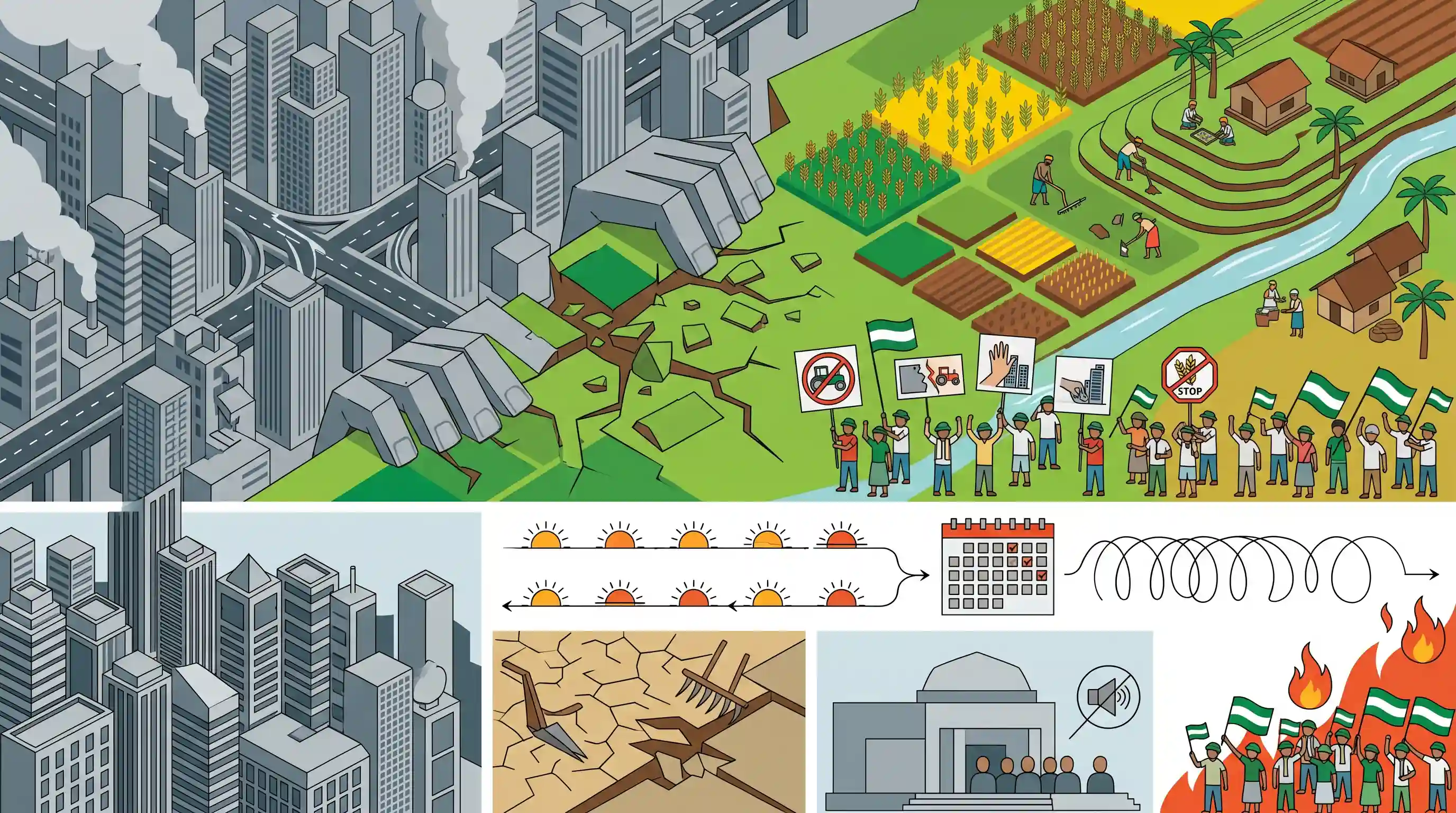
Why It Matters
Provides a real-world case study on the negative externalities of rapid, unchecked urbanization—particularly around major IT hubs like Bengaluru. It exemplifies the socio-economic and ecological conflicts that arise when peripheral agricultural lands are acquired for satellite townships, emphasizing the need for sustainable urban planning that does not compromise rural livelihoods or food security.
Summary
Farmers in Karnataka are protesting the proposed Bidadi Integrated Satellite Township project, which threatens to acquire 9,640 acres of fertile agricultural land across 38 villages in Ramanagara district. Under the banner of Samyukta Horata - Karnataka, protesters argue that converting multi-crop farmland into a concrete township to accommodate Bengaluru's unchecked urban sprawl will devastate local ecology and destroy the livelihoods of small farmers. Despite demonstrating for over 400 days, the government's lack of response has prompted farm leaders to warn of intensified agitations. The issue highlights the ongoing conflict between aggressive urban expansion and the preservation of rural agrarian economies.
Key Points
- Farmers' organizations are demanding the withdrawal of the Bidadi Integrated Satellite Township project, which aims to acquire 9,640 acres of land across 38 villages.
- The targeted area consists of highly fertile agricultural land that supports mixed-cropping and provides steady livelihoods for small and marginal farmers, as well as agro-based industries.
- Protesters argue the project serves Bengaluru's unchecked urban expansion at the severe cost of local ecology and rural sustainability, turning green belts into concrete spaces.
- After 428 days of continuous protest without government redressal, farm leaders have threatened to intensify their agitation and confront elected representatives.
Important Terms
Bidadi Integrated Satellite Township Project

A ₹18,000-crore project to develop a 9,640-acre "work-live-play" city in Ramanagara to decongest Bengaluru. It involves large-scale acquisition of fertile farmland, sparking intense regional farmer protests.
UPSC context
GS Paper 1 (Urbanization) and GS Paper 3 (Land Reforms). Tests understanding of urban-rural conflicts in infrastructure development.
Samyukta Horata - Karnataka
An umbrella coalition of farmers, workers, Dalits, and students in Karnataka. It spearheads agitations against "anti-farmer" policies and land acquisitions, functioning as the state-level affiliate of the Samyukta Kisan Morcha.
UPSC context
GS Paper 2 (Pressure Groups). Tests knowledge of organized collective bargaining and social movements in agrarian politics.
Satellite Town
A planned urban settlement situated near a major metropolis, intended to be self-sufficient with its own infrastructure and employment, thereby reducing the population pressure and congestion on the central city.
UPSC context
GS Paper 1 (Urbanization). Essential concept for discussing remedies to urban overcrowding and unplanned city expansion.
Land Acquisition, Rehabilitation and Resettlement (LARR) Act
The 2013 central legislation (LARR Act) that mandates fair compensation (up to 4x market value in rural areas), Social Impact Assessment, and consent of affected families for public and private projects.
UPSC context
GS Paper 3 (Land Reforms/Development). Critical for questions on industrialization versus agricultural sustainability and tribal/farmer rights.
Urban Sprawl
The unrestricted, unplanned expansion of a city into surrounding rural areas. It often leads to the conversion of fertile agricultural land into residential or industrial zones and strains public services.
UPSC context
GS Paper 1 (Urbanization). Core problem in Indian metropolitan growth, frequently tested regarding environmental and socio-economic impacts.
Multi-crop Farmland
Agricultural land capable of producing two or more crops per year through irrigation. The LARR Act 2013 generally restricts its acquisition to prevent threats to food security and rural livelihoods.
UPSC context
GS Paper 3 (Agri-Economy/Food Security). Highlights the tension between infrastructure needs and the protection of high-productivity agricultural resources.
Prelims Trap
The RFCTLARR Act 2013 imposes an absolute ban on acquiring multi-crop irrigated land for infrastructure.
The Act does not completely ban it. It restricts such acquisition, allowing it only as a 'demonstrable last resort' under exceptional circumstances, mandating equivalent wasteland development.
Static Concepts Connected
How does the RFCTLARR Act 2013 protect multi-crop irrigated land?
- Last Resort Rule: Acquisition of multi-crop irrigated land is restricted and allowed only under exceptional circumstances as a demonstrable last resort.
- Compensatory Agriculture: An equivalent area of cultivable wasteland must be developed for agricultural purposes, or a proportionate amount deposited.
- State Limits: State governments are empowered to set strict limits on the aggregate area of multi-crop land that can be acquired in the state.
What are the ecological impacts of peri-urban satellite townships?
- Green Belt Loss: Converts fertile agricultural land and peripheral green belts into concrete heat islands, raising local temperatures.
- Hydrological Disruption: Destroys wetlands, lakes, and natural drainage patterns, significantly increasing urban flood risks in lower-lying areas.
- Resource Over-extraction: Depletes local groundwater reserves and strains carrying capacity to feed the artificially expanded urban demand.
Cross-Topic Patterns
Peri-urban flooding & climate resilience
Satellite towns often disrupt natural drainage and peri-urban wetlands, linking GS1 Urbanization models with GS3 Disaster Management (urban flooding).
Land acquisition vs Food Security
Unchecked conversion of multi-crop agricultural zones into real estate directly threatens GS3 imperatives of rural livelihood preservation and national food security.

Mains 2026 could feature a GS1/GS3 question on the socio-ecological trade-offs of satellite towns versus brownfield urban redevelopment.
Linked PYQs · 4
Linked PYQs · 4
- 2015MainsGS1
Smart cities in India cannot sustain without smart villages. Discuss this statement in the backdrop of rural urban integration.
- 2017MainsGS1
"The growth of cities as I.T. hubs has opened up new avenues of employment, but has also created new problems." Substantiate this statement with examples.
- 2016MainsGS3
Rehabilitation of human settlements is one of the important environmental impacts which always attracts controversy while planning major projects. Discuss the measures to be adopted to mitigate the impact of the recent incidents of cloudbursts in many places of Uttarakhand.
- 2013MainsGS1
Discuss the various social problems which originated out of the speedy process of urbanization in India.
