Indo US Bilateral Trade and Agricultural Subsidy Disparities
Source:The Hindu ↗
Why It Matters
This article is crucial for understanding the real-world implications of Free Trade Agreements on Indian agriculture. It highlights the disparity in agricultural subsidies between developed and developing nations—a major issue at the WTO—and demonstrates how farmers' organizations act as pressure groups to influence national trade and economic policies.
Summary
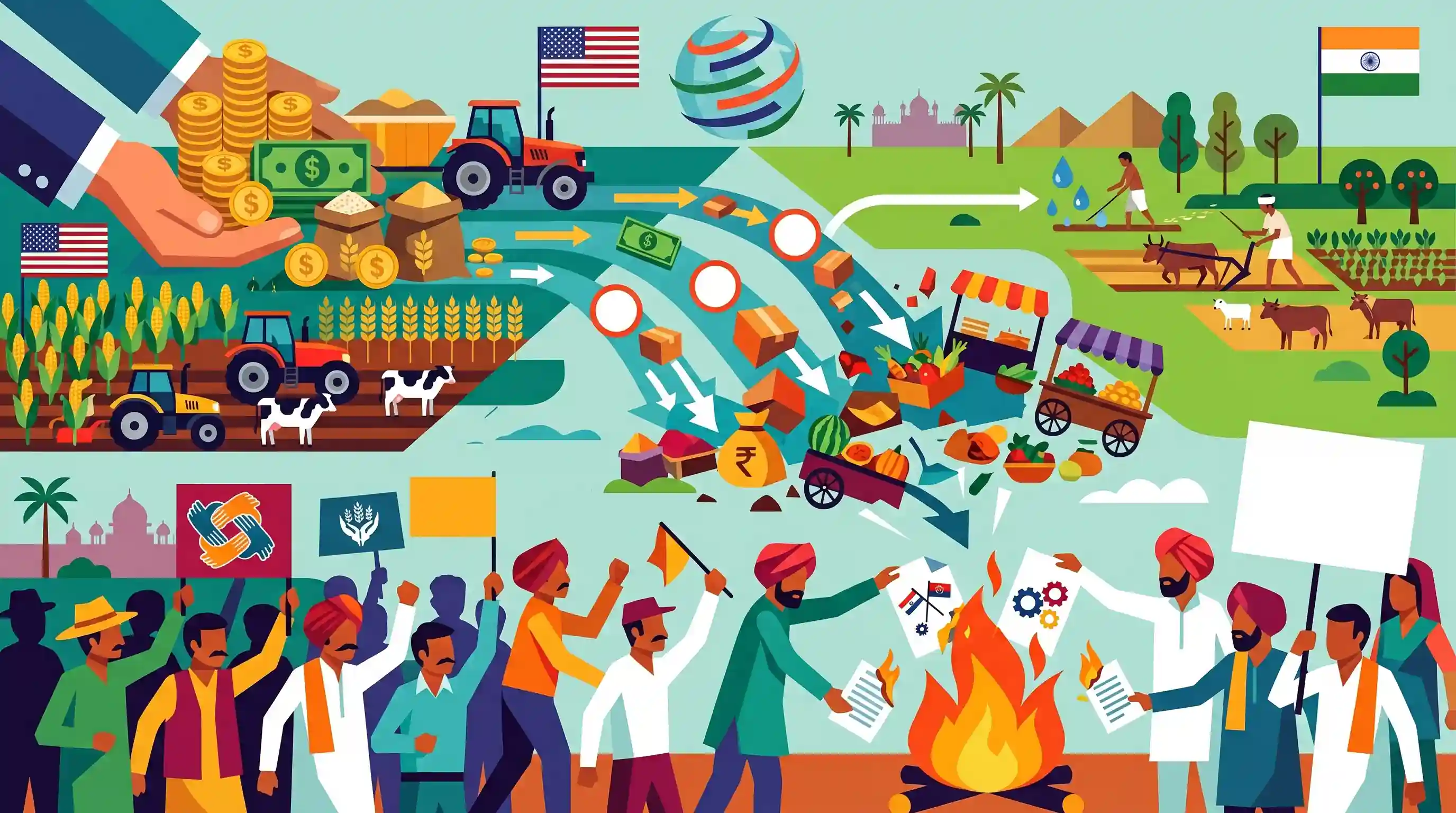
Farmers in Mysuru staged protests against a proposed Indo-US trade deal, burning draft copies to express their opposition. Organized by the Samyukta Kisan Morcha and local farmers' associations, the protesters argued that offering duty-free concessions to US agricultural and dairy imports would decimate the domestic market. They specifically criticized the uneven playing field created by disparate subsidy structures, noting that US farmers receive massive subsidies compared to a negligible percentage for Indian farmers. The agitation underscores the ongoing friction between international free trade agreements and the need to protect vulnerable domestic agricultural sectors.
Key Points
- Farmers in Mysuru protested against an Indo-US trade deal by burning its draft copies, responding to a call by the Samyukta Kisan Morcha.
- Protesters expressed severe concern that duty-free concessions on US agricultural and dairy products would drastically reduce domestic demand and harm Indian farmers.
- They highlighted a major disparity in agricultural support, claiming US farmers receive subsidies of up to 200%, whereas Indian farmers receive only about 3%.
- The protests emphasize the demands for a level playing field and the withdrawal of import duty concessions on US agricultural products to protect domestic livelihoods.
Important Terms
Indo-US Interim Trade Agreement

A bilateral pact aimed at reducing tariffs on US industrial and specific agricultural goods (like tree nuts) while securing preferential access for Indian exports like textiles and spices.
UPSC context
GS Paper II & III: International Relations and Indian Economy; focuses on bilateral trade dynamics and agricultural protectionism.
Free Trade Agreement (FTA)
An agreement between nations to reduce or eliminate trade barriers like tariffs and quotas, facilitating the free movement of goods and services across borders.
UPSC context
GS Paper II & III: Tests understanding of trade liberalisation vs. domestic sector safeguards (MSMEs and Agriculture).
Samyukta Kisan Morcha (Non-Political)
A faction of the original Samyukta Kisan Morcha (SKM) that spearheads protests for legal MSP guarantees and opposes FTAs, maintaining distance from political parties.
UPSC context
GS Paper II: Pressure groups and formal/informal associations and their role in the polity.
State Sugarcane Growers’ Association
A regional pressure group in Karnataka advocating for better sugarcane prices (FRP/SAP) and protecting farmers from the adverse impacts of international trade deals.
UPSC context
GS Paper II: Role of agrarian pressure groups in influencing regional and national agricultural policies.
Minimum Support Price (MSP)
The minimum price set by the Government of India for specific crops, ensuring a guaranteed floor price for farmers during procurement.
UPSC context
GS Paper III: Issues related to direct and indirect farm subsidies and minimum support prices.
Fair and Remunerative Price (FRP) / State Advisory Price (SAP)
FRP is the mandatory minimum price sugar mills must pay to farmers, fixed by the Centre; SAP is an additional price announced by some state governments.
UPSC context
GS Paper III: Specifically addresses the economics of the sugar industry and price-fixing mechanisms.
Tariff-Rate Quotas (TRQs)
A trade policy tool that combines quotas and tariffs, allowing a set quantity of a product to be imported at lower duties, with higher duties applied thereafter.
UPSC context
GS Paper III: Trade policy instruments used to balance market opening with the protection of sensitive domestic sectors.
Prelims Trap
"The WTO strictly limits all forms of agricultural subsidies by developed nations like the US to 5% of their total production value."
False. The limits (5% for developed, 10% for developing) apply ONLY to trade-distorting 'Amber Box' subsidies. Developed nations categorize massive direct payments under the limitless 'Green Box'.
Static Concepts Connected
What are the subsidy 'boxes' under the WTO Agreement on Agriculture (AoA)?
- Amber Box: Trade-distorting subsidies (e.g., MSP, fertilizer support). Subject to 'de minimis' limits: 5% of agricultural production value for developed countries, 10% for developing ones.
- Green Box: Subsidies causing minimal or no trade distortion (e.g., environmental protection, R&D, decoupled direct income support). These have no financial limits.
- Blue Box: Essentially 'Amber Box with conditions'. These are subsidies tied to programs that require farmers to limit their production. Currently no limits apply.
Why is the dairy sector historically protected in India's FTAs?
- Smallholder dominance: Over 80 million rural Indian families depend on dairy, largely operating as smallholders (1-2 animals) rather than large industrial farms, making them highly vulnerable to price shocks.
- Threat of subsidized dumping: Advanced economies heavily subsidize their industrial dairy sectors. Duty-free imports would allow 'dumping' of artificially cheap milk products, destroying India's domestic cooperative networks like Amul and Nandini.
Cross-Topic Patterns
Dairy sector sensitivities in FTAs
The tension between Western trade pacts and India's domestic dairy model (Operation Flood) frequently stalls negotiations, as duty-free imports threaten millions of marginal farmers relying on cooperative networks.
Pressure groups shaping foreign policy
Organizations like SKM are expanding beyond domestic MSP demands to actively oppose bilateral trade agreements, illustrating the rising influence of domestic agrarian pressure groups on foreign economic policy.

Expect a multi-statement question on WTO's AoA (Amber/Green boxes) paired with India's defensive trade stance on dairy imports in FTAs.
Linked PYQs · 3
Linked PYQs · 3
- 2023MainsGS3
What are the direct and indirect subsidies provided to farm sector in India? Discuss the issues raised by the World Trade Organization (WTO) in relation to agricultural subsidies.
- 2019MainsGS2
What are the methods used by the farmers' organisations to influence the policy-makers in India and how effective are these methods?
- 2017MainsGS3
How do subsidies affect the cropping pattern, crop diversity and economy of farmers? What is the significance of crop insurance, minimum support price and food processing for small and marginal farmers?
