Sugar Export Bans and Agrarian Economic Viability
Source:The Hindu ↗
Why It Matters
This topic provides excellent case studies for GS3 on how export policies aimed at inflation control can inadvertently cause agrarian distress. It frequently connects to Prelims questions on the mechanisms of FRP (decided by CCEA), MSP limits, and the role of agencies like NAFED in market intervention.
Summary
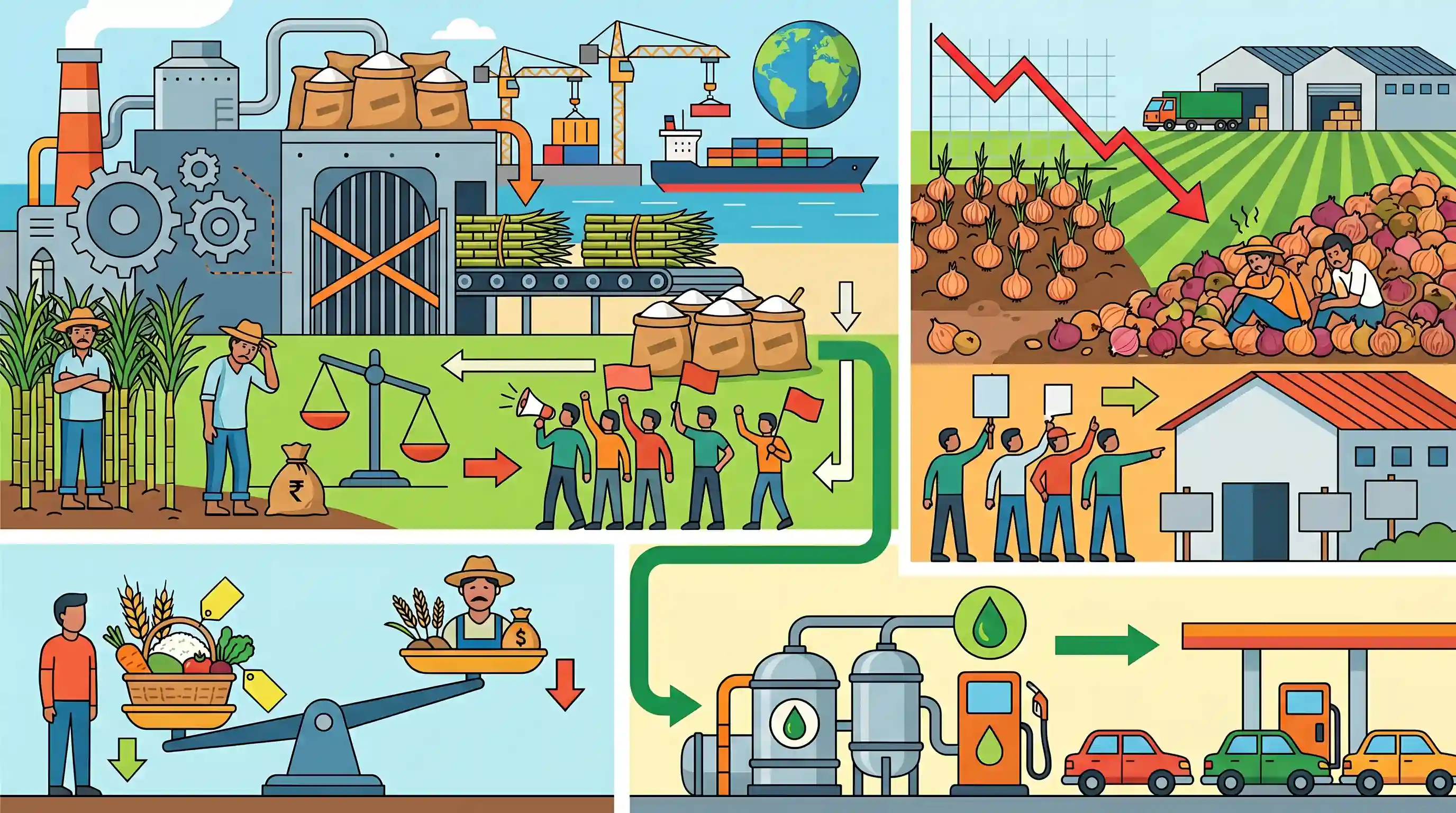
The Central Government's decision to ban sugar exports until September 30 has triggered strong opposition from farmers' bodies and political leaders in Maharashtra. Implemented to control domestic inflation, the ban leaves sugar mills struggling with excess stock and inability to pay the mandatory Fair and Remunerative Price (FRP) to sugarcane farmers. Concurrently, a crash in onion prices has prompted demands for an MSP for horticulture crops and market intervention by NAFED. The issue underscores the recurring conflict between anti-inflation trade policies (like export bans) and the financial viability of the agricultural sector, while also highlighting ethanol blending as a potential structural solution.
Key Points
- The Central Government has extended the ban on sugar exports until September 30, upgrading the restriction from 'controlled' to 'prohibited' to contain domestic inflation.
- Opposition leaders and farmers' bodies like AIKS are demanding an immediate rollback, citing financial disaster for Maharashtra sugar mills due to excess stock and rising Fair and Remunerative Price (FRP).
- Alongside sugar, plunging onion prices have sparked farmer protests in Nashik, leading to demands for an MSP of ₹2,000 per quintal and a ₹1,500 per acre subsidy.
- To mitigate excess sugar stock and global volatility, farmers advocate shifting focus towards the ethanol blending programme.
- The situation highlights the classic policy dilemma between protecting domestic consumers from food inflation and ensuring remunerative prices for agricultural producers.
Important Terms
Fair and Remunerative Price (FRP)

The statutory minimum price that sugar mills are legally obligated to pay sugarcane farmers for their produce, fixed by the Central Government on the recommendation of the CACP.
UPSC context
GS Paper 3: Agricultural pricing and subsidies; essential for understanding sugar sector economics and price support mechanisms.
Minimum Support Price (MSP)
A market intervention by the Government of India to ensure farmers receive a minimum price for 23 crops during bumper harvests, protecting them against sharp price drops.
UPSC context
GS Paper 3: Issues related to direct and indirect farm subsidies and minimum support prices; critical for food security debates.
Ethanol Blending Programme (EBP)
A government initiative to blend ethanol (derived from sugarcane or grains) with petrol, aiming for a 20% blend (E20) by 2025 to reduce oil imports and emissions.
UPSC context
GS Paper 3: Energy security, biofuels, and environment; links agricultural byproducts to renewable energy targets.
National Agricultural Cooperative Marketing Federation of India (NAFED)
The apex organization of marketing cooperatives for agricultural produce in India, functioning as a nodal agency for price stabilization and procurement of oilseeds, pulses, and onions.
UPSC context
GS Paper 3: Transport and marketing of agricultural produce; relevant for market intervention schemes like Operation Greens.
All India Kisan Sabha (AIKS)
A peasant organization founded in 1936 by Sahajanand Saraswati to advocate for land reforms and farmers' rights; it played a vital role in India's freedom struggle.
UPSC context
GS Paper 1 & 3: Peasant movements and modern history; also relevant for current farmer organizations and agrarian pressure groups.
Prelims Trap
FRP for sugarcane is merely an advisory price similar to MSP and is paid by the government.
FRP is statutorily binding under the Sugarcane (Control) Order, 1966. Unlike MSP, which is largely an administrative guarantee, sugar mills are legally mandated to pay FRP.
Static Concepts Connected
How is the Fair and Remunerative Price (FRP) for sugarcane determined?
- Recommendation body: The Commission for Agricultural Costs and Prices (CACP) recommends the FRP based on production cost, sugar recovery rate, and inter-crop price parity.
- Final approval: The Cabinet Committee on Economic Affairs (CCEA), chaired by the Prime Minister, gives final approval to the FRP.
- Statutory backing: It is legally backed by the Sugarcane (Control) Order, 1966, under the Essential Commodities Act, making it binding on sugar mills.
What is the mandate of NAFED in managing agricultural volatility?
- Market Intervention: It serves as a central nodal agency for procuring oilseeds, pulses, and cotton under the Price Support Scheme (PSS).
- Buffer Stocking: It manages strategic buffer stocks for perishable commodities like onions and potatoes under the government's Price Stabilization Fund (PSF).
Cross-Topic Patterns
Inflation targeting vs. Farm income
Export bans cool domestic CPI by increasing local supply, but they transfer the cost of inflation control onto farmers via depressed price realization, conflicting with the goal of doubling farm income.
Sugar surplus to energy security (E20)
Shifting excess sugarcane to the Ethanol Blended Petrol (EBP) programme solves mill liquidity (FRP payment) issues while simultaneously reducing India's crude import bill and carbon footprint.

Questions linking sugarcane pricing (FRP/SAP), ethanol blending targets (E20), and WTO sugar subsidy disputes are highly probable for 2026.
Linked PYQs · 5
Linked PYQs · 5
- 2015PrelimsGS1
The Fair and Remunerative Price (FRP) of sugarcane is approved by the
- 2018PrelimsGS1
Consider the following: 1. Areca nut 2. Barley 3. Coffee 4. Finger millet 5. Groundnut 6. Sesamum 7. Turmeric The Cabinet Committee on Economic Affairs has announced the Minimum Support Price for which of the above?
- 2020PrelimsGS1
Consider the following statements: 1. In the case of all cereals, pulses and oil-seeds, the procurement at Minimum Support Price (MSP) is unlimited in any State/UT of India. 2. In the case of cereals and pulses, the MSP is fixed in any State/UT at a level to which the market price will never rise. Which of the statements given above is/are correct?
- 2020PrelimsGS1
Which of the following factors/policies were affecting the price of rice in India in the recent past? 1. Minimum Support Price 2. Government's trading 3. Government's stockpiling 4. Consumer subsidies Select the correct answer using the code given below:
- 2023MainsGS3
What are the direct and indirect subsidies provided to farm sector in India? Discuss the issues raised by the World Trade Organization (WTO) in relation to agricultural subsidies.
