Organic Farming: Seed Festivals and Gene Editing Debates in Tamil Nadu
Source:The Hindu ↗
Why It Matters
The article connects grassroots agricultural movements with broader UPSC syllabus themes like organic farming, sustainable agriculture, and biotechnology. It raises a critical, analytical point about how genetically modified non-food crops (like Bt Cotton) can indirectly enter and impact the human food chain via livestock feed, a nuanced argument highly relevant for GS3 Mains answers on biotechnology and food safety.
Summary
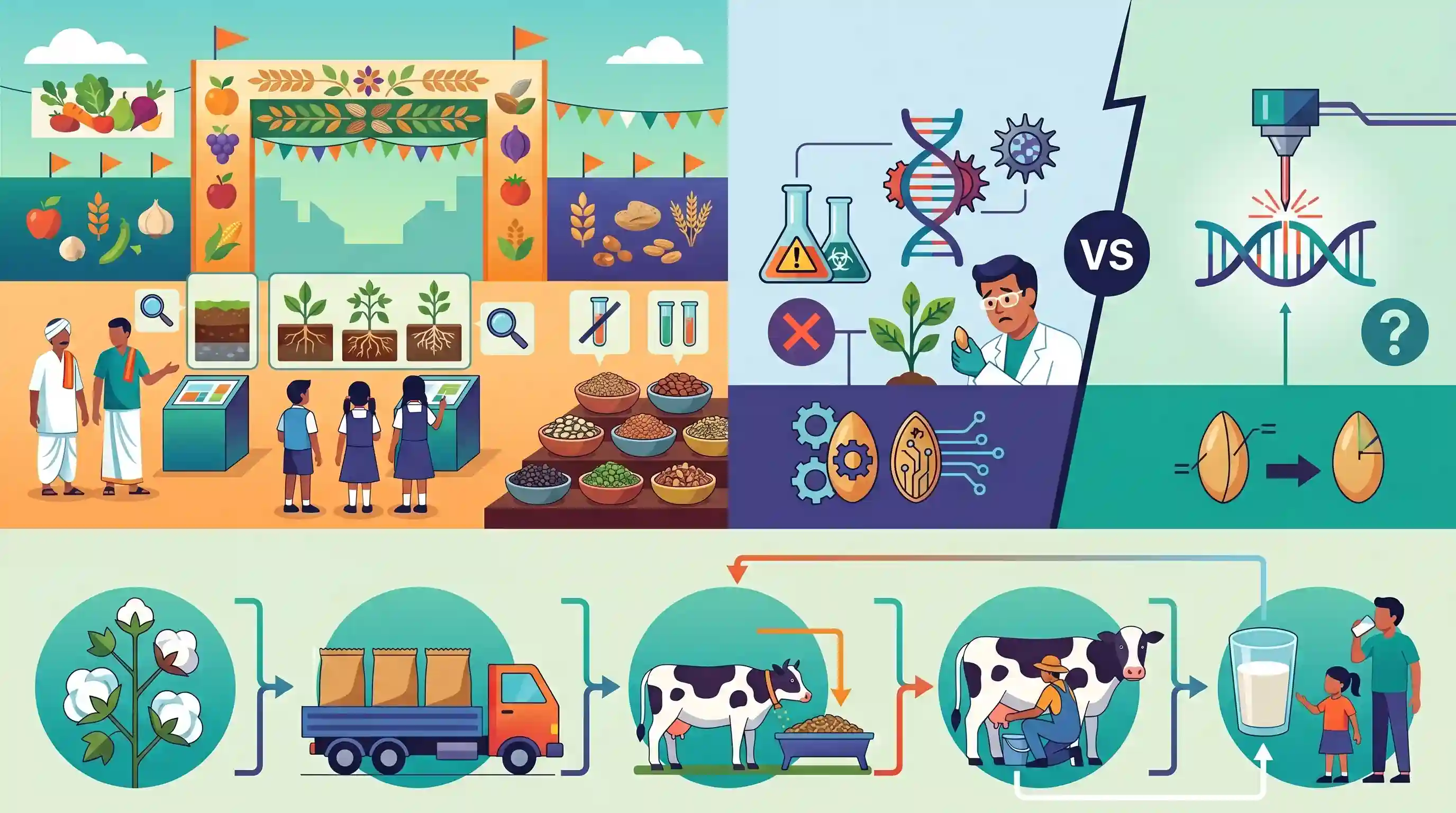
Farmers' associations in Tamil Nadu, including the TNFPA and TNNFF, are expanding the scale of the upcoming Kongu Region Seeds and Food Festival in Tiruppur. The two-day organic festival aims to sensitize thousands of school students about sustainable agriculture, soil suitability, and traditional farming practices. A key focus of the event is a critical debate on the nuances between 'genetic modification' and 'gene editing', raising concerns about the lack of rigorous testing for genetically manipulated seeds. Organizers will particularly highlight the hidden impacts of Bt Cotton on the broader food chain, noting how GM cottonseed cake fed to livestock ultimately affects human food systems through milk consumption.
Key Points
- The second edition of the Kongu Region Seeds and Food Festival is being organized in Tiruppur by TNFPA and TNNFF to promote organic farming.
- The event targets the younger generation, with significant participation expected from over 60 schools to create awareness about sustainable agriculture and soil suitability.
- A major highlight is the debate over the political shift from using the term 'genetic modification' to 'gene editing', alongside a demand for rigorous testing of genetically manipulated seeds.
- Activists will discuss the overlooked impact of GM crops like Bt Cotton on the food chain, where cottonseed cake is used as livestock feed and its by-products (milk) enter the human food system.
- The festival will also showcase ancient farming implements and rare crop varieties, including lesser-known edible banana species.
Important Terms
Genetically Modified (GM) Crops

Crops with DNA altered via genetic engineering, typically by inserting foreign genes (transgenics) to introduce specific traits like pest resistance or herbicide tolerance.
UPSC context
GS Paper 3 (Science & Tech/Agriculture); tests understanding of biotechnology and regulatory hurdles in food security.
Genome Editing
A precise biotechnology (e.g., CRISPR) that modifies an organism's own DNA without necessarily adding foreign genetic material, recently distinguished from GM crops in Indian regulations.
UPSC context
GS Paper 3 (Science & Tech); relevant for recent policy shifts (2022) exempting certain edits from stringent biosafety rules.
Genetic Engineering Appraisal Committee (GEAC)
India's apex regulator under the Ministry of Environment for assessing and approving the environmental release of genetically engineered organisms and products.
UPSC context
GS Paper 3 (Environment/Agriculture); tests knowledge of statutory bodies and the biosafety approval process.
Bt Cotton
A transgenic variety engineered with Bacillus thuringiensis genes to produce insecticidal proteins; it remains the only GM crop commercially cultivated in India.
UPSC context
GS Paper 3 (Agriculture); foundational case study for biotechnology's impact on yields, pesticide use, and farmer economics.
Organic Farming
An agricultural system excluding synthetic inputs (fertilizers, pesticides, GMOs) to maintain soil health through crop rotation, green manures, and biological pest control.
UPSC context
GS Paper 3 (Agriculture); vital for topics on sustainable practices and the National Mission for Sustainable Agriculture (NMSA).
SDN-1 and SDN-2 Categories
Technical categories of genome editing that modify native DNA without introducing foreign genetic material; India's 2022 memorandum exempts these from GEAC field trial requirements.
UPSC context
GS Paper 3 (S&T Policy); specific terminology testing awareness of the latest regulatory relaxations for agricultural innovation.
Prelims Trap
Gene-edited crops (SDN-1 and SDN-2) require the same stringent GEAC approval as transgenic GM crops.
India actually exempts SDN-1 and SDN-2 categories (non-transgenic gene editing) from the strict environmental regulations governing GMOs (SDN-3/transgenics) under the EPA 1986 rules.
Static Concepts Connected
What is the difference between Genetic Modification and Gene Editing?
- Genetic Modification (GMO): Involves introducing foreign DNA (transgenics) from a different species to acquire new traits. Highly regulated by GEAC.
- Gene Editing: Alters the organism's existing DNA (e.g., using CRISPR-Cas9) without adding foreign genes. SDN-1 and SDN-2 edits are exempt from strict GMO rules in India.
What is the regulatory framework for Genetically Modified crops in India?
- Apex Body: The Genetic Engineering Appraisal Committee (GEAC) under MoEFCC evaluates and approves the environmental release of GM crops.
- Statutory Backing: GEAC functions as a statutory body constituted under the Environment (Protection) Act, 1986.
- Current Status: Bt Cotton is the only commercialized GM crop in India, while GM Mustard (DMH-11) has received conditional environmental clearance.
Cross-Topic Patterns
Bt Cotton + Livestock Feed
Though Bt Cotton is technically a non-food cash crop, its seed cake is widely used as cattle feed, covertly introducing GM traits into dairy (milk) supply chains.
Organic Farming + PKVY Certification
The push for traditional seeds aligns with the Paramparagat Krishi Vikas Yojana (PKVY), which utilizes the Participatory Guarantee System (PGS) to certify organic farming clusters locally.

Expect a multi-statement question in 2026 linking Bt Cotton's indirect food chain entry with India's SDN-1/SDN-2 gene-editing exemptions.
Linked PYQs · 4
Linked PYQs · 4
- 2021PrelimsGS1
Bollgard I and Bollgard II technologies are mentioned in the context of
- 2019PrelimsGS1
What is Cas9 protein that is often mentioned in news?
- 2018MainsGS3
Sikkim is the first 'Organic State' in India. What are the ecological and economical benefits of Organic State?
- 2019MainsGS3
How can biotechnology help to improve the living standards of farmers?
