Farmer Fatality Highlights Human Wildlife Conflict in Tamil Nadu
Source:The Hindu ↗
Why It Matters
Incidents of human-elephant conflict represent a core environmental challenge in India, directly tying into UPSC GS-3 topics on biodiversity conservation and environmental degradation. It forces aspirants to evaluate the balance between wildlife protection (e.g., Project Elephant, Wildlife Protection Act) and the safety/livelihoods of local communities.
Summary
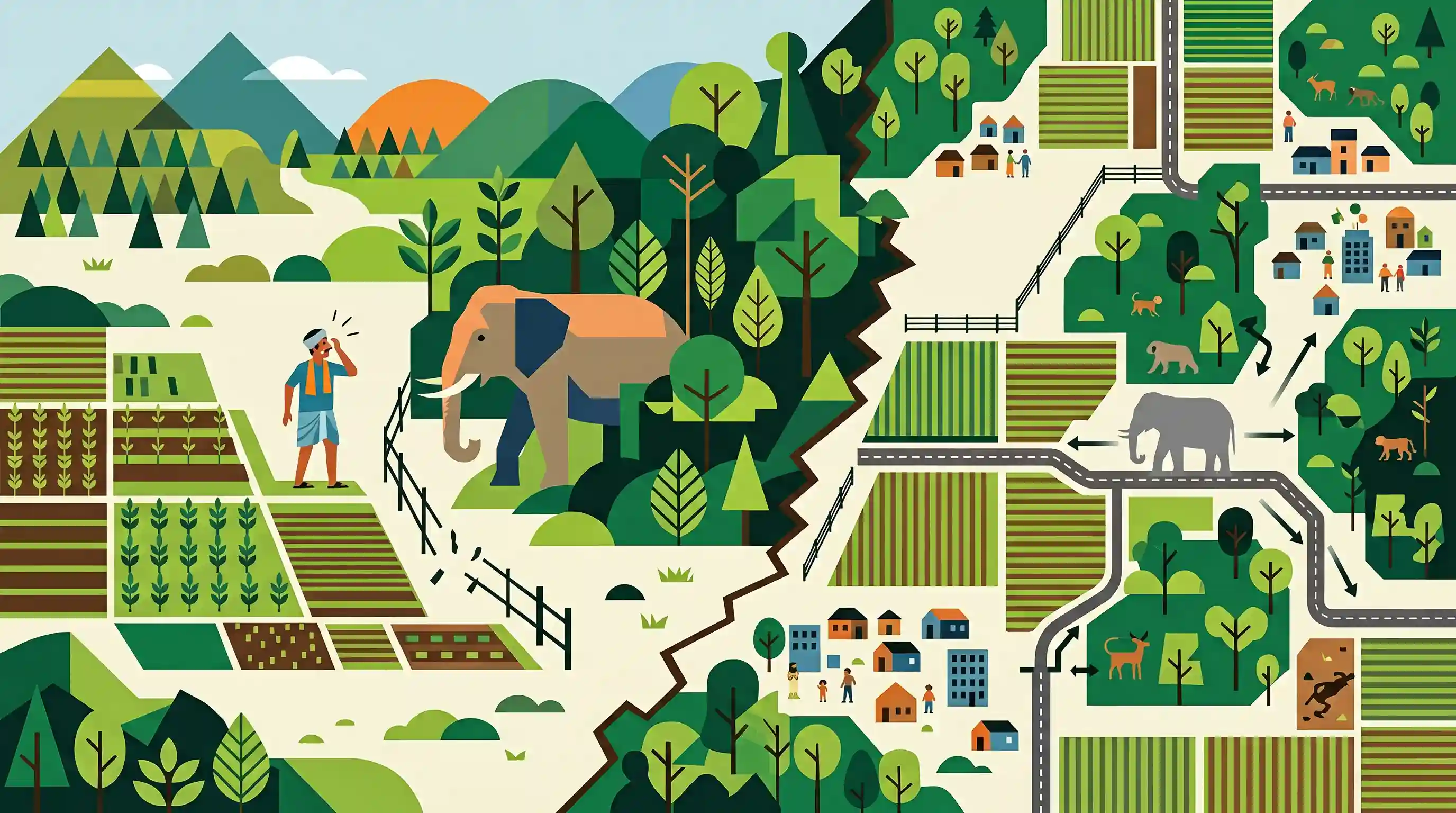
A farmer in the Kadambur hills of Erode district was trampled to death by a wild elephant near his agricultural field. The incident highlights the persistent and fatal nature of human-wildlife conflict in regions where human settlements and agricultural lands directly abut forest boundaries. It raises concerns over habitat fragmentation and the safety of fringe communities, emphasizing the need for effective conflict mitigation strategies.
Key Points
- A 56-year-old farmer, Chinnasamy, was trampled to death by a wild elephant in the Kadambur hills (Erode district).
- The incident occurred while the farmer was checking on ploughing work in his field located near the forest boundary.
- This tragic event underscores the ongoing and severe issue of human-wildlife conflict, specifically human-elephant conflict (HEC), in villages bordering forest areas.
- Local police and Forest Department officials intervened for the recovery and post-mortem procedures.
Important Terms
Human-Wildlife Conflict (HWC)

Negative interactions between humans and wild animals resulting in loss of life, crops, or livestock. It occurs when human activities expand into wildlife habitats, creating competition for space and resources.
UPSC context
GS Paper III: Environment and Disaster Management. Tests knowledge of conservation challenges, community safety, and mitigation strategies like ex-gratia payments.
Habitat Fragmentation
The division of large, continuous natural habitats into smaller, isolated patches, usually due to infrastructure development (roads/farming). This forces wildlife into human settlements, increasing conflict.
UPSC context
GS Paper III: Biodiversity. Tests understanding of ecological decay, edge effects, and the root causes of species population decline.
Elephant Corridors
Narrow strips of land connecting two larger elephant habitats. They facilitate safe migration, prevent genetic isolation, and reduce human-elephant encounters by providing designated routes for movement.
UPSC context
GS Paper III: Conservation. Important for Prelims (mapping/corridor locations) and Mains (biodiversity management and legal protection under the WPA).
Sathyamangalam Tiger Reserve (STR)
A protected area in Erode, Tamil Nadu, acting as a crucial wildlife corridor between the Eastern and Western Ghats. It hosts significant elephant and tiger populations.
UPSC context
Prelims: Geography/Environment mapping. Tests identification of Tiger Reserves and their role in the Nilgiri Biosphere Reserve.
Project Elephant
A centrally sponsored scheme launched in 1992 to ensure the long-term survival of elephants. It focuses on habitat protection, corridor management, and mitigating human-elephant conflict.
UPSC context
GS Paper III: Environment. Tests awareness of government conservation initiatives and the administrative framework for managing the National Heritage Animal.
Wildlife Protection Act (WPA), 1972
The primary legal framework for protecting wildlife in India. It empowers the government to declare protected areas and provides the highest protection to Schedule I animals like elephants.
UPSC context
GS Paper II & III: Governance and Environment. Tests legal provisions, penal powers of forest officials, and species categorization.
Prelims Trap
"Project RE-HAB for mitigating human-elephant conflict is implemented by the Ministry of Environment, Forest and Climate Change."
Project RE-HAB is actually an initiative of the Khadi and Village Industries Commission (KVIC) under the Ministry of MSME, not the MoEFCC or local Forest Departments.
Static Concepts Connected
What is the ecological significance of the Sathyamangalam Tiger Reserve (STR)?
- Corridor link: It acts as a crucial genetic bridge connecting the Western Ghats and the Eastern Ghats, enabling mega-fauna migration.
- Contiguous landscape: It forms a massive contiguous landscape with Mudumalai, Bandipur, and BRT Tiger Reserves, supporting the single largest elephant population in India.
- Tribal presence: Home to indigenous forest-dwelling communities like the Irulas and Kurumbas, whose rights are protected under the FRA, 2006.
How does the Wildlife (Protection) Act, 1972 address animal ownership and conflict?
- State property: The Supreme Court has clarified that wild animals (including Schedule I elephants) are the absolute property of the Government.
- Threat to life: Section 11 permits killing a Schedule I animal only if it threatens human life, and requires written permission from the Chief Wildlife Warden (CWLW).
- No commercial rights: Even if an elephant is killed in legitimate self-defense, the carcass and tusks remain government property with no commercial rights for the killer.
Cross-Topic Patterns
KVIC (MSME) + Wildlife Conservation
Project RE-HAB uses bee-boxes to deter elephants, linking rural livelihood schemes (apiculture under MSME) directly with biodiversity protection goals.
Infrastructure growth vs Elephant Corridors
Rising trampling incidents are often the direct ecological cost of linear infrastructure (highways, railways) severing historical migratory corridors in the Western Ghats.

Expect a multi-statement prelims question combining the 2023-24 merger of Project Tiger & Elephant (PT&E) with KVIC's Project RE-HAB.
Linked PYQs · 2
Linked PYQs · 2
- 2020PrelimsGS1
With reference to Indian elephants, consider the following statements: 1. The leader of an elephant group is a female. 2. The maximum gestation period can be 22 months. 3. An elephant can normally go on calving till the age of 40 years only. 4. Among the States in India, the highest elephant population is in Kerala. Which of the statements given above is/are correct?
- 2022PrelimsGS1
With reference to Indian laws about wildlife protection, consider the following statements : 1. Wild animals are the sole property of the government. 2. When a wild animal is declared protected, such animal is entitled for equal protection whether it is found in protected areas or outside. 3. Apprehension of a protected wild animal becoming a danger to human life is sufficient ground for its capture or killing. Which of the statements given above is/are correct?
