Human Wildlife Conflict Escalates Near Bandipur Tiger Reserve
Source:The Hindu ↗
Why It Matters
This issue is highly relevant for GS Paper 3 (Environment & Conservation) as it illustrates the complex challenges arising from conservation successes—specifically, how growing tiger populations in restricted habitats like Bandipur-Nagarahole lead to increased human-animal conflict. It also provides important geographical and ecological facts about major Tiger Reserves for Prelims.
Summary
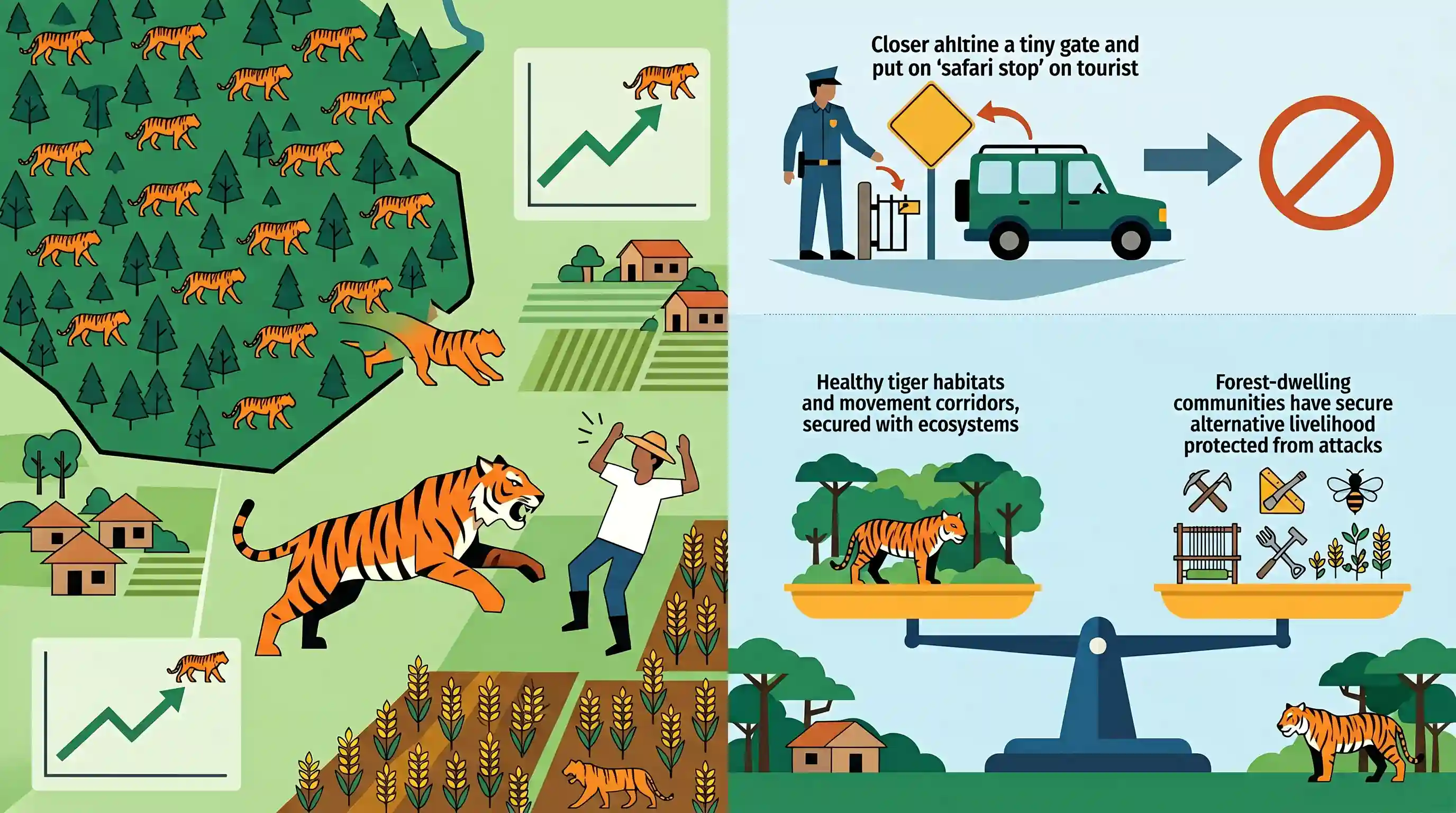
A fatal tiger attack on a farmer in Karnataka's Saragur taluk underscores the intensifying human-wildlife conflict near the Bandipur Tiger Reserve. The Bandipur-Nagarahole belt, housing nearly 300 tigers as per the NTCA's 2022 report, is experiencing habitat spillover effects as successful conservation outpaces carrying capacity. While local authorities have proposed limiting safaris in response, experts criticize such measures as 'tokenism' that distracts from the pressing need for substantive policy interventions to secure both wildlife habitats and the livelihoods of forest-dwelling communities.
Key Points
- A farmer was killed by a tiger near the Bandipur Tiger Reserve in Karnataka, highlighting the severe escalation of human-wildlife conflict in the area.
- The Bandipur-Nagarahole forest belt has seen a surge in its tiger population, currently standing at nearly 300 tigers according to the 2022 NTCA report, putting pressure on surrounding habitats.
- The conflict dynamic is shifting; while crop-raiding by elephants was historically the primary issue, there is now an increasing frequency of tiger attacks on humans and livestock.
- Experts point out that reactive, superficial measures like curtailing wildlife safaris amount to mere 'tokenism' and fail to address the core problem of habitat limits and human livelihood dependencies on forest fringes.
- There is an urgent need for robust, long-term policies that balance the success of wildlife conservation efforts with the socio-economic security of local communities.
Important Terms
National Tiger Conservation Authority (NTCA)

A statutory body under the MoEFCC, established in 2005 to provide legal and policy oversight for Project Tiger and the management of India's tiger reserves.
UPSC context
GS Paper III: Environment & Biodiversity; tests knowledge of regulatory bodies and conservation governance.
Human-Wildlife Conflict (HWC)
Negative interactions between humans and wildlife resulting in loss of life, property, or crops, frequently occurring in forest fringe areas due to habitat fragmentation.
UPSC context
GS Paper III: Environment; essential for discussing conservation challenges, mitigation strategies, and man-animal coexistence.
Project Tiger
Launched in 1973, this centrally sponsored scheme aims to protect Bengal tigers; it was merged into the 'Project Tiger and Elephant Division' in 2023.
UPSC context
GS Paper III: Conservation; critical for understanding flagship species protection and the evolution of wildlife schemes.
Bandipur Tiger Reserve
A major tiger reserve in Karnataka and part of the Nilgiri Biosphere Reserve, established in 1973 as one of India's first nine Project Tiger sites.
UPSC context
GS Paper I (Geography) and III (Environment); focuses on protected area locations and ecological confluence zones.
Nagarahole Tiger Reserve
Also known as Rajiv Gandhi National Park, it is a key Karnataka reserve forming a contiguous landscape with Bandipur and hosting high tiger densities.
UPSC context
GS Paper III: Biodiversity; highlights the importance of wildlife corridors and contiguous protected areas.
Carrying Capacity
The maximum number of individuals of a species that an ecosystem can sustainably support given its available resources and habitat.
UPSC context
GS Paper III: Environment; relevant for analyzing why successful conservation leads to spillover and human-wildlife conflict.
Prelims Trap
Bandipur and Nagarhole Tiger Reserves are geographically separated by the Moyar river.
False. Bandipur and Nagarhole are separated by the Kabini river. The Moyar river actually forms the natural boundary separating Bandipur from the Mudumalai Tiger Reserve.
Static Concepts Connected
What protected areas constitute the Nilgiri Biosphere Reserve and how are they linked?
- Components: Includes Bandipur, Nagarhole, Mudumalai, Wayanad, Silent Valley, and Mukurthi national parks and wildlife sanctuaries.
- River Boundaries: The Kabini river reservoir separates Bandipur and Nagarhole, while the Moyar river separates Bandipur from Mudumalai.
- Significance: It is India's first biosphere reserve (1986), hosting the world's largest single continuous population of tigers.
What is the statutory mandate and structure of the NTCA?
- Statutory Origin: Established in 2005 following an amendment to the Wildlife (Protection) Act, 1972, to reorganize tiger conservation.
- Leadership: The Authority is chaired by the Union Minister for Environment, Forest and Climate Change.
- Key Functions: Evaluates tiger reserve carrying capacities, approves state Tiger Conservation Plans, and coordinates the quadrennial tiger census.
Cross-Topic Patterns
Carrying Capacity vs. Conservation Success
The paradox of Project Tiger is the "spill-over" effect. Success leading to populations exceeding ecological carrying capacity shifts the UPSC focus from basic conservation to conflict management and landscape connectivity.
FRA 2006 and Human-Wildlife Conflict
Frequent large carnivore conflicts on forest fringes intersect with the Forest Rights Act (FRA), highlighting the tension between Critical Tiger Habitats (CTHs) and the livelihood security of forest-dwelling communities.

Expect a Prelims 2026 mapping question linking Bandipur/Nagarhole to the Kabini river, Nilgiri Biosphere, and NTCA carrying capacity.
Linked PYQs · 2
Linked PYQs · 2
- 2012PrelimsGS1
Consider the following protected areas: 1. Bandipur 2. Bhitarkanika 3. Manas 4. Sunderbans Which of the above are declared Tiger Reserves?
- 2020PrelimsGS1
Which of the following Protected Areas are located in Cauvery basin ? 1. Nagarhole National Park 2. Papikonda National Park 3. Sathyamangalam Tiger Reserve 4. Wayanad Wildlife Sanctuary Select the correct answer using the code given below:
