Punjab Farmer Protests on India US Trade Agreement
Source:The Hindu ↗
Why It Matters
Highlights the socio-economic vulnerabilities of India's agricultural sector when exposed to global markets through bilateral trade deals. It emphasizes the structural disparities between developing and developed nation farming (e.g., economies of scale and subsidy frameworks), an important concept for analyzing agricultural policies, WTO negotiations, and Free Trade Agreements.
Summary
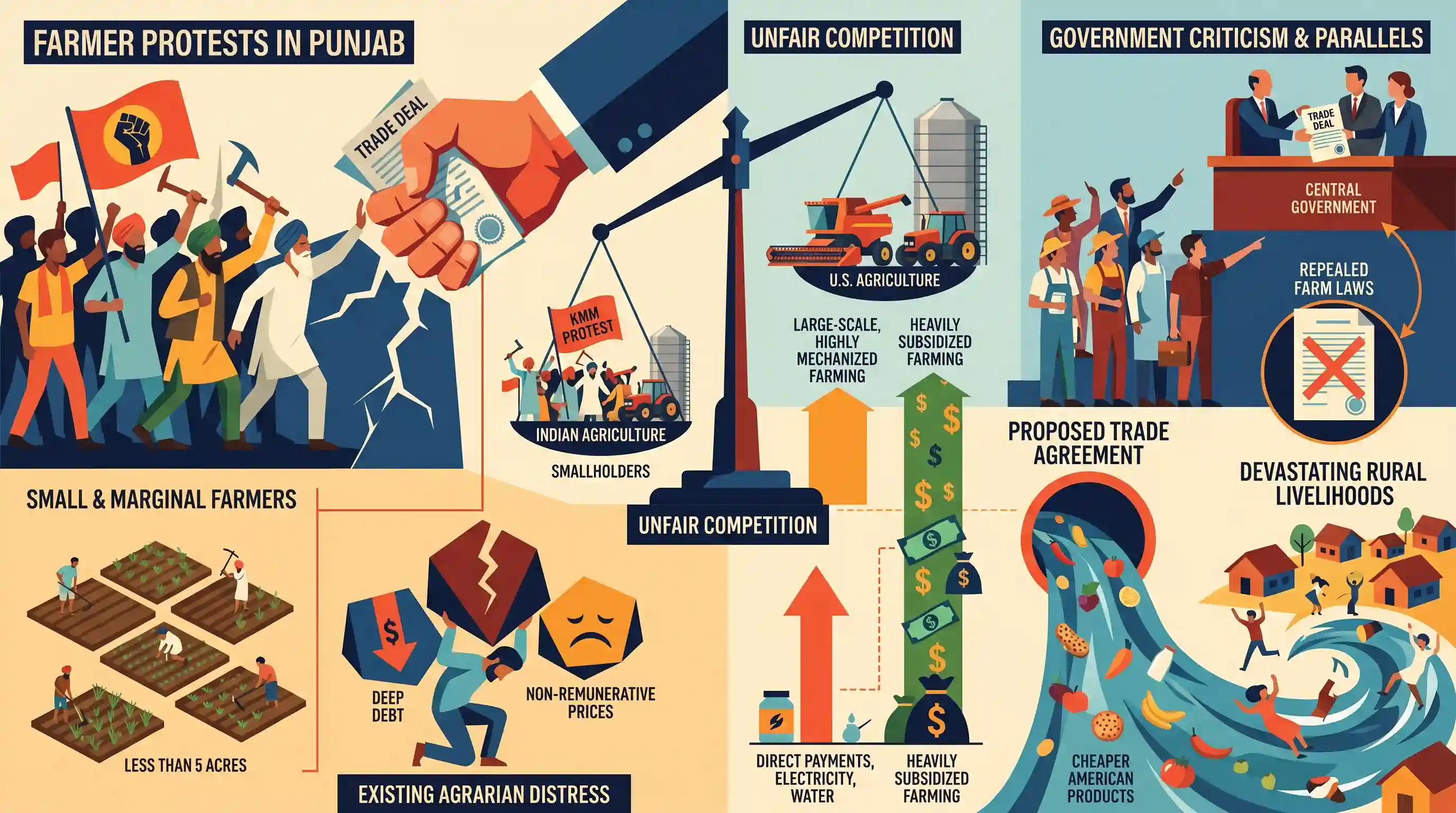
Farmer groups in Punjab have launched protests against a proposed India-U.S. trade agreement, citing severe risks to India's agrarian economy. Organizations like the Kisan Mazdoor Morcha argue that Indian farmers—86% of whom are smallholders with less than 5 acres—cannot compete with heavily subsidized, large-scale, and highly mechanised U.S. farming. Amidst existing agrarian distress characterized by deep debt and non-remunerative prices, farmers fear that an influx of cheaper American agricultural products will devastate rural livelihoods. Protest leaders also criticized the central government for advancing the deal without consulting stakeholders, drawing parallels to the previously repealed farm laws.
Key Points
- Farmer groups in Punjab, including the Kisan Mazdoor Morcha (KMM), are protesting a proposed India-U.S. trade agreement.
- Protesters allege that opening the agricultural market to the U.S. will destroy Indian farmers, labourers, and local businesses.
- A major concern is unequal competition: U.S. farmers operate on vast, highly mechanised lands and receive massive government subsidies, whereas 86% of Indian farmers are smallholders with 5 acres or less.
- Indian farmers are already distressed by severe debt, low crop prices, and high suicide rates, making them exceptionally vulnerable to cheap agricultural imports.
- Farmers criticized the lack of consultation regarding the trade deal, drawing comparisons to the unilateral introduction of the repealed farm laws.
Important Terms
India-U.S. Trade Agreement

A proposed bilateral pact aimed at reducing tariffs on American agricultural and industrial goods; farmers fear it exposes Indian smallholders to competition from heavily subsidized U.S. agribusiness.
UPSC context
GS Paper II: Bilateral agreements; GS Paper III: Impact of trade agreements on the domestic agrarian economy.
Legal Guarantee for MSP
A long-standing demand by farmer groups for a statutory guarantee that crop prices will not fall below a set floor, typically based on the Swaminathan Commission's C2+50% formula.
UPSC context
GS Paper III: Issues related to direct/indirect farm subsidies, buffer stocks, and food security.
Samyukt Kisan Morcha (SKM)
An umbrella coalition of hundreds of farmer unions that led the 2020-21 protests against farm laws; it continues to advocate for farmers' rights and trade protections.
UPSC context
GS Paper II: Pressure groups and formal/informal associations and their role in the Polity.
Amber Box Subsidies
A category of trade-distorting domestic support under the WTO Agreement on Agriculture, including MSP and input subsidies, which are subject to a 10% "de minimis" limit for India.
UPSC context
GS Paper III: WTO agreements and their impact on Indian agriculture and food security.
Kisan Mazdoor Morcha (KMM)
A prominent splinter/allied organization of the SKM that spearheads current agitations in Punjab and Haryana, focusing on MSP legislation and opposing international trade deals perceived as anti-farmer.
UPSC context
GS Paper II: Role of agrarian pressure groups in influencing government policy.
Prelims Trap
"India's Minimum Support Price (MSP) program qualifies as a Green Box subsidy under WTO rules because it ensures food security."
MSP is a market price support measure. Under WTO rules, it is considered trade-distorting and falls under the 'Amber Box', subject to strict de minimis limits.
Static Concepts Connected
What are the three main 'boxes' of agricultural subsidies under the WTO Agreement on Agriculture?
- Amber Box: Trade-distorting subsidies tied to price/production (e.g., MSP, fertilizer). Capped at 5% of production value for developed nations, 10% for developing nations.
- Blue Box: Amber Box subsidies with conditions designed to limit overall production. Currently, there are no spending limits on these subsidies.
- Green Box: Non-trade-distorting subsidies disconnected from production levels, such as direct income support (e.g., PM-KISAN), R&D, and environmental programs. These are uncapped.
How does the Agricultural Census classify Indian farmers by landholding size?
- Marginal Farmers: Farmers operating less than 1 hectare (approx. 2.5 acres) of land.
- Small Farmers: Farmers operating between 1 and 2 hectares (approx. 2.5 to 5 acres) of land. Together with marginal farmers, they form 86% of the agrarian base.
- Medium and Large: Those holding 2-4 hectares (semi-medium), 4-10 hectares (medium), and over 10 hectares (large).
Cross-Topic Patterns
Parallels with India's 2019 RCEP withdrawal
Just as dairy farmers successfully lobbied against the RCEP to prevent cheap imports from New Zealand, Punjab farmers now fear subsidized US dairy, poultry, and apples under a new bilateral FTA.
Legal MSP demands vs WTO subsidy limits
Domestic pressure to legally guarantee MSP conflicts directly with India's international obligations under the WTO Agreement on Agriculture, where such price support faces a 10% de minimis cap.

Expect a multi-statement question on WTO AoA subsidies, contrasting India's Amber Box MSP with US Green Box direct income support.
Linked PYQs · 4
Linked PYQs · 4
- 2023MainsGS3
What are the direct and indirect subsidies provided to farm sector in India? Discuss the issues raised by the World Trade Organization (WTO) in relation to agricultural subsidies.
- 2017MainsGS3
How do subsidies affect the cropping pattern, crop diversity and economy of farmers? What is the significance of crop insurance, minimum support price and food processing for small and marginal farmers?
- 2013MainsGS3
What are the different types of agriculture subsidies given to farmers at the national and at state levels ? Critically analyse the agricultural subsidy regime with reference to the distortions created by it.
- 2021MainsGS3
How did land reforms in some parts of the country help to improve the socio-economic conditions of marginal and small farmers?
