Artificial Intelligence Applications in Precision Agriculture
Source:The Hindu ↗
Why It Matters
The convergence of emerging technologies like Artificial Intelligence with agriculture is a major theme in GS3 (e-technology in the aid of farmers). Understanding how predictive data can solve systemic agricultural issues—such as climate vulnerability and market instability—is crucial for addressing challenges related to doubling farmers' income and ensuring sustainable agriculture.
Summary
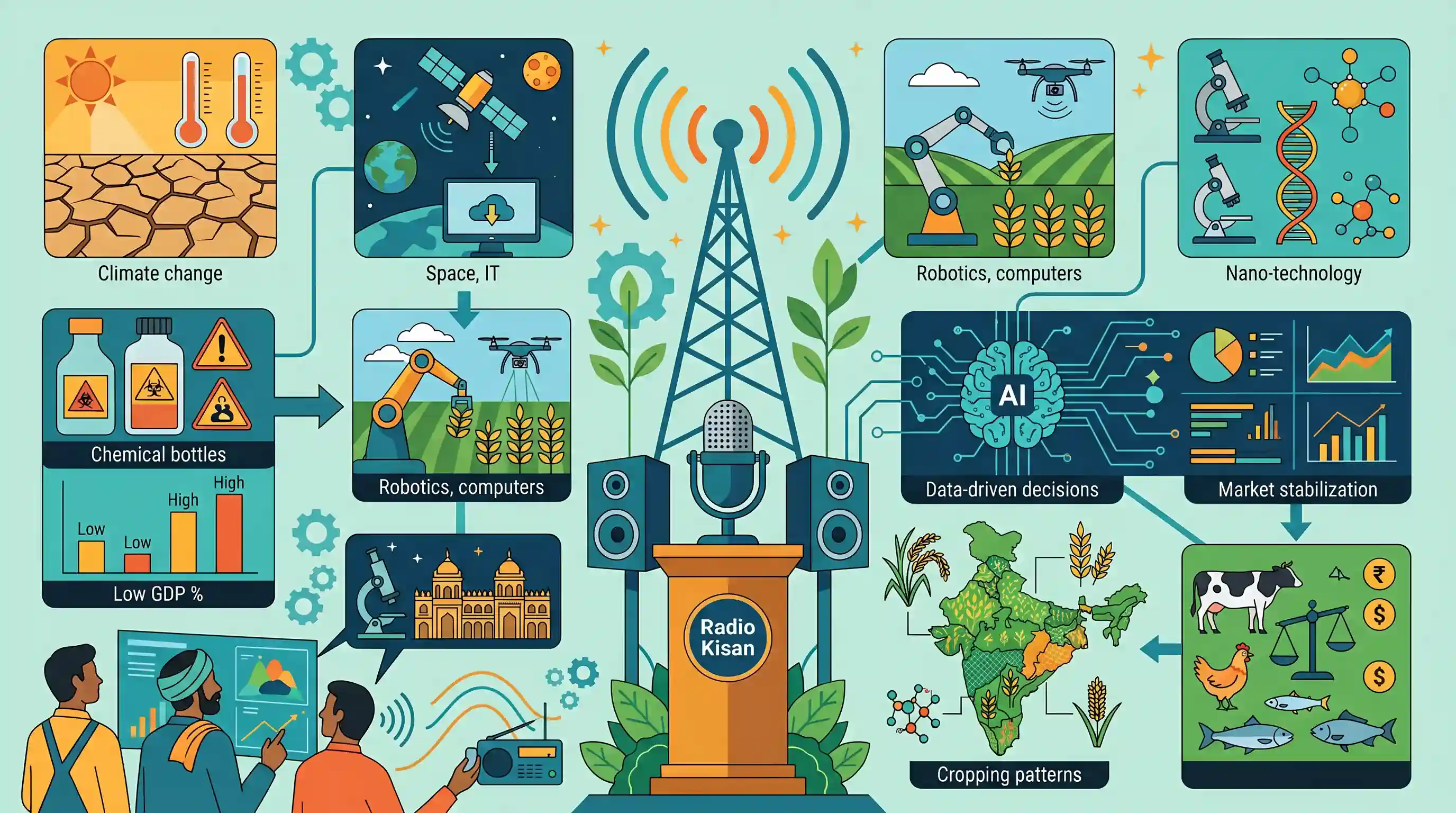
At a workshop organized on Radio Kisan Day in Mysuru, agricultural scientists highlighted the transformative potential of Artificial Intelligence (AI) for Indian farming. Despite contributing 18% to the GDP and employing 46% of the workforce, Indian agriculture struggles with climate change, rising costs, and soil degradation from chemical overuse. Experts advocated for AI as a critical tool to help farmers make predictive, data-driven decisions, thereby mitigating risks and stabilizing markets. The event also underscored the enduring importance of radio in communicating agricultural innovations to rural communities.
Key Points
- Indian agriculture contributes around 18% to the national GDP and provides direct or indirect employment to nearly 46% of the population.
- The sector faces major headwinds, including climate change, rising input costs, production risks, market instability, and land degradation caused by excessive chemical usage.
- Artificial Intelligence (AI) can revolutionize agriculture by equipping farmers with predictive, data-driven insights to improve decision-making.
- Integration of AI can help optimize crop yields, manage risks, ensure better market stability, and ultimately uplift the livelihoods of farmers.
- Traditional mass media, particularly radio broadcasts like those by All India Radio, continue to play a pivotal role in agricultural extension and disseminating technological innovations to rural communities.
Important Terms
Krishi Vigyan Kendra (KVK)

A district-level agricultural extension center established by ICAR to bridge the gap between research and farmers through training, on-farm trials, and frontline demonstrations of modern technologies.
UPSC context
GS3: Agriculture (Extension Services). Essential for understanding technology transfer mechanisms and grassroots-level institutional support for farmers.
Artificial Intelligence (AI) in Agriculture
The application of machine learning, predictive analytics, and data-driven tools to optimize farm operations, predict weather impacts, and stabilize market prices through informed decision-making.
UPSC context
GS3: IT, Computers, and E-technology. Tests knowledge of technological interventions for climate resilience and farm productivity.
All India Radio (AIR)
India's national public broadcaster that disseminates scientific agricultural knowledge to rural and illiterate communities through localized programs like 'Kisanvani' to overcome the digital divide.
UPSC context
GS3: E-technology in the aid of farmers. Focuses on mass communication tools for rural development and extension services.
University of Agricultural Sciences (UAS)
Specialized state institutions (e.g., UAS Bangalore/Mandya) focused on agricultural research, education, and development, recently integrating advanced technologies like AI into their curricula to modernize farming.
UPSC context
GS3: Major Crops/Agricultural Research. Tests the role of academic and research institutions in driving innovation in the primary sector.
Central Institute of Indian Languages (CIIL)
A Mysuru-based research institute under the Ministry of Education that coordinates the development of Indian languages, crucial for translating complex agricultural AI tools into regional dialects.
UPSC context
GS2: Government Policies/Education. Highlights the importance of linguistic inclusivity in the adoption of digital governance and technology.
Precision Agriculture
A management strategy that uses digital tools (GPS, AI, IoT) to observe and respond to inter-field variability, ensuring precise application of water, fertilizers, and pesticides.
UPSC context
GS3: Agriculture. Core concept for resource-use efficiency, cost reduction, and sustainable farming practices in modern India.
Prelims Trap
"YES-TECH and CROPIC are AI-based navigation systems developed by the government for autonomous farming machinery."
They are government frameworks deploying AI and remote sensing for yield estimation and fast-tracking insurance claim settlements under PMFBY, not for autonomous vehicles.
Static Concepts Connected
What causes the structural productivity gap in Indian agriculture?
- Disguised unemployment: Employs ~46% of the workforce for just ~18% of GDP, meaning the marginal productivity of many agricultural laborers is close to zero.
- Fragmented holdings: Shrinking operational landholdings restrict the adoption of mechanized farming and limit economies of scale.
- Input inefficiencies: Overuse of chemical fertilizers and reliance on erratic monsoons drive up input costs while degrading soil health.
How is Artificial Intelligence currently deployed in Indian agriculture?
- Pest Management: The National Pest Surveillance System (NPSS) uses machine learning image analytics to instantly detect infestations across 60+ crops, reducing arbitrary pesticide use.
- Language Accessibility: Kisan e-Mitra, an AI voice chatbot, resolves farmer queries regarding schemes in regional languages, effectively bypassing rural literacy barriers.
- Crop Insurance: AI models integrated with satellite data automate yield estimation and damage assessments for quicker Pradhan Mantri Fasal Bima Yojana (PMFBY) claim settlements.
Cross-Topic Patterns
AgriStack as agricultural DPI
Similar to UPI's impact on finance, AgriStack acts as an agricultural Digital Public Infrastructure (DPI), linking Farmer IDs with land records to deliver targeted AI advisories and direct credit.
Space tech for financial inclusion
Frameworks like YES-TECH bridge GS3 Space Technology and Economy by using satellite remote sensing and AI computer vision to automate crop damage assessments for PMFBY insurance claims.

Expect a Prelims 2026 match-the-pair question linking agricultural AI portals (Kisan e-Mitra, NPSS, YES-TECH) to their specific functions.
Linked PYQs · 4
Linked PYQs · 4
- 2023MainsGS3
How does e-Technology help farmers in production and marketing of agricultural produce? Explain it.
- 2021MainsGS3
What are the present challenges before crop diversification? How do emerging technologies provide an opportunity for crop diversification?
- 2023MainsGS3
Introduce the concept of Artificial Intelligence (AI). How does Al help clinical diagnosis? Do you perceive any threat to privacy of the individual in the use of Al in healthcare?
- 2021MainsGS2
Has digital illiteracy, particularly in rural areas, coupled with lack of Information and Communication Technology (ICT) accessibility hindered socio-economic development? Examine with justification.
