Unions Oppose US Free Trade Agreement Over Farm Sector Risks
Source:The Hindu ↗
Why It Matters
The article illustrates the socio-economic tensions surrounding international trade agreements. It is highly relevant for GS3 questions on the impact of FTAs on domestic agriculture, the debate over agricultural subsidies at the WTO, and the broader implications of trade liberalization on vulnerable domestic sectors and rural livelihoods.
Summary
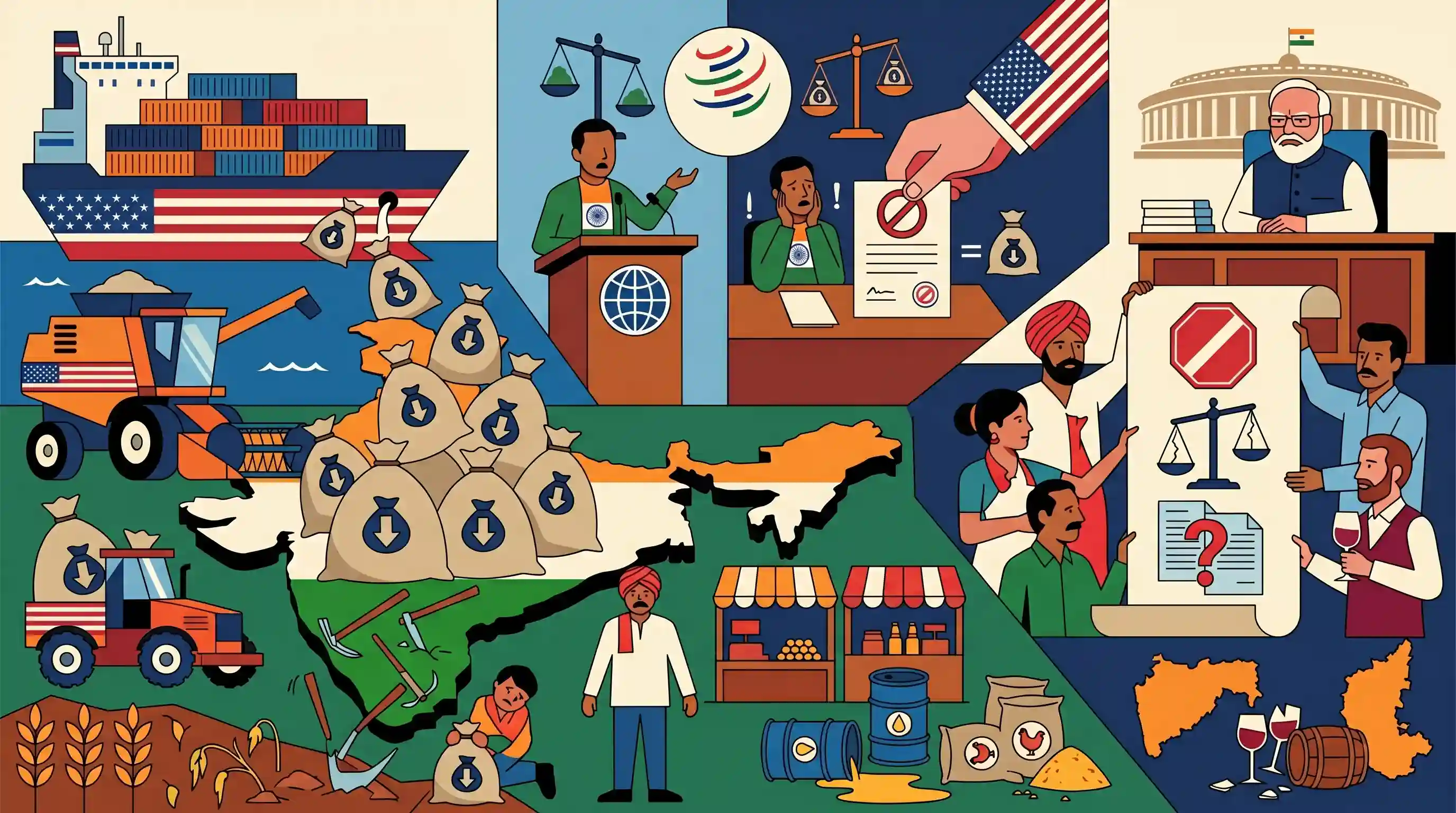
Farm organizations, trade unions, poultry traders, and winemakers have jointly urged Prime Minister Narendra Modi to halt ongoing Free Trade Agreement (FTA) negotiations with the United States. The groups warned that an FTA would lead to an influx of heavily subsidized U.S. agricultural products, devastating India's domestic agriculture, retail trade, and rural economy. They emphasized that permitting such imports would contradict India's longstanding opposition to developed nations' farm subsidies at the World Trade Organization (WTO). Specific industries, including domestic edible oils, poultry feed, and wine production across states like Maharashtra and Karnataka, could face severe disruptions. Consequently, the coalition demands a suspension of all FTA negotiations and advocates for a comprehensive Parliamentary and public review of India's trade agreements.
Key Points
- A coalition of farm outfits, trade unions, and industry bodies has written to PM Modi demanding an immediate halt to ongoing Free Trade Agreement (FTA) negotiations with the U.S.
- They argue that importing heavily subsidized agricultural products from the U.S. will devastate domestic farm production and threaten rural livelihoods.
- The groups pointed out that allowing such imports undermines India's historical opposition at the WTO to the massive farm subsidies provided by developed nations.
- Specific concerns include the impact of imported maize, cattle/poultry feed, and edible oils on local crops, as well as reduced import duties harming the domestic wine and spirits industry.
- The organizations are calling for a suspension of all FTA talks and a comprehensive Parliamentary and public review of all free trade agreements.
Important Terms
India-US Free Trade Agreement (FTA)

A proposed bilateral trade pact aimed at reducing tariffs and barriers between India and the U.S., currently debated for its potential impact on India's sensitive agricultural and dairy sectors.
UPSC context
GS Papers II & III; tests trade policy and bilateral economic relations.
World Trade Organization (WTO)
An international body regulating global trade; it serves as a forum for negotiating agreements and resolving disputes, including India's challenges regarding developed nations' farm subsidies.
UPSC context
GS Papers II & III; essential for understanding global trade governance.
Agreement on Agriculture (AoA)
A WTO treaty aimed at liberalizing agricultural trade by reducing domestic support and export subsidies; it categorizes support into Amber, Blue, and Green "boxes."
UPSC context
GS Paper III; vital for understanding trade-distorting vs non-distorting support.
Amber Box Subsidies
Trade-distorting domestic supports (e.g., MSP, input subsidies) subject to WTO reduction commitments, capped at 10% of total production value for developing nations like India.
UPSC context
GS Paper III; tests knowledge of WTO support boxes and India’s compliance.
Public Stockholding (PSH)
A policy where governments buy and store food to ensure food security; India seeks a "permanent solution" at the WTO to exempt these programs from subsidy limits.
UPSC context
GS Paper II & III; tests India’s stance in multilateral trade negotiations.
Minimum Support Price (MSP)
An assured price at which the Indian government procures crops from farmers, providing a safety net but often challenged at the WTO as an Amber Box subsidy.
UPSC context
GS Paper III; core topic regarding farmer welfare and market price stability.
Hind Mazdoor Sabha (HMS)
A major independent national trade union federation founded in 1948 by socialist leaders like Ashok Mehta; it advocates for workers' rights and transparency in trade deals.
UPSC context
GS Papers I & III; tested in Prelims 2018 regarding its founders.
Samyukt Kisan Morcha (SKM)
An umbrella coalition of over 40 Indian farmers' unions formed in 2020, coordinating nationwide protests against farm policies and liberalized trade agreements.
UPSC context
GS Paper III; relevant for farmer organizations and policy advocacy.
Prelims Trap
Free Trade Agreements (FTAs) and international treaties require mandatory prior ratification by the Parliament.
The Union Executive has the sole power to negotiate and sign treaties under Article 73. Parliamentary ratification is not constitutionally mandated unless domestic laws require amendment.
Static Concepts Connected
What are the main subsidy boxes under the WTO Agreement on Agriculture (AoA)?
- Amber Box: Trade-distorting subsidies (like MSP) capped at 5% of production value for developed and 10% for developing nations (de minimis limit).
- Green Box: Non-trade distorting support like agricultural R&D, infrastructure, and environmental programs. These face no spending limits.
- Blue Box: Broadly, these are Amber Box subsidies tied to conditions designed to limit production. Currently, they have no spending limits.
How does the Indian Constitution distribute power regarding international treaties?
- Union Executive Power: Under Article 73, the executive power to negotiate and sign international treaties rests solely with the Union government.
- Legislative Implementation: Article 253 empowers Parliament to make laws implementing international treaties, even on subjects in the State List, bypassing state legislatures.
Cross-Topic Patterns
SPS Measures & Cultural Sensitivities
India resists US dairy/poultry imports using Sanitary and Phytosanitary (SPS) measures. This links trade economics directly to cultural sensitivities (animal-derived cattle feed) and ecological concerns (GM crops).
Permanent Solution & Public Stockholding
Aspirants must link FTA resistance to India's WTO fight for a 'Permanent Solution' to public stockholding. Subsidized US agricultural dumping directly undermines India's domestic food security framework.

Expect a multi-statement question interlinking WTO Amber Box subsidies, India's FTA negative lists, and Article 253 treaty-making powers.
Linked PYQs · 2
Linked PYQs · 2
- 2023MainsGS3
What are the direct and indirect subsidies provided to farm sector in India? Discuss the issues raised by the World Trade Organization (WTO) in relation to agricultural subsidies.
- 2017MainsGS3
How do subsidies affect the cropping pattern, crop diversity and economy of farmers? What is the significance of crop insurance, minimum support price and food processing for small and marginal farmers?
