NCR Cities Remain Polluted Despite Drop in Farm Fire Share
Source:Indian Express ↗
Why It Matters
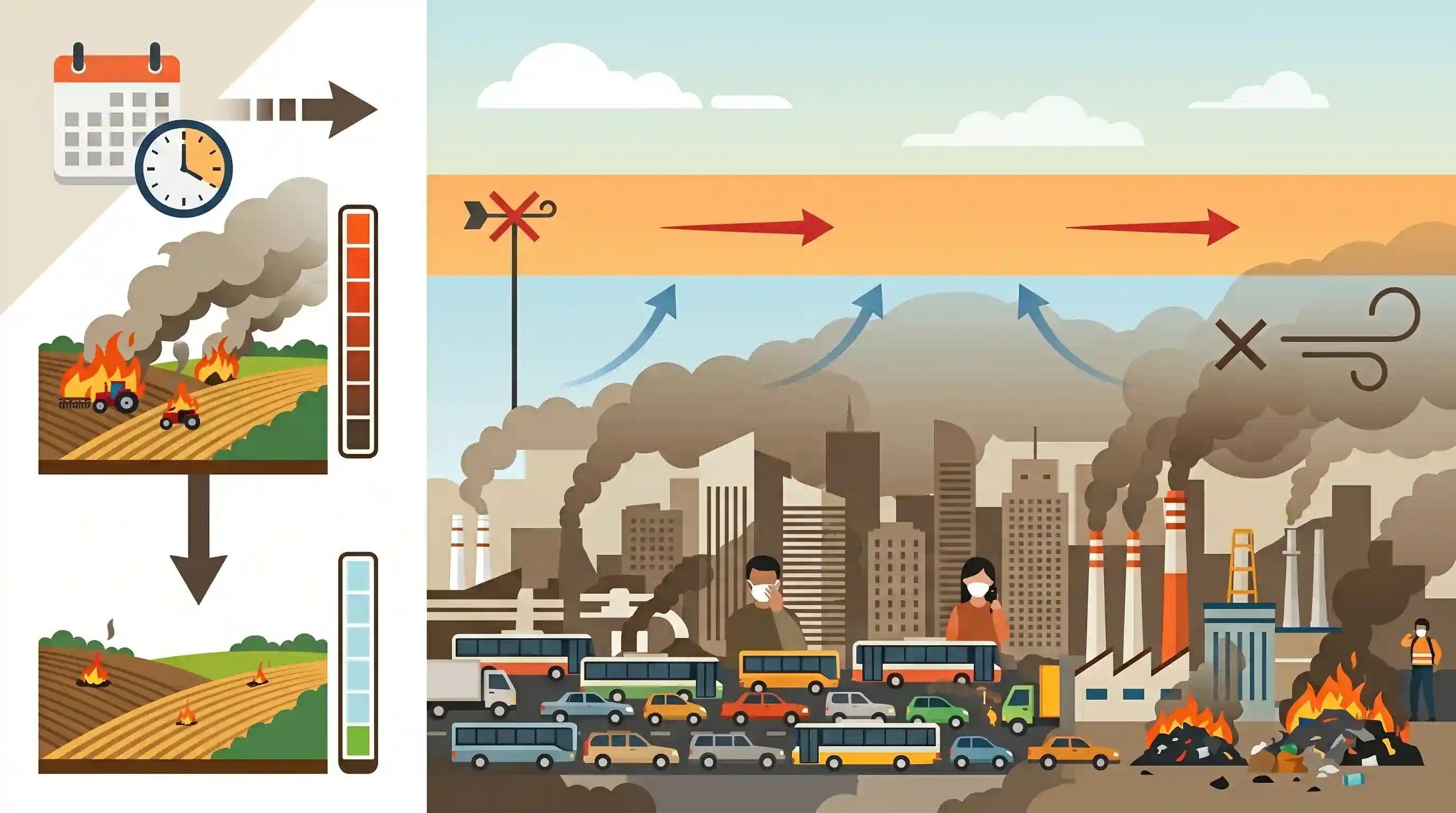
It emphasizes the complex interplay between seasonal factors (farm fires), perennial urban emissions (vehicles, industries), and geographical/meteorological conditions (temperature inversion) in North India's air pollution crisis, which is a recurring theme in UPSC GS1 (Geography) and GS3 (Environment).
Summary
The share of farm fires in Delhi-NCR's air pollution has dropped to its lowest after peaking earlier in the season, yet the region continues to experience severe air pollution. This persistent poor air quality is driven by year-round local sources—such as vehicular transport, industrial emissions, and waste burning—coupled with unfavorable winter meteorological conditions like low wind speeds and temperature inversion. Data indicates that while stubble burning in states like Punjab and Haryana has decreased, local urban emissions trapped by cold weather are the primary culprits for the sustained smog, necessitating year-round, multi-sectoral pollution control measures.
Key Points
- The contribution of farm fires (stubble burning) to Delhi-NCR's air pollution has dropped significantly after reaching its peak for the season.
- Despite this drop, NCR cities remain highly polluted due to year-round local emission sources like vehicular exhaust, industrial emissions, and waste burning.
- Winter meteorological conditions, specifically low wind speeds and dropping temperatures (temperature inversion), trap these local pollutants close to the surface.
- The data highlights that addressing Delhi-NCR's air quality crisis requires sustained, year-round interventions against urban emission sources, rather than focusing exclusively on seasonal agricultural fires.
Important Terms
Air Quality Index (AQI)

A color-coded numerical scale (0–500) used by government agencies to communicate daily air quality, tracking eight major pollutants like PM2.5, PM10, and Ozone to reflect health risks.
UPSC context
GS Paper III: Environment. Tests knowledge of pollution monitoring metrics and their health/policy implications.
Commission for Air Quality Management (CAQM)
An overarching statutory body established in 2021 to coordinate, monitor, and resolve air quality issues in the Delhi-NCR region and adjoining states like Punjab and Haryana.
UPSC context
GS Paper II & III: Governance and Environment. Tests institutional frameworks for inter-state environmental management.
Graded Response Action Plan (GRAP)
A set of emergency measures implemented by CAQM in Delhi-NCR, triggered by deteriorating AQI levels, ranging from construction bans to industrial restrictions.
UPSC context
GS Paper III: Environment. Tests understanding of administrative responses to seasonal environmental crises.
Temperature Inversion
A meteorological phenomenon where a layer of warm air traps cooler air near the ground, preventing the vertical dispersion of pollutants and causing smog.
UPSC context
GS Paper I: Geography. Tests knowledge of climatological factors affecting urban microclimates and pollution.
Stubble Burning
The practice of burning leftover crop residue (parali) to clear fields quickly for the next crop, significantly contributing to seasonal particulate matter in North India.
UPSC context
GS Paper III: Agriculture/Environment. Tests socio-economic and technical challenges in sustainable crop residue management.
Central Pollution Control Board (CPCB)
India's apex statutory organization established in 1974 to prevent and control water and air pollution and set national environmental quality standards.
UPSC context
GS Paper II: Governance. Tests knowledge of statutory bodies and their regulatory functions.
Prelims Trap
Stubble burning is the primary and largest contributor to Delhi-NCR's severe winter air pollution.
While farm fires cause brief, severe spikes in AQI, they are seasonal. The baseline severe pollution is overwhelmingly driven by local urban emissions trapped by temperature inversion.
Static Concepts Connected
How does Temperature Inversion exacerbate winter air pollution?
- Mechanism: Instead of the normal lapse rate (cooling with altitude), a layer of warm air traps cooler, denser air near the surface.
- Trapping Effect: This stable atmospheric condition acts as a 'lid', preventing the vertical mixing and dispersion of local pollutants.
- Favorable Conditions: Long winter nights, clear skies, and calm winds (anticyclonic conditions) heavily favor the formation of surface temperature inversions.
What is the statutory basis of the CAQM and GRAP?
- Statutory Body: The Commission for Air Quality Management (CAQM) is a statutory body established under a 2021 Act, replacing the EPCA.
- GRAP Enforcement: CAQM enforces the Graded Response Action Plan (GRAP), a dynamic, 4-stage framework triggered by worsening AQI thresholds.
- Geographical Mandate: CAQM's jurisdiction is strictly limited to the National Capital Region (NCR) and adjoining areas, not pan-India.
Cross-Topic Patterns
Agri-waste to Bio-Energy (SATAT)
Links the persistent stubble burning issue to ex-situ management solutions, specifically the conversion of agricultural residue into Compressed Biogas (CBG) under the SATAT scheme.
Climatology + Urban Governance
Contrasts Delhi's landlocked, winter subsidence zones with coastal cities (like Chennai or Mumbai) where sea breezes naturally disperse similar loads of vehicular and industrial emissions.

Expect a 2026 multi-statement question combining winter temperature inversion mechanisms with the statutory powers of the CAQM.
Linked PYQs · 3
Linked PYQs · 3
- 2013MainsGS1
What do you understand by the phenomenon of 'temperature inversion' in meteorology? How does it affect weather and the habitants of the place?
- 2016PrelimsGS1
In the cities of our country, which among the following atmospheric gases are normally considered in calculating the value of Air Quality Index? 1. Carbon dioxide 2. Carbon monoxide 3. Nitrogen dioxide 4. Sulfur dioxide 5. Methane Select the correct answer using the code given below.
- 2022PrelimsGS1
In the context of WHO Air Quality Guidelines, consider the following statements: 1. The 24-hour mean of PM2.5 should not exceed 15 µg/m³ and annual mean of PM2.5 should not exceed 5 µg/m³. 2. In a year, the highest levels of ozone pollution occur during the periods of inclement weather. 3. PM10 can penetrate the lung barrier and enter the bloodstream. 4. Excessive ozone in the air can trigger asthma. Which of the statements given above are correct?
