Prison Identity Lapses and Undertrial Impersonation Case
Source:Indian Express ↗
Why It Matters
The incident underscores critical administrative vulnerabilities within India's prison management system, highlighting the urgent need for systemic reforms such as biometric verification and modernization. It also presents a practical application of the newly enacted Bharatiya Nyaya Sanhita (BNS) regarding offences of impersonation and escaping lawful custody.
Summary
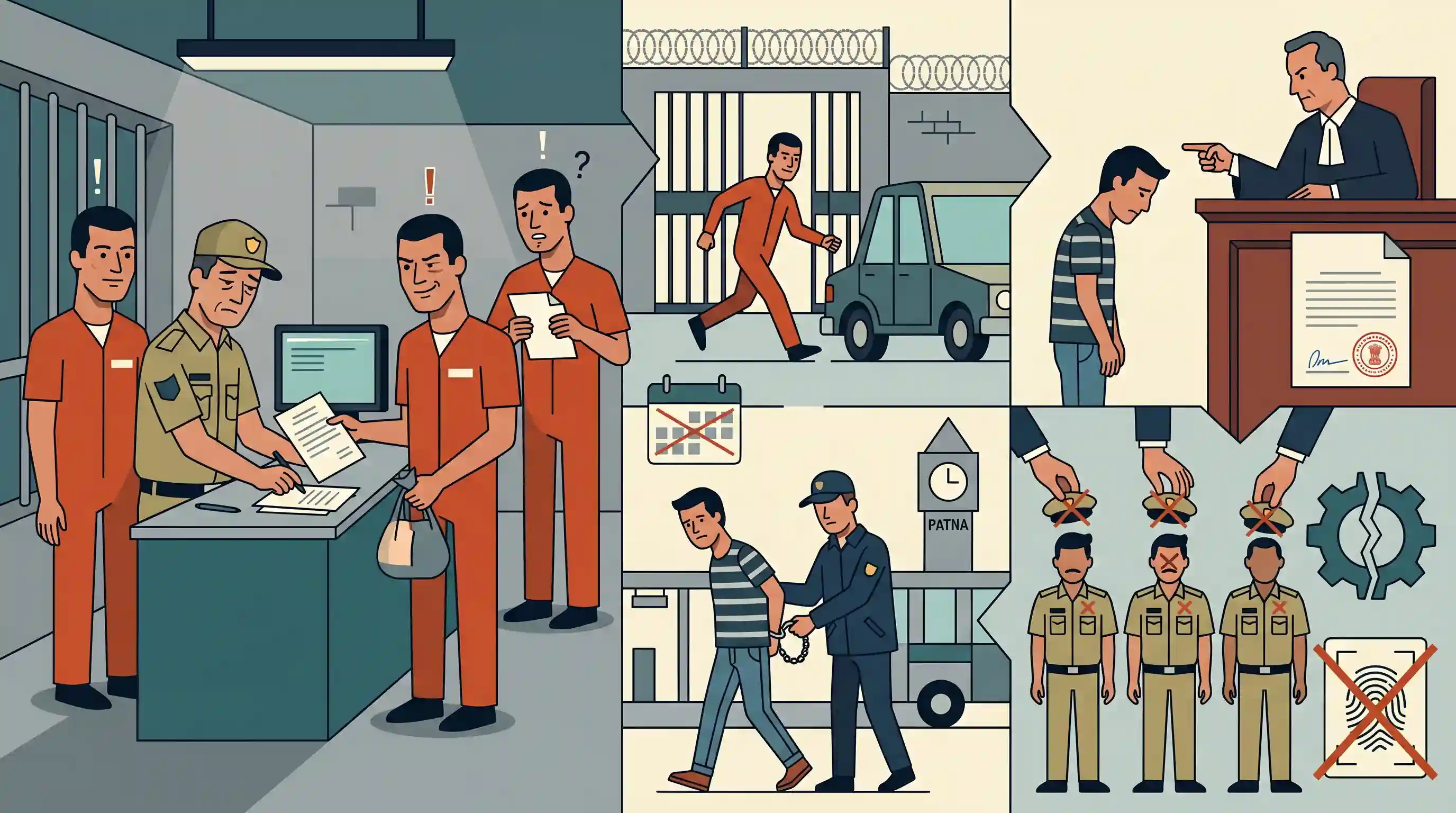
An undertrial facing severe charges under the IPC and POCSO Act wrongfully secured his release from Faridabad's Neemka jail by impersonating another inmate with the exact same name and father's name who had been granted bail. The accused, Nitesh Pandey, was apprehended four days later in Patna by the Delhi Police Special Cell. Following the incident, an FIR under the Bharatiya Nyaya Sanhita (BNS) was lodged against him for impersonation and obstructing lawful apprehension. Multiple jail officials were suspended for critical lapses in identity verification, highlighting severe administrative deficiencies in the prison management system.
Key Points
- An undertrial prisoner facing charges under the POCSO Act and IPC walked out of Faridabad's Neemka jail on a bail order meant for another inmate.
- The mistaken release occurred because both the accused and the other inmate shared the same name (Nitesh) and their fathers' names (Ravinder) were identical.
- Delhi Police's Special Cell apprehended the fugitive four days later in Patna.
- A fresh FIR was registered under Sections 262 and 319 of the Bharatiya Nyaya Sanhita (BNS) for resistance to lawful apprehension and cheating by personation.
- Several prison officials were suspended for negligence and failing to adequately verify the identity of the prisoner before his release.
Important Terms
Bharatiya Nyaya Sanhita (BNS)

The primary criminal code of India, effective July 1, 2024, replacing the colonial-era IPC to modernize justice and prioritize victim-centricity while introducing new offenses like organized crime.
UPSC context
GS Paper II (Governance/Judiciary). Tests knowledge of criminal law reforms and transition from colonial-era legal frameworks.
Protection of Children from Sexual Offences (POCSO) Act
A 2012 law providing a gender-neutral framework to protect children under 18 from sexual assault and exploitation, mandating special courts and child-friendly trial procedures.
UPSC context
GS Paper II (Social Justice). Tests understanding of protection mechanisms and statutory laws for vulnerable populations like children.
Undertrial
An individual held in judicial custody while awaiting trial or the conclusion of legal proceedings; in India, they constitute over 75% of the total prison population.
UPSC context
GS Paper II (Fundamental Rights). Tests awareness of judicial delays, Article 21 violations, and prison overcrowding.
Prison Reforms
Administrative and legal changes aimed at improving jail conditions, reducing overcrowding, and modernizing management to transform punitive centers into rehabilitative institutions.
UPSC context
GS Paper II (Governance). Tests ability to critique administrative lapses and institutional reforms within the criminal justice system.
Indian Penal Code (IPC)
India's official criminal code from 1860 to 2024; it defined offenses and punishments but was replaced by the BNS to shed its colonial legacy.
UPSC context
GS Paper II (Polity). Relevant for understanding the historical development of Indian law and its recent comprehensive overhaul.
Prelims Trap
"Prisons fall under the Concurrent List since the Union Ministry of Home Affairs introduced the Model Prisons Act 2023."
Prisons fall strictly under the State List (Entry 4, List II). The Union's Model Act serves merely as a guiding framework that states may voluntarily adopt.
Static Concepts Connected
How is jurisdiction over prisons and criminal law divided under the Constitution?
- Prisons: Listed under Entry 4 of the State List (List II). State governments hold exclusive legislative and administrative power over jail management.
- Criminal Law: Listed under the Concurrent List (List III). Both Parliament and States can legislate on substantive and procedural criminal codes (e.g., BNS, BNSS).
- Union Guidance: The Centre drafts 'Model Acts' (like the Model Prisons Act 2023) to provide reformative templates, but their adoption by states remains entirely voluntary.
What are the key committees and frameworks guiding prison reforms in India?
- Amitava Roy Panel: SC-appointed committee (2018) that highlighted severe overcrowding and recommended mandatory segregation of undertrials from convicts alongside filling staff vacancies.
- Mulla Committee: Historic 1983 committee that advocated for an All India Prison Service, better prison conditions, and a shift towards rehabilitative justice.
- Model Prisons Act 2023: Introduced to replace the colonial Prisons Act of 1894; heavily emphasizes technology integration like biometric identification and electronic monitoring.
Cross-Topic Patterns
ICJS and Biometric Prison Tech
Identity mix-ups highlight the critical necessity of integrating state prisons with the Inter-operable Criminal Justice System (ICJS) using biometric markers and e-Prisons databases.
Undertrial Crisis & Bail Jurisprudence
Administrative chaos in prisons is directly exacerbated by judicial pendency. With undertrials forming ~75% of inmates, overcrowding severely degrades verification protocols and security.

A multi-statement Prelims question contrasting the State-List status of 'Prisons' with the Concurrent-List status of Criminal Law (BNS) is highly probable.
Linked PYQs · 1
Linked PYQs · 1
- 2023PrelimsGS1
Consider the following statements: Statement-I: In India, prisons are managed by State Governments with their own rules and regulations for the day-to-day administration of prisons. Statement-II: In India, prisons are governed by the Prisons Act, 1894 which expressly kept the subject of prisons in the control of Provincial Governments. Which one of the following is correct in respect of the above statements?
