Farakka Treaty Expiry: Bihar Opposition to Siltation and Water Sharing
Source:the-sunday-guardian ↗
Why It Matters
The expiry of the Farakka Treaty in 2026 is a critical geopolitical, ecological, and federal issue. It directly intersects BPSC and UPSC syllabi across geography (river systems, siltation, flooding), international relations (transboundary water agreements), and Indian federalism (sub-national pushback in foreign policy negotiations from states like Bihar and West Bengal).
Summary
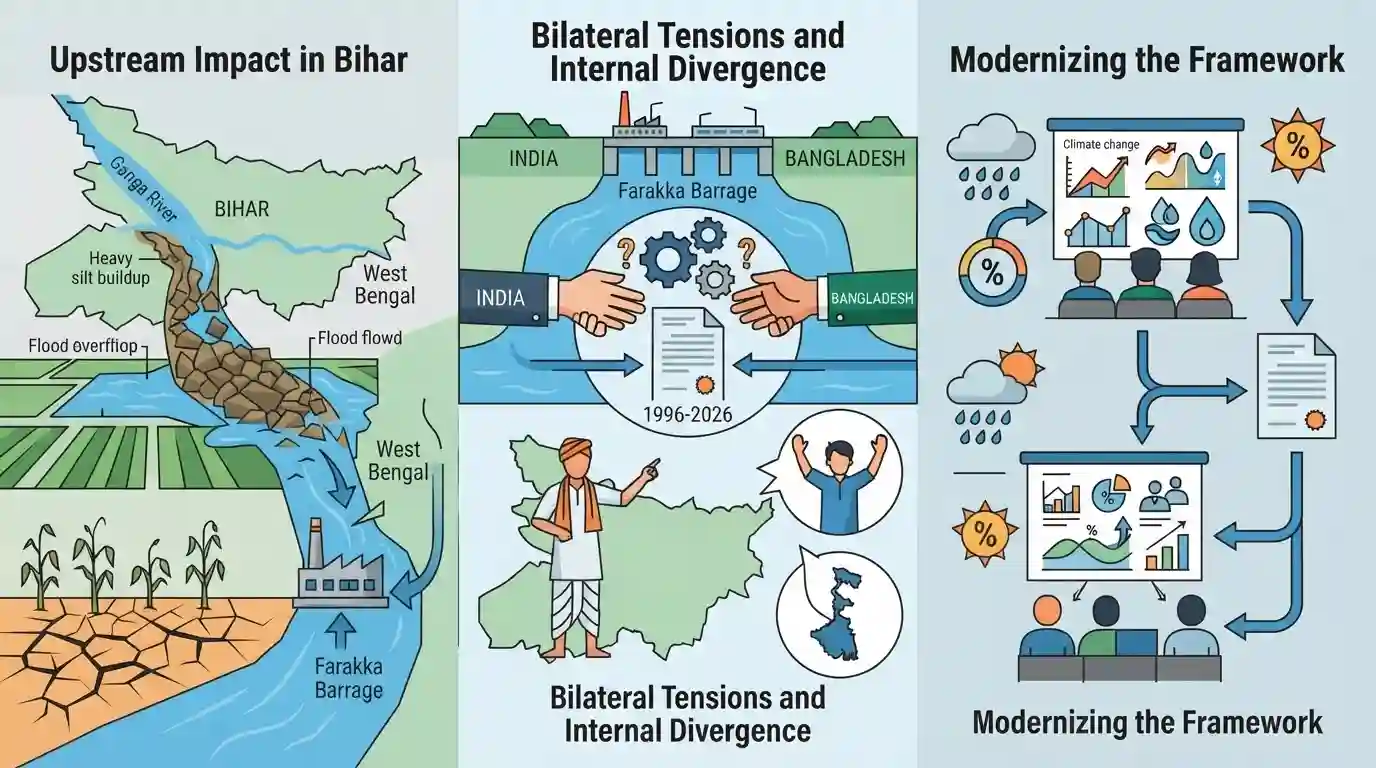
The 1996 Farakka Water Sharing Treaty between India and Bangladesh is slated to expire in December 2026. However, the Bihar government is strongly opposing its renewal in its current form. Bihar argues that the Farakka Barrage (operational since 1975 in West Bengal's Murshidabad district) causes severe upstream siltation, raising the riverbed of the Ganga and triggering annual monsoon floods and summer droughts in Bihar. Political parties in Bihar demand that the state's agricultural, irrigation, and ecological needs be integrated into any new water-sharing framework, while West Bengal also protests its exclusion from the bilateral discussions. Meanwhile, a parliamentary panel has advised updating the treaty's core parameters with modern hydrological and climate change data.
Key Points
- The 30-year Farakka Water Sharing Treaty, signed between India and Bangladesh on December 12, 1996, is set to expire in December 2026.
- The treaty regulates the sharing of Ganga River water during the lean season (January 1 to May 31) through a structured cusec-based sharing formula monitored by a joint bilateral committee.
- Commissioned in 1975 in West Bengal's Murshidabad district, the Farakka Barrage was built to divert 40,000 cusecs of water into the Hooghly River to prevent silt accumulation and preserve Kolkata Port navigation.
- Bihar's political leaders (from JD-U, BJP, and RJD) are strongly pushing back against renewing the treaty in its current form, arguing that the barrage causes immense siltation upstream.
- According to Bihar, the accumulated silt has raised the Ganga's riverbed, triggering severe monsoon floods in cities like Patna, Bhagalpur, Begusarai, and Chhapra, followed by acute water scarcity in the summer.
- West Bengal Chief Minister Mamata Banerjee has also raised objections, protesting her state's exclusion from the central government's bilateral renewal discussions with Bangladesh.
- The Parliamentary Standing Committee on External Affairs has recommended that the renewal or replacement pact incorporate updated hydrological assessments and climate change variables.
Important Terms
Farakka Water Sharing Treaty of 1996

A 30-year bilateral agreement between India and Bangladesh regulating dry-season (January–May) sharing of Ganga River water at the Farakka Barrage in West Bengal, expiring in December 2026.
UPSC context
GS Paper 2 (IR/Federalism). Critical for examining Bihar's water rights, siltation issues, and transboundary diplomacy.
Joint Committee of India and Bangladesh
An institutional body of equal representatives from India and Bangladesh established to observe daily water flows, exchange data, and oversee the implementation of the Farakka sharing formula.
UPSC context
GS Paper 2 (International Relations). Tests knowledge of bilateral institutional mechanisms and water diplomacy frameworks.
Parliamentary Standing Committee on External Affairs
A department-related standing committee of the Indian Parliament that examines policies, treaties, and activities of the Ministry of External Affairs, advising on transboundary diplomacy.
UPSC context
GS Paper 2 (Polity). Evaluates legislative oversight over foreign policy and international treaties.
Janata Dal (United)
A major regional political party in Bihar, led by Chief Minister Nitish Kumar, actively opposing the Farakka treaty's renewal due to upstream siltation and flood concerns.
UPSC context
GS Paper 2 (Bihar Polity/Federalism). Tests understanding of regional political pressure on national foreign policy.
Rashtriya Janata Dal
The primary opposition party in Bihar, led by Lalu Prasad Yadav, demanding all-party consensus and central intervention over the Farakka Treaty's impact on Bihar.
UPSC context
GS Paper 2 (Bihar Polity). Relevant for studying regional party dynamics and bipartisan environmental advocacy.
Bharatiya Janata Party
A national political party in India and a coalition partner in Bihar's ruling alliance, whose state leaders oppose the current treaty over local flood issues.
UPSC context
GS Paper 2 (Polity/Federalism). Illustrates how state units of national parties balance local grievances with central foreign policies.
Prelims Trap
The Farakka Treaty regulates Ganga water sharing year-round, and the barrage was built to provide irrigation water to Bihar.
The treaty applies strictly to the lean season (Jan 1 to May 31), not year-round. Also, Farakka was built to flush Kolkata Port, not to irrigate Bihar.
Static Concepts Connected
What are the geographical features of Ganga's course in Bihar?
- Entry and Exit: Enters Bihar at Chausa (Buxar district) and exits near Manihari (Katihar district), flowing roughly 445 km.
- District Coverage: Flows through exactly 12 districts, bisecting Bihar into northern and southern plains.
- Division Exclusion: Completely bypasses the Kosi and Magadh administrative divisions out of Bihar's 9 divisions.
How does the Constitution govern inter-state and international water disputes?
- Article 262: Empowers Parliament to adjudicate disputes relating to waters of inter-state rivers or river valleys.
- Legislative Lists: State List (Entry 17) governs water, but Union List (Entry 56) allows central regulation of inter-state rivers.
- Article 253: Allows Parliament to make laws for implementing international treaties, overriding state-list subjects like water.
Cross-Topic Patterns
Paradiplomacy in transboundary water management
Demonstrates how domestic states (Bihar, Bengal) demand a veto or consultation in international treaties, testing the boundaries of Article 253 and cooperative federalism.
Riverbed aggradation and Bihar flood disasters
Upstream siltation at Farakka causes riverbed aggradation, directly linking transboundary engineering projects to severe inland flood vulnerability and drainage congestion in Bihar.

Bihar's physical geography (Ganga districts/divisions) likely to be paired with federal treaty-making powers in a multi-statement question.
Linked PYQs · 4
Linked PYQs · 4
- 2020BPSC_PRELIMSGS1
In which one of the following pairs of Administrative Divisions of Bihar, Ganga river does not flow?
- 2019BPSC_PRELIMSGS1
Among the following tributaries, which one is the part of Ganga river basin?
- 2020BPSC_PRELIMSGS1
Which of the following rivers flowing in Bihar is a north flowing river?
- 2025BPSC_PRELIMSGS1
According to the Indus Waters Treaty, the three eastern rivers are allocated to India. Which of the following is not one of them?
