Bihar Raises Farakka Barrage Siltation Issues at GFCC Meeting
Source:thestatesman ↗
Why It Matters
Crucial for understanding regional water governance, interstate river disputes, and environmental challenges specific to Bihar such as siltation and floods.
Summary
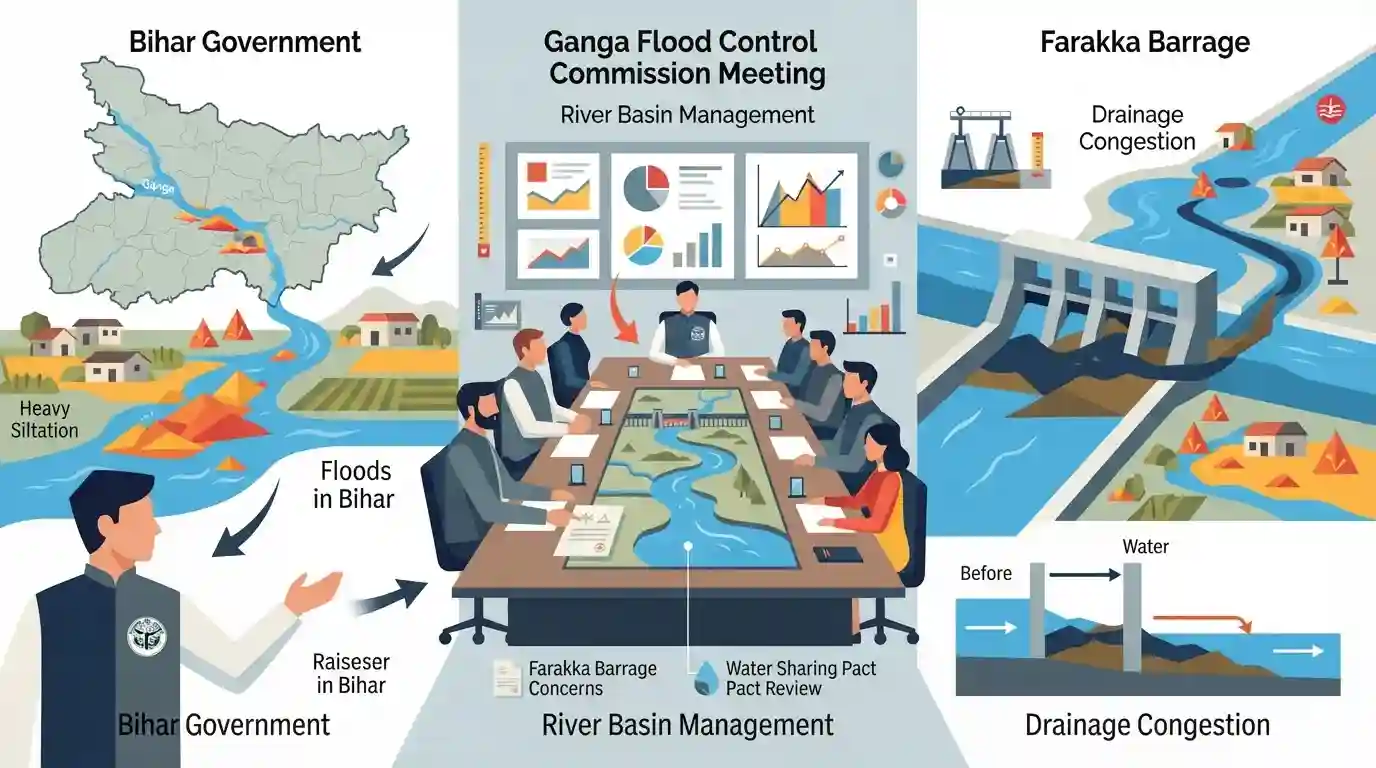
The Bihar government has put forward its concerns regarding heavy siltation caused by the Farakka Barrage and the review of the Ganga Water Sharing Pact at the Ganga Flood Control Commission (GFCC) meeting, highlighting issues related to drainage congestion and floods in Bihar.
Key Points
- The Bihar government has raised concerns over the Farakka Barrage and heavy siltation in the Ganga river at the Ganga Flood Control Commission (GFCC) meeting.
- Silt accumulation due to the Farakka Barrage has been blamed for aggravating floods and drainage congestion in Bihar.
- The 1996 Indo-Bangladesh Ganga Water Sharing Treaty, which is due for renewal or review around 2026, is also a key point of discussion concerning Bihar's water interests.
Important Terms
Indo-Bangladesh Ganga Water Sharing Treaty

A bilateral 30-year treaty signed in 1996 between India and Bangladesh to regulate the lean-season sharing of Ganga waters at the Farakka Barrage, expiring in 2026.
UPSC context
Important for GS Paper II (International Relations - India-Bangladesh bilateral ties) and GS Paper III (Water Resources Management).
Ganga Flood Control Commission (GFCC)
A central technical body established in 1972 under the Ministry of Water Resources to formulate and coordinate flood management master plans across the Ganga river basin.
UPSC context
Relevant for BPSC/UPSC GS Paper III (Disaster Management, River Basin Governance, and Flood Mitigation Policies).
Farakka Barrage
A barrage built on the Ganga River in West Bengal near the Bangladesh border to divert water into the Hooghly River to flush silt and preserve Kolkata Port.
UPSC context
Crucial for BPSC/UPSC GS Paper III (Infrastructure, Inter-state and Transboundary Water Disputes, and Drainage Congestion).
Prelims Trap
The Ganga Flood Control Commission is a statutory tribunal established under the Inter-State Water Disputes Act to adjudicate siltation disputes.
Aspirants often confuse the Ganga Flood Control Commission (GFCC) as a statutory body under the Inter-State Water Disputes Act, whereas it is an advisory body under the Union Ministry of Jal Shakti.
Static Concepts Connected
What are the key institutional mechanisms and treaties governing the Ganga river basin in India?
- GFCC Mandate: Established in 1972 under the erstwhile Ministry of Irrigation and Power, it formulates comprehensive plans for flood control in the Ganga basin.
- 1996 Ganga Treaty: Signed in December 1996 for a 30-year period, it governs sharing of Ganga waters at Farakka during the lean season (January 1 to May 31).
- Farakka Barrage: Commissioned in 1975 to preserve and maintain the Calcutta Port by flushing out sediment with Farakka waters.
Cross-Topic Patterns
Farakka Barrage & Indo-Bangladesh Treaty 1996
The Farakka Barrage siltation debate directly intersects with transboundary river diplomacy under the Ministry of Jal Shakti and international treaty commitments with Bangladesh.
Flood Management & Ganga Flood Control Commission
Heavy silt accumulation in North Bihar rivers links river basin management with recurring flood disasters and the mandate of the Ganga Flood Control Commission.

BPSC frequently asks about inter-state/transboundary river projects; expect a question on the 1996 Ganga Treaty review or GFCC mandate.
Linked PYQs · 1
Linked PYQs · 1
- 2024-EBPSC_PRELIMSGS1
Which of the following drainage systems drains the lands of Bihar?
