US Iran Conflict Escalates Amid Breakdown of Ceasefire Agreement
Source:The Hindu ↗
Why It Matters
The strategic stability of West Asia and the Persian Gulf is of paramount importance to India's foreign policy. The Strait of Hormuz is the world's most critical maritime oil transit chokepoint, and any conflict there directly threatens India's energy security, global oil prices, and the safety of millions of Indian expats residing in Gulf countries like Kuwait and Bahrain. Understanding this conflict helps analyze India's diplomatic balancing act between the U.S. and Iran.
Summary
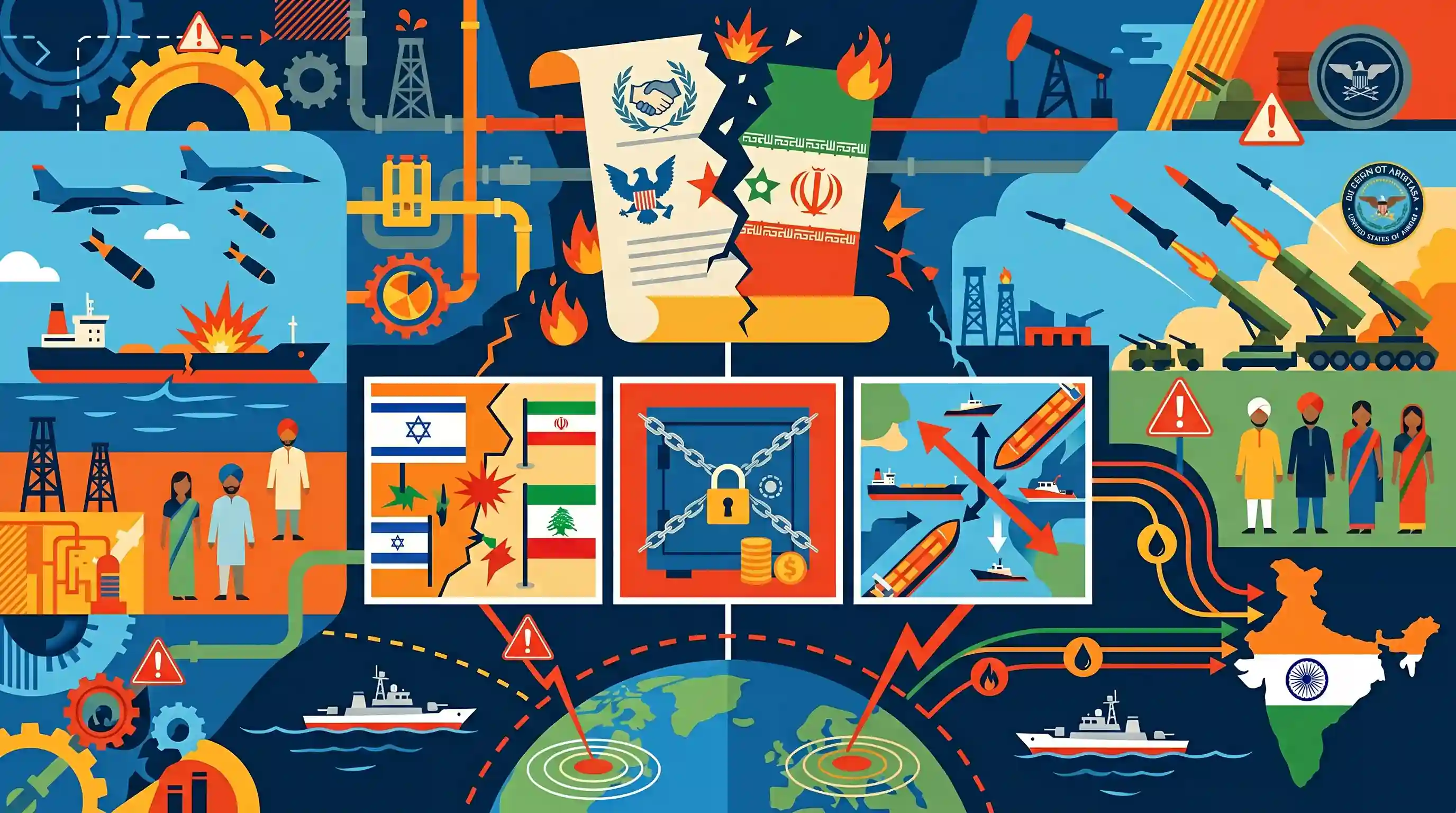
The article examines the rapid breakdown of the U.S.-Iran Memorandum of Understanding (MoU) within 20 days of its signing. Initiated to extend a ceasefire and launch negotiations on outstanding issues—including Iran's nuclear programme—the agreement unravelled following U.S. airstrikes in Iran (after commercial tanker attacks) and subsequent Iranian retaliatory strikes on U.S. military bases in Kuwait and Bahrain. The breakdown is attributed to three core friction points: Israel's presence in southern Lebanon, Iran's lack of access to its frozen funds, and a strategic dispute over shipping routes in the crucial Strait of Hormuz. The editorial warns that continuing the U.S. 'maximum pressure' campaign will only harden Iran's nuclear stance, destabilize West Asia, and disrupt the global economy.
Key Points
- Unravelling of the Ceasefire: The U.S.-Iran Memorandum of Understanding (MoU), designed to secure a 60-day ceasefire and initiate talks on Iran's nuclear programme, collapsed within 20 days due to reciprocal military strikes.
- Strait of Hormuz Shipping Dispute: A key flashpoint is the maritime sovereignty contest; Iran is asserting dominance via a coastal 'safe passage route' while the U.S. backs an alternative route along the Omani coast to prevent Tehran from becoming the sole custodian of the chokepoint.
- Lebanon and Frozen Funds Sticking Points: Tehran objects to Israel's ongoing presence in southern Lebanon and the U.S. push for a parallel trilateral framework (U.S.-Lebanon-Israel). Additionally, Iran's failure to gain access to its frozen assets despite the MoU has deepened the trust deficit.
- Inefficacy of 'Maximum Pressure': The editorial critiques the U.S. reliance on military airstrikes and economic pressure, arguing that such tactics fail to shift Iran's negotiating position and instead risk hardening its stance on its nuclear program.
- Threat to Regional and Global Stability: A resumption of active war in West Asia threatens the global economy, maritime shipping routes, and energy security, demanding a diplomatic resolution and a return to the MoU framework.
Important Terms
Joint Comprehensive Plan of Action (JCPOA)

A landmark 2015 agreement between Iran and the P5+1 powers that restricted Iran’s nuclear program in exchange for relief from international sanctions, serving as the benchmark for nuclear diplomacy in West Asia.
UPSC context
GS Paper II (Bilateral Agreements). Tests knowledge of nuclear non-proliferation treaties, regional stability in West Asia, and energy import impacts.
U.S.-Iran Memorandum of Understanding (MoU)
A June 2026 framework agreement (Islamabad Memorandum) signed by the U.S. and Iran establishing a temporary 60-day ceasefire, intended to halt active warfare, suspend blockades, and initiate comprehensive peace negotiations.
UPSC context
GS Paper II (International Relations). Tests understanding of conflict resolution, diplomatic negotiations, and geopolitical shifts affecting West Asian stability.
Strait of Hormuz
A critical geopolitical waterway connecting the Persian Gulf and the Gulf of Oman, serving as a global maritime choke point through which a significant portion of global petroleum shipments transit.
UPSC context
GS Paper I (Geography) & GS III (Security). Tests understanding of critical global shipping corridors, maritime choke points, and energy security risks.
Maximum Pressure Campaign
A unilateral U.S. foreign policy strategy utilizing severe economic sanctions, diplomatic isolation, and military pressure to force Iran into renegotiating its nuclear capabilities and regional operations.
UPSC context
GS Paper II (Effect of policies of developed countries). Tests analytical grasp of unilateral economic statecraft, secondary sanctions, and third-party diplomatic fallout.
Prelims Trap
The Strait of Hormuz is bordered exclusively by Iran, giving Tehran absolute territorial jurisdiction over all shipping lanes.
The southern coast is actually Oman's Musandam Peninsula exclave. This geographic split makes the Omani passage a vital legal alternative to Iranian-controlled waters.
Static Concepts Connected
What are the key maritime chokepoints in West Asia and their bordering nations?
- Strait of Hormuz: Connects Persian Gulf to Gulf of Oman; bordered by Iran and Oman's Musandam Peninsula, handling 20-25% of global oil.
- Bab-el-Mandeb: Connects Red Sea to Gulf of Aden; bordered by Yemen, Djibouti, and Eritrea, a key transit point for Suez traffic.
- Suez Canal: Egyptian sea-level waterway connecting Mediterranean to Red Sea, bypassing the Cape of Good Hope.
What is the structure and significance of the International North-South Transport Corridor (INSTC)?
- INSTC Network: A 7,200-km multi-mode trade corridor connecting India, Iran, and Russia, bypassing Pakistan to reach Central Asia.
- Chabahar Port: Located on Iran's Gulf of Oman coast (outside Hormuz), managed by India, acting as a crucial transit node.
- Legal Framework: Governed by the 2000 treaty signed by India, Iran, and Russia, now expanding to Central Asian nations.
Cross-Topic Patterns
Maritime choke points and national security
Escalation in Hormuz impacts India’s LNG imports from Qatar, accelerating the expansion of Strategic Petroleum Reserves and domestic gas infrastructure.
Strategic autonomy in maritime security
India's unilateral 'Operation Sankalp' showcases its preference for strategic autonomy, protecting national interests without formally joining Western-led maritime alliances.

West Asian choke points, naval escort operations like Operation Sankalp, and JCPOA breakout dynamics will likely merge into a map-based 2026 MCQ.
Linked PYQs · 3
Linked PYQs · 3
- 2018MainsGS2
In what ways would the ongoing US-Iran Nuclear Pact Controversy affect the national interest of India? How should India respond to this situation?
- 2025MainsGS2
"Energy security constitutes the dominant kingpin of India's foreign policy, and is linked with India's overarching influence in Middle Eastern countries.” How would you integrate energy security with India's foreign policy trajectories in the coming years?
- 2026PrelimsGS1
Ships from which of the following countries have to cross the Strait of Hormuz to reach out to the Indian Ocean ? 1. Bahrain 2. Syria 3. Qatar 4. Egypt Select the answer using the code given below :
