Kolkata Pavement Dwellers Offered Municipal Housing Amid Political Row
Source:theweek ↗
Why It Matters
Understanding local governance bodies like the Kolkata Municipal Corporation (KMC) and the political dynamics surrounding welfare schemes is crucial for WBCS aspirants. It highlights issues of urban poverty, pavement dwellers, and how political accountability and welfare delivery operate at the state and municipal levels.
Summary
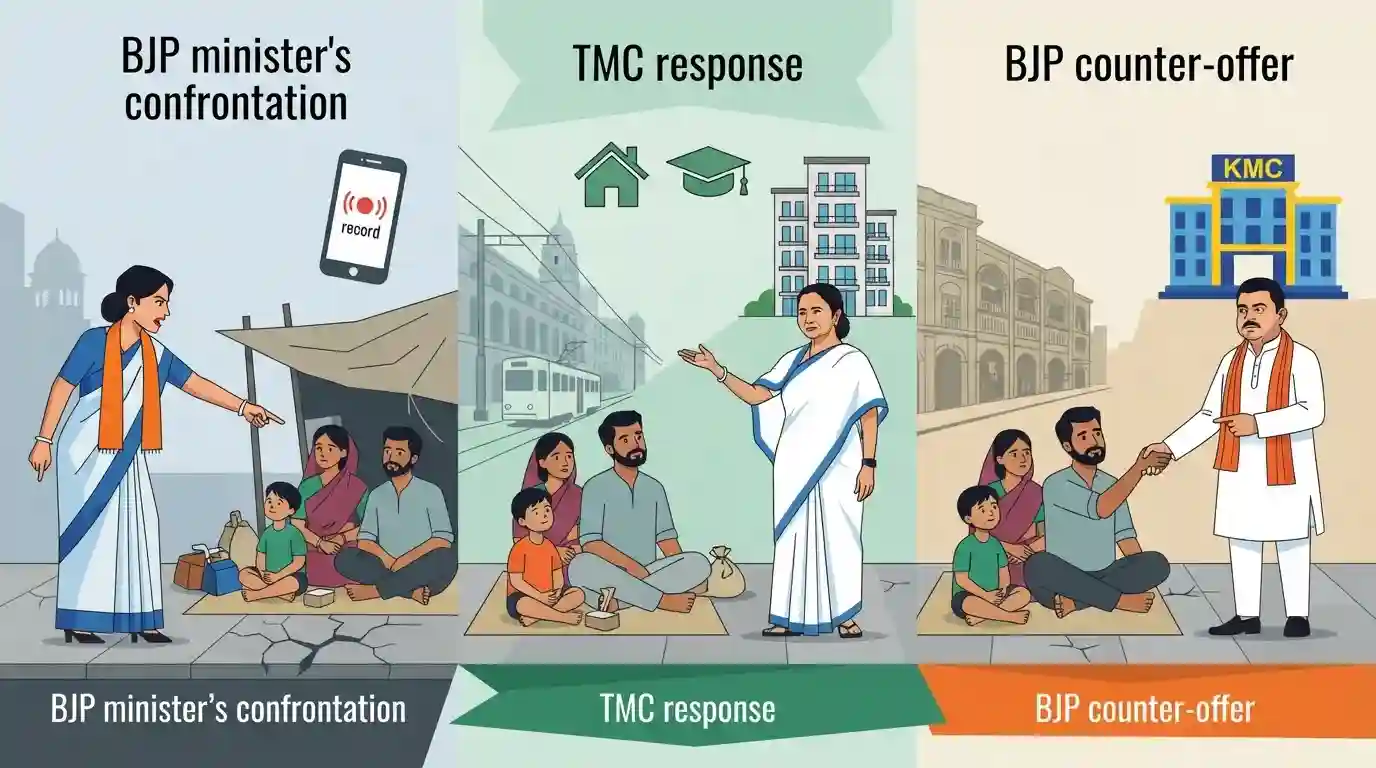
A political controversy in West Bengal erupted after a video showed BJP minister Agnimitra Paul reprimanding a family living on a Kolkata pavement. In response, former CM Mamata Banerjee offered housing and education to the family. To counter this, current Chief Minister Suvendu Adhikari met the family and promised them permanent housing facilitated by the Kolkata Municipal Corporation (KMC). The incident underscores the intense political rivalry between the TMC and BJP over welfare initiatives and urban rehabilitation.
Key Points
- A controversy arose when a video surfaced of BJP minister Agnimitra Paul reprimanding a pavement-dwelling family in Kolkata for heating milk on the footpath.
- Former Chief Minister Mamata Banerjee intervened by offering the family housing and educational assistance, leveraging the incident to criticize the ruling BJP.
- Chief Minister Suvendu Adhikari countered by meeting the family at a 'Janata Durbar' and promising permanent housing arranged through the Kolkata Municipal Corporation (KMC).
- The episode highlights the intense political competition between the BJP and TMC over welfare policies and urban poverty alleviation in West Bengal.
Important Terms
Kolkata Municipal Corporation (KMC)

The civic administrative body governing Kolkata. It provides essential municipal services, manages urban infrastructure, and implements urban rehabilitation and poverty alleviation schemes under a Mayor-in-Council system.
UPSC context
Important for WBCS Paper 5 (Polity). Tests knowledge of urban local bodies, the 74th Constitutional Amendment, and municipal governance.
Bharatiya Janata Party (BJP)
A major national political party in India. In West Bengal, it is a primary political force driving intense electoral competition and policy debates over governance, urbanization, and state welfare initiatives.
UPSC context
Relevant for WBCS Paper 5 (Polity). Tests understanding of India's party system, national versus state political dynamics, and electoral competition.
Trinamool Congress (TMC)
A prominent political party based in West Bengal, founded by Mamata Banerjee. It has significantly influenced state politics through regional governance, grassroots mobilization, and extensive social welfare programs.
UPSC context
Crucial for WBCS Paper 5 (Polity). Tests the role of regional parties in federal dynamics, state governance, and welfare populism.
Prelims Trap
"The Mayor-in-Council system is a mandatory structure for all municipalities in West Bengal."
The Mayor-in-Council (MIC) system is specific to Municipal Corporations (like KMC under the 1980 Act), not smaller municipalities governed by the West Bengal Municipal Act of 1993.
Static Concepts Connected
What is the historical evolution and unique administrative structure of the Kolkata Municipal Corporation (KMC)?
- 1923 Municipal Act: Formulated by Surendranath Banerjee, it democratized governance, making C.R. Das the first elected Mayor and Subhas Chandra Bose the CEO.
- Mayor-in-Council (MIC): Introduced by the KMC Act of 1980, this unique system functions as a municipal cabinet headed by the Mayor.
- Ward Structure: Currently comprises 144 administrative wards following the inclusion of the Joka area.
How does the 74th Amendment Act integrate urban poverty alleviation into municipal duties?
- 12th Schedule: Enshrines 18 functional items for municipalities, specifically listing urban poverty alleviation, slum improvement, and upgrading.
- Welfare Execution: Urban local bodies (like KMC) serve as the primary implementing agencies for state and central housing schemes for the urban poor.
Cross-Topic Patterns
74th CAA + Urban Poverty Alleviation
The intersection of municipal governance (KMC) and pavement dwellers' rehabilitation connects directly to the 12th Schedule's mandate on urban poverty alleviation and slum upgrading.
Historical evolution of Bengal's civic bodies
Modern municipal actions trace back to the Calcutta Municipal Act of 1923, which pioneered democratized local governance under Surendranath Banerjee and C.R. Das.

Expect a question linking the 12th Schedule's urban poverty mandate with the historical evolution of KMC under the 1923 and 1980 Acts.
Linked PYQs · 1
Linked PYQs · 1
- 2015WBCS_PRELIMSGS1
The local self-government of Kolkata is
