RG Kar hospital medical negligence and public health governance gaps
Source:punjab-kesari ↗
Why It Matters
Recurring issues of medical negligence and administrative lapses at prominent public hospitals like RG Kar highlight gaps in public health management, governance, and infrastructural safety. Under West Bengal civic and state administration, these topics intersect with constitutional obligations under Article 21 (Right to Life, encompassing the Right to Health) and the state's duty to provide adequate medical emergency response.
Summary
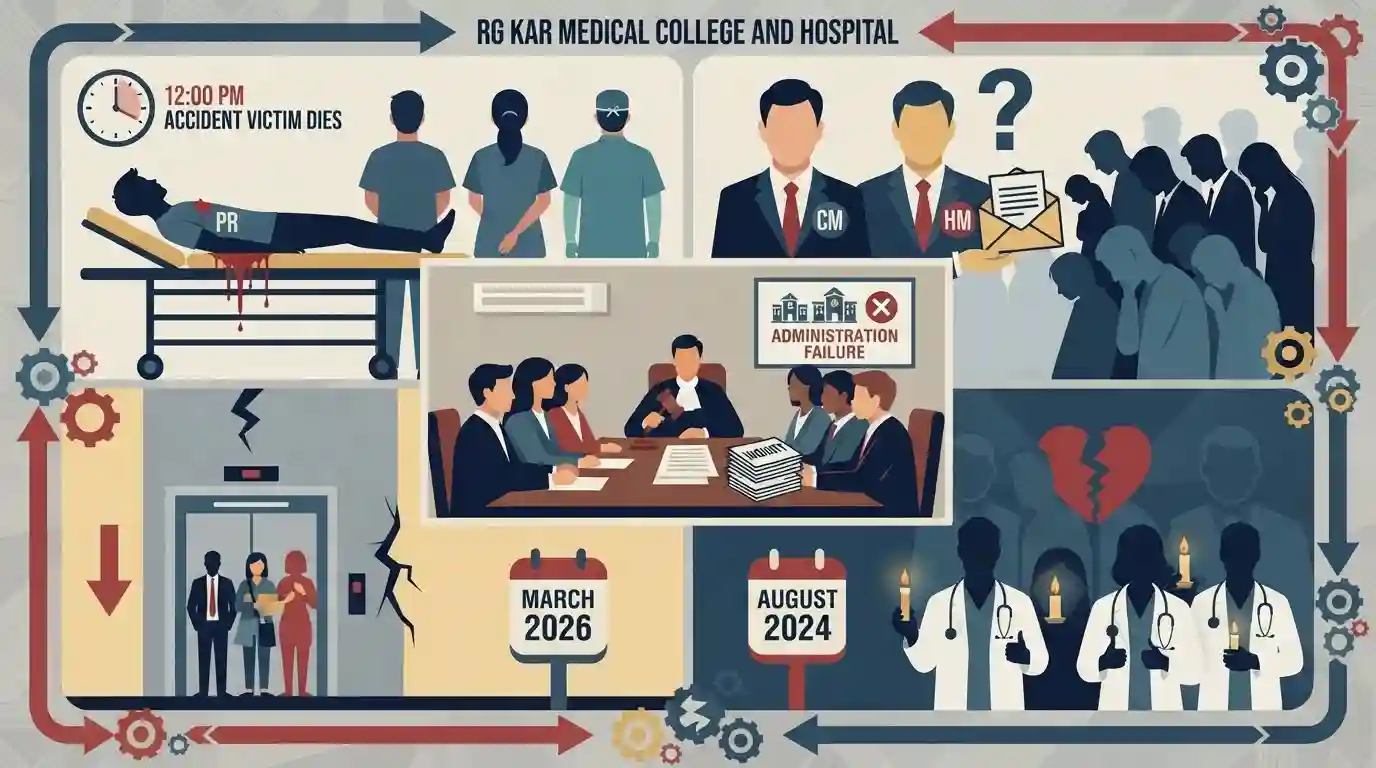
A young road accident victim, Pritam Roy, died at RG Kar Medical College and Hospital in Kolkata due to excessive bleeding, prompting his family to allege severe medical negligence. The family appealed to West Bengal Chief Minister Suvendu Adhikari and Health Minister Sharadwat Mukherjee for systemic healthcare reforms and an investigation. The hospital has initiated an inquiry under Superintendent Saptarshi Chatterjee. This incident follows past administrative and safety failures at the facility, including a patient's elevator death in March 2026 and the high-profile August 2024 junior doctor tragedy, underscoring ongoing infrastructure and management challenges in the state's public healthcare system.
Key Points
- Pritam Roy, a resident of Howrah, died at the trauma care centre of Kolkata's RG Kar Medical College and Hospital due to haemorrhagic shock from severe bleeding, triggering allegations of medical negligence.
- The victim's family, represented by Shouvik Sarkar, appealed to West Bengal Chief Minister Suvendu Adhikari and Health Minister Sharadwat Mukherjee to reform public healthcare administration and initiate an inquiry.
- Hospital Superintendent Saptarshi Chatterjee confirmed that the hospital is investigating the family's complaint of negligence.
- The death adds to a series of safety and administrative crises at the hospital, including an elevator-entrapment death in March 2026 (Arup Banerjee) and the nationwide security and systemic protests following the August 9, 2024 rape and murder of a female junior doctor.
Important Terms
RG Kar Medical College and Hospital

Established in 1886 as Asia's first non-governmental medical college, it is a premier state-run teaching hospital in Kolkata. It was conceptualized by Dr. Radha Gobinda Kar to ensure medical self-sufficiency.
UPSC context
Relevant for WBCS Paper IV (History) and Paper V (State Infrastructure), highlighting West Bengal's healthcare heritage and contemporary administrative challenges.
Article 21 (Right to Health)
An implicit fundamental right under Article 21's "Right to Life" in the Indian Constitution. The judiciary mandates it as the State's binding obligation to provide timely, adequate medical care.
UPSC context
Tested in WBCS Paper V (Indian Constitution). Evaluates state accountability regarding fundamental rights when administrative failures or infrastructure deficits cause loss of life.
Medical Negligence
A breach of duty by healthcare professionals or institutions failing to meet standard care protocols, resulting in patient harm. In India, it invokes civil, criminal, and consumer protection liabilities.
UPSC context
Vital for WBCS Paper V (Governance and Law) to analyze administrative accountability, ethical healthcare management, and grievance redressal mechanisms.
Public Health Governance
The systemic administration, policy-making, and structural oversight of state healthcare facilities. It encompasses infrastructure maintenance, resource management, and implementing reforms to ensure accessible patient safety.
UPSC context
Crucial for WBCS Mains Paper V (Social Sector Development), testing knowledge of policy implementation and structural challenges in state-run systems.
Prelims Trap
"The Right to Health is explicitly enshrined as a fundamental right under Part III of the Indian Constitution."
The Right to Health is not explicitly written in the Constitution; it has been judicially inferred under Article 21 (Right to Life).
Static Concepts Connected
How is the Right to Health and emergency medical care governed constitutionally?
- Judicial Interpretation: The Right to Health is judicially inferred under Article 21 (Protection of Life and Personal Liberty) rather than explicitly stated.
- Paschim Banga Case (1996): The Supreme Court ruled that denial of timely emergency care by government hospitals violates Article 21.
- Seventh Schedule: 'Public health and sanitation; hospitals and dispensaries' falls under Entry 6 of List II (State List).
What is the historical significance of R.G. Kar Medical College?
- Founding: Established in 1886 as the 'Calcutta School of Medicine' by Dr. Radha Gobinda Kar.
- Pioneering Status: It holds the distinction of being Asia's first private medical college established and run entirely by Indians.
- Government Takeover: Administrative control of the institution was officially transferred to the Government of West Bengal in 1958.
Cross-Topic Patterns
Healthcare delivery and Judicial Activism
Medical negligence incidents often bridge State List administrative failures with Supreme Court PILs enforcing Article 21, frequently invoking the landmark 1996 Paschim Banga Khet Mazdoor Samity precedent.
Heritage infrastructure and modern urban governance
The administrative decay of 19th-century institutions (like RG Kar, est. 1886) highlights broader urban governance challenges in retrofitting heritage facilities to handle massive modern civic loads.

Expect multi-statement questions linking historical Indian-founded institutions (RG Kar, 1886) to Article 21 and the State List.
Linked PYQs · 1
Linked PYQs · 1
- 2021WBCS_PRELIMSGS1
Article 21 of the Indian Constitution ensues
